3 Sisters Vegetarian Chili, with Winter Squash, Corn and Beans

3 Sisters Vegetarian Chili, with Winter Squash, Corn and Beans

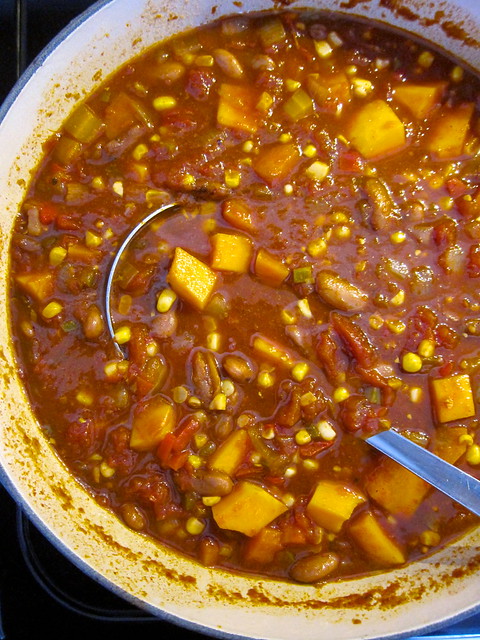
While we’ve started planning for the new growing season, we’re still eating from the last, and this 3 Sisters Vegetarian Chili with Winter Squash, Corn and Beans makes good use of what we have left in storage. To the traditional Native American trio we added onion, carrots and garlic from the root cellar; and dried beans, and home canned tomatoes and corn from the pantry. The combination made for a savory, satisfying pot of spicy chili, warming enough to make us forget that it’s still winter outside.

The beans we used were Boston Roman, a kidney-shaped heirloom from Baer’s Best, the only grower of this unusual variety in New England. It’s large size, nutty flavor, and ability to hold it’s shape when cooked gave additional heft to the meatless mix. We had both frozen and canned corn at our disposal, and ended up using a jar of corn relish since it also contained red and green peppers; just drain it before adding. If you like, some toasted cornmeal tossed in at the end will thicken the chili and add a hint of smokiness.

3 Sisters Vegetarian Chili, with Winter Squash, Corn and Beans

2 tablespoons vegetable oil
1 onion, finely chopped
1 large or 2 medium carrots, cut in small dice
1 red or green pepper, diced
2 large garlic cloves, minced
2 to 3 tablespoons ground chili, to taste
1 tablespoon ground cumin
2 tablespoons tomato paste
1 quart canned tomatoes, chopped or crushed, with liquid
1 teaspoon dried oregano, crushed
2 tablespoons tomato paste
4 cups cooked beans, with pot liquor
2 cups corn kernels
2 cups diced winter squash (about ¾ pound)
Sea salt and freshly ground black pepper, to taste
Chopped red onion, grated cheese (jack, queso fresco, cheddar) for garnish

– Heat oil over medium heat in a heavy pot and add the onion, carrot and pepper. Cook, stirring often, until the onion is tender and beginning to color. Stir in the garlic and continue cooking until fragrant, about a minute. Add the ground chili and cumin, and cook, stirring, until the mixture begins to stick to the pan. Stir in the tomato paste, and let cook briefly, about a minute.  Add the chopped tomatoes with their liquid, oregano, and salt to taste, and simmer until mixture is thick and fragrant, about 30 to 45 minutes.
– Stir in the cooked beans, and bring back to a simmer, then add the winter squash and corn. If letting sit overnight for the flavors to develop, remove pot from heat and let cool; the winter squash and corn will finish cooking through reheating. For serving the same day, continue simmering until the squash is tender, about 15 to 20 minutes. The chili should be thick, but can be thinned out with water. Adjust seasonings, and serve with diced red onion, scallions or cilantro, and grated cheese.

Adapted from Martha Rose Shulman.

Local ingredients: Boston Roman beans from Baer’s Best; onions from Black Kettle Farm; carrots from Red Manse Farm; cheddar from Brookford Farm; home canned tomatoes and paste, corn relish; Tromboncino winter squash and garlic from the garden.
Posted in cooking | Tagged , , , , , , | 7 Comments

Open Hearth Cooking Class: Coffins

2013 Open Hearth Cooking

“Raise a coffin neatly of hot paste, bone your turkey, season it with savory spices, add one pound of ham, a little force meat, a little grave and half a pound of butter, close up the pie and ornament it, and set it in the oven, where two hours will bake it.”
— Mary Smith, “The Complete House-Keeper and Professed Cook”, 1772

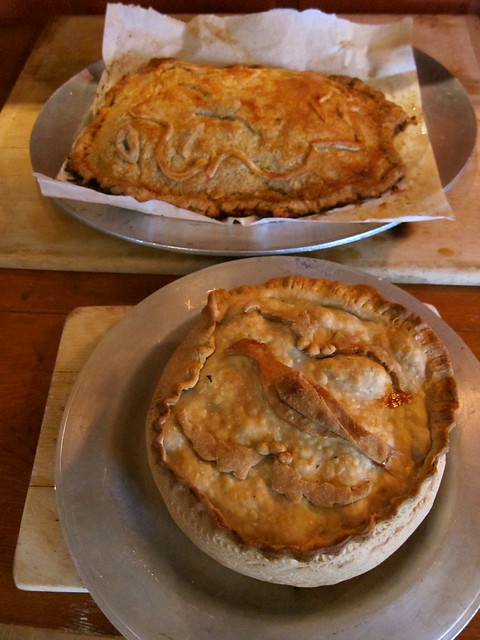
If you happen to be in possession of a house with an oversized fireplace, learning to cook on an open hearth is a skill worth acquiring. With a focus on 17th and 18th century food, Sandie Tarbox, an historic foodways culinarian, offers a series of hands-on classes cooking on an open hearth and the attached bake oven in her Newmarket home. The classes include an assortment of dishes selected from historic sources, and the one we attended was on the topic of coffins, a colonial version of pie. During this era, the technique of cooking food in a pastry shell was mainly to serve as a baking dish, storage container, and serving vessel, as we would soon discover.

2013 Open Hearth Cooking

Our small group of six split into two to tackle the day’s menu: Two types of coffins, one filled with turkey and another called Lumber Pye; Fried Beets and Carrot Pudding to accompany; and Custard Apples for dessert.

2013 Open Hearth Cooking 2013 Open Hearth Cooking

The filling for Turkey Coffin — turkey breast, onions, chicken livers, mushrooms, hazelnuts, thyme, and a glug of brandy — is cooked in the hearth.

2013 Open Hearth Cooking

The Turkey Coffin is assembled with a puff paste made of flour, water, salt, and butter, then shaped into decorative shield.

2013 Open Hearth Cooking 2013 Open Hearth Cooking

The Turkey Coffin is then placed in the bake oven next to the hearth; roast beets are ready to be breaded and fried.

2013 Open Hearth Cooking

The second coffin, Lumber Pye, is a rich and complex mix of savory and sweet ingredients: Boiled eggs; a mix of ground meat seasoned with nutmeg, cloves, ginger, parsley and thyme, formed into small sausages, stuffed with marrow and wrapped in caul; fresh figs and grapes; and covered with a creamy gravy.

 2013 Open Hearth Cooking 2013 Open Hearth Cooking

A hot water crust, the traditional dough for hand-raised pies, is formed into a high coffin. A carved roller is used for a second piece of dough.

2013 Open Hearth Cooking

The decorative piece is attached to the coffin wall with egg wash.

2013 Open Hearth Cooking 2013 Open Hearth Cooking

The coffin is filled with layers of sausages, eggs and fruit.

2013 Open Hearth Cooking

The Lumber Pye — topped, decorated, and ready for the bake oven.

2013 Open Hearth Cooking 2013 Open Hearth Cooking

Making Carrot Pudding: Grated carrots are mixed with bread crumbs, eggs, cream, and spices, then bound in a heavily buttered and floured cheesecloth, and submerged in a pot of water and left to boil for an hour.

2013 Open Hearth Cooking

The humble result is delicious all the same, and tastes similar to Indian Pudding.

2013 Open Hearth Cooking 2013 Open Hearth Cooking

For dessert, Custard Apples: Cored apples are coated with whipped egg whites, dusted with powdered sugar, then filled with a rich custard and baked in the remaining embers.

2013 Open Hearth Cooking

After the flurry of activity, we take a moment to tidy up and set the table, then sit down and enjoy the results of the day’s labors in one another’s company.

2013 Open Hearth Cooking

To find out more about Open Hearth Cooking Workshops with Sandie, visit www.colonialtable.com. In addition, Strawbery Banke Museum is also offering a series of Hearth Cooking Workshops this season. Click here for full slideshow >

Posted in cooking, field trip | Tagged , , | 10 Comments

2.24.14 In Winter’s Grip

2.24.14 In Winter's Grip

“You can’t get too much winter in the winter.”
— Robert Frost

2.24.14 In Winter's Grip

Others may complain and flee to warmer climes. We, on the other hand, side with Robert Frost.
2.24.14 In Winter's Grip

The third storm within a week’s time left the tress outlined with snow, creating a canopy of white light.

2.24.14 In Winter's Grip

As the temperature rose, the snow fell from the branches, landing in soft wet plops on the ground below.

2.24.14 In Winter's Grip

A brief thaw on Saturday presented an opportunity to dig out the covered beds and see if anything’s still alive. Nothing left but 4 hardy leeks. Time to hit the seed catalogs.

Posted in garden | Tagged , , | 10 Comments

Roasted Winter Squash, Brussels Sprout and Apple Stuffing

Roasted Winter Squash, Brussels Sprout and Apple Stuffing

We really didn’t know what to call this, but it seemed unfair to just call it stuffing. There’s nothing really being stuffed, and it’s far too good to be relegated to the side. Nomenclature aside, Roasted Winter Squash, Brussels Sprout and Apple Stuffing tastes as it sounds — a savory mix of winter vegetables, toasted bread and herbs that will remind you of Thanksgiving. That it’s also vegan is almost incidental.

Roasted Winter Squash, Brussels Sprout and Apple Stuffing

From the original recipe, we swapped out ingredients to suit what we had on hand, and used an entire loaf of semolina bread made especially for this. The major change was to cook everything in the same large, shallow roasting pan. After the stuffing reached sufficient brownness, all that was needed to round out the meal was a green salad and a milky sphere of freshly made mozzarella from Wolf Meadow Farm. If there should be any leftover, it makes a fine breakfast topped with a poached or fried egg.

Roasted Winter Squash, Brussels Sprout and Apple Stuffing

10 slices hearty bread (such as crusty sourdough, cornbread, or whole grain), cubed and left out to partially dry for 1 to 2 days
Olive oil
1 pound butternut squash, cubed
1 pound brussels sprouts, halved
1 medium apple, cut into a ½ inch dice
2 to 3 red or yellow onions, thickly sliced lengthwise
2 teaspoons fresh or 1 teaspoon dried rosemary, chopped
1 teaspoon fresh or ½ teaspoon dried thyme
1 teaspoon chopped fresh or ½ teaspoon dried sage
⅓ cup chopped walnuts or pecans
1½ cups vegetable stock (plus extra as needed)
Sea salt and pepper to taste

– Heat oven to 400°F. Coat the bottom of a large, shallow roast pan, them place the pan in the oven to briefly heat up, about 1 minute. Add the cubed bread to the pan, toss with the hot oil, and cook until lightly toasted, stirring occasionally for even browning. Remove the toasted bread cubes to a bowl and set aside.
– Toss the squash, brussels sprouts, apples, and red onions in 3 tablespoons olive oil and season well with salt and pepper. Place the vegetables in the pan and roast until they are tender and taking on color, becoming slightly singed. Remove pan from oven and reduce heat to 350°F.
– Add the toasted bread cubes, herbs, nuts, and vegetable broth to the roasted vegetables. Stir the mixture until the broth is almost entirely absorbed by the toasted bread. Place pan in oven and bake for about 20 minutes, or until top is browned. Serve hot.

Adapted from Food52.

Local ingredients: Brussels sprouts from Heron Pond Farm; apples from New Hampshire Cider Works; red onions from Black Kettle Farm; Tromboncino winter squash from the garden; homemade semolina bread and vegetable stock.

Submitted to YeastSpotting.

Posted in cooking | Tagged , , , , | 3 Comments

Daily Bread: Semolina Loaf, Bialys, and Morning Buns

Daily Bread: Semolina Loaf, Bialys, and Morning Buns

We never realized how much bread we eat until we took up the challenge of baking our own. Whether a slice of toast for breakfast, a quick sandwich at lunch, or something crusty to go alongside soup for supper, one way or another it’s on the table most every day. In the coming year, we’ll be trying out new recipes, experimenting with different flours, and, hopefully, become better bakers. It’ll give us a chance to put some newly acquired skills to practice, and, since learning and failing go hand in hand, you’re bound to see our mistakes as well as successes.

Daily Bread: Semolina Loaf, Bialys, and Morning Buns

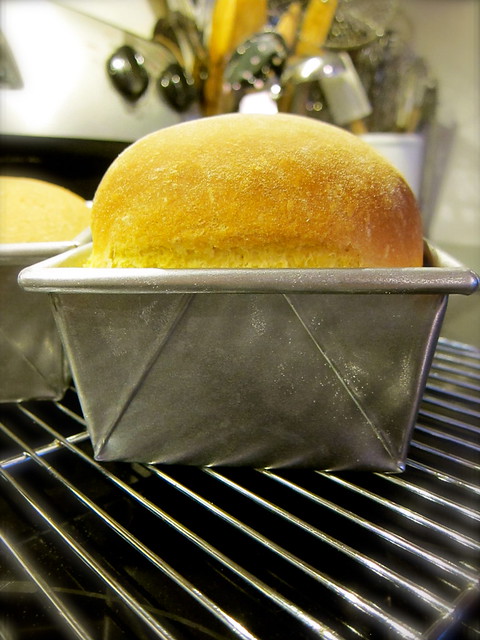
The bread we most often buy is a sandwich loaf, and we started out with Daniel Leader’s Semolina Sandwich Loaf from his book, Local Breads. You may be familiar with semolina from making pasta, however, look for something more finely ground, such as King Arthur’s Extra Fancy Durum Flour (above). This is a straight dough, with everything mixed in at once, and weighing the ingredients into one bowl simplifies the process even further.

Daily Bread: Semolina Loaf, Bialys, and Morning Buns

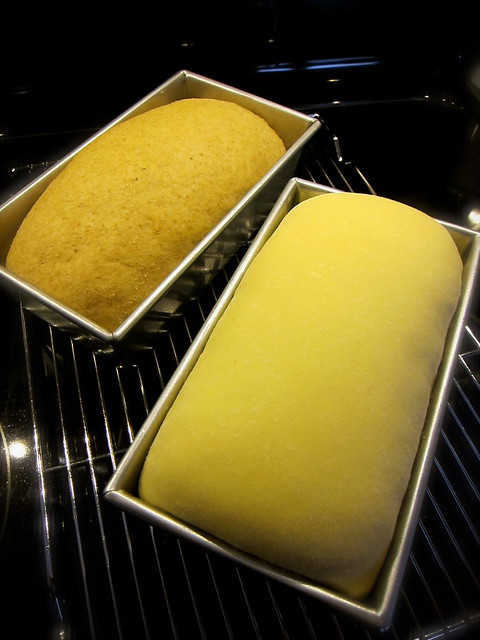
In general, coarsely ground semolina needs to be combined with other flours for baking, whereas finely ground durum flour is suitable for recipes that require 100 percent semolina. As a comparison, we used whole grain durum flour from Fiddler’s Green Farm in one loaf (above left), and fine durum flour in the other (right).

Daily Bread: Semolina Loaf, Bialys, and Morning Buns

The difference between the loaves is noticeable though not surprising, as whole grain flours contain different levels of bran, protein, and gluten — factors which can influence the dough’s development.

Daily Bread: Semolina Loaf, Bialys, and Morning Buns

Some tips for a lofty loaf: We made sure to knead it long enough, shaped it with this method, and used a 1-pound loaf pan. Other than that, the recipe is a reliable one, especially if you weigh your ingredients, and it turns out a beautifully well-formed loaf.

Daily Bread: Semolina Loaf, Bialys, and Morning Buns

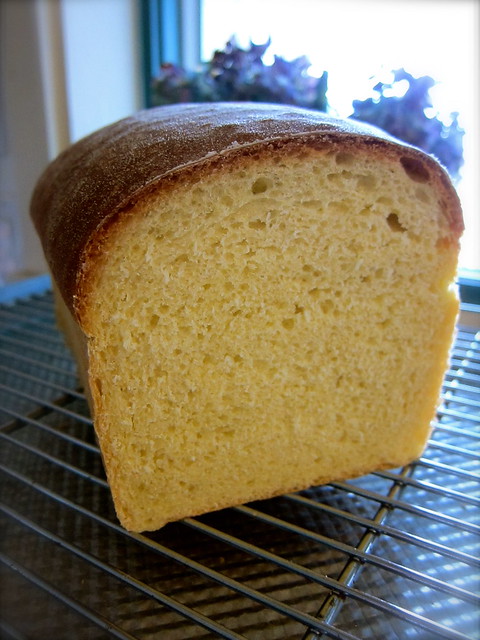
The even crumb is characteristic of bread made from semolina, as is its buttery golden hue. In addition to sandwiches, we’ve taken to using it for croutons, stuffing, and panzanella or bread salad. If any is leftover, it also makes excellent breadcrumbs.

Daily Bread: Semolina Loaf, Bialys, and Morning Buns

What the whole grain semolina loaf lacked in refinement is more than made up for in  flavor. To be fair, Fiddler’s Green Farm grinds their flour to order, and the freshness is evident in this loaf’s almost sweet nutty quality.

Daily Bread: Semolina Loaf, Bialys, and Morning Buns

While living in the far reaches of New York’s Upper West Side, there was a bakery near our subway stop that sold onion and blue cheese bialys, a savory combination that we still find ourselves craving decades later. Like bagels, recipes for bialys vary widely, and the one from The Kitchn (above) came the closest to what we were imagining.

Daily Bread: Semolina Loaf, Bialys, and Morning Buns

We let the dough proof overnight to develop more flavor, and omitted the cream/butter glaze; it’s the dry surface that makes it a bialy. We had a hunk of Bayley Hazen Blue from Jasper Hill Farm on hand, but found that a milder and younger blue cheese would be more suitable. Here, we added the cheese after the bialys were baked. The next time, we’ll try adding the cheese beforehand to avoid over baking.

Daily Bread: Semolina Loaf, Bialys, and Morning Buns

The bialy by which all others are judged come from Kossar’s Bialys, and Maggie Glezer’s recipe adaptation was worth tackling, if only to learn from our mistakes. In her book, Artisan Baking, she notes that the dough at Kossar’s is intentionally over mixed, which renders it slack and extensible. To replicate this, Glezer mixes the dough in a food processor. This technique pushed our processor to its limit, and it began to smell of burnt oil before we finish the required number of repeats. This gave us a puffier bialy than we would’ve liked, which then ended up overbaked (above) when we forgot to set the timer.

Daily Bread: Semolina Loaf, Bialys, and Morning Buns

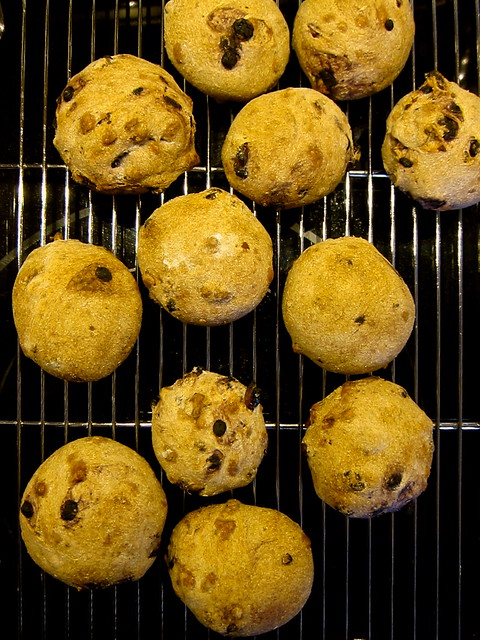
We finished the month by baking Morning Buns, based on the ones from Beach Pea Baking Co. They’ve long been on our baking list but have proven tricky to duplicate. We used Rodale’s recipe for Whole-Wheat Walnut-Raisin Rolls as a base, which at a proportion of 4 cups of flour to 3 cups of water makes for a very slack dough. Working with the sticky dough, we lost our nerve and added too much flour, which made them overly dense.

In sum, the Semolina Sandwich Loaf is a great introduction to baking with durum flour, and is a versatile bread to have on hand. Substituting whole grain semolina gave flavorful results, and it deserves another go with some tweaking in hydration and proofing time. Unless we want to buy a new processor, we’ll only use it to grind the onions, otherwise, we’ll stick with the bialy recipe from the Kitchn. As for the Morning Buns, they’re definitely a work in progress.

Resources
Semolina Sandwich Loaf (Pane in cassetta di Altamura), from Local Bread by Daniel Leader
Bread 101 — Basic White Bread: Shaping and Baking the Loaf, video from King Arthur Flour
King Arthur Extra Fancy Durum Flour
Fiddler’s Green Farm Stone-Ground Organic Durum Flour
Homemade Bialys, The Kitchn
Kossar’s Bialys, from Artisan Baking by Maggie Glezer
Whole-Wheat Walnut-Raisin Rolls, Rodale

Submitted to YeastSpotting.

Posted in cooking | Tagged , , , , , , | 8 Comments

2.17.14 Break the Cold Frosty Silence

2.17.14 Break the Cold Frosty Silence

“Come when the rains
Have glazed the snow and clothed the trees with ice,
While the slant sun of February pours
Into the bowers a flood of light.”
— William Cullen Bryant

2.17.14 Break the Cold Frosty Silence

Snowy days are interspersed with brilliantly sunny ones, creating a cycle of freezing and and melting, and a ring of icicles around the house.

2.17.14 Break the Cold Frosty Silence

A mountain of snow awaits shoveling.

2.17.14 Break the Cold Frosty Silence

Though we may be buried in snow, the days are becoming palpably longer, and even the garlic senses the change in season by sending out tiny rootlets in anticipation of the coming one.

Posted in garden | Tagged , , | 10 Comments

Intertwined

Intertwined

Be mine.

Posted in interlude, le due sorelle | 5 Comments