

With Hurricane Sandy headed this way, the wind began picking up as early as yesterday afternoon.

We’re hoping for the best, but expecting the worst.

And hope you all weather it safely.
With Hurricane Sandy headed this way, the wind began picking up as early as yesterday afternoon.
We’re hoping for the best, but expecting the worst.
And hope you all weather it safely.

With bags still to unpack and memories to sort, we’re in the midst of reentry from our travels in Puglia. Next to jet lag, the biggest adjustment on returning home has been to the difference in what’s now in season. The eggplant, zucchini and basil we’d become accustomed to feasting on while there won’t be available again for a good while.

Finding Romanesco cauliflower at this week’s Exeter Farmers’ Market, however, quickly transported us back. While smaller than their Italian brethren, Heron Pond Farm had these beguiling celadon-colored beauties on offer. Knowing that pasta was on the evening’s menu, we hungrily snatched up a bulging bagful and eagerly set about recreating some of the flavors we left behind.
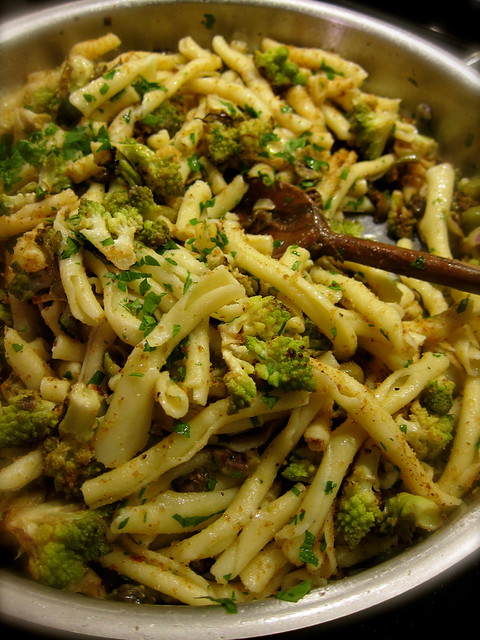
This is another recipe adapted from the ever-reliable Olives & Oranges. Though not entirely of Italian origin, the selection of pasta recipes contained within could keep one happily fed for a lifetime. Other varieties of cauliflower are easily substituted for the Romanesco, which usually appears in fall into winter. It has a nutty flavor, and holds up well in roasting. We like using green olives for the brightness they add, in contrast with the saline capers and anchovies. Use salt-packed capers if you can find them, they’ll taste more of capers than the brined ones. For a vegan variation, feel free to skip the parmesan and anchovies. The toasted breadcrumbs are a traditional Southern Italian garnish that usually takes the place of cheese, and, especially when homemade from good bread, can stand on their own in this rustic dish.
Strozzapreti with Romanesco Cauliflower, Green Olives, and Capers
4 small heads Romanesco cauliflower, cored and broken into florets
¼ cup plus 2 tablespoons extra-virgin olive oil
1 garlic clove, thinly sliced
Pinch of red pepper flakes
½ cup pitted green olives, coarsely chopped
2 tablespoons salt-packed capers, well-rinsed and drained
2 to 3 anchovy fillets (optional)
1 pound strozzapreti, or other similarly short pasta
1/2 cup grated parmesan (optional)
⅓ cup chopped flat-leaf parsley
1 cup homemade breadcrumbs, toasted with olive oil
– Heat oven to 400°F with rack in center. Line a baking sheet with parchment paper. Toss cauliflower with 2 tablespoons olive oil, and season with salt and pepper. Spread on baking sheet and roast, stirring midway through as needed, until tender and beginning to brown, about 30 to 45 minutes. Remove from oven and let cool.
– Heat remaining ¼ cup oil in large frying pan. Add garlic and pepper flakes, and cook until garlic begins to color. Add olives and capers, and cook for a minute or two more. Add anchovies, stirring until dissolved. Add roasted cauliflower, mix well, then remove from heat.
– Cook pasta in salted water until al dente. Drain and toss into the pan with the cauliflower. Mix in the cheese and half of the parsley, then the breadcrumbs last. Garnish with the remaining parsley and a drizzle of really good olive oil, and serve with additional cheese on the side.
Recipe adapted from “Olives & Oranges” by Sara Jenkins and Mindy Fox.
Local ingredients: Romanesco cauliflower from Heron Pond Farm; garlic from the garden.

It’s no secret that we love pasta. Save for a day or two, we once again managed to have it most every day while traveling in Puglia these past several weeks. Even then, the days without pasta were more than made up for by those when we ate it twice a day. There may have also been a meal where it was served in at least two of the courses. We’ll have to get back to you on that. In the meantime, join us in celebrating World Pasta Day, and “Butta la pasta!”
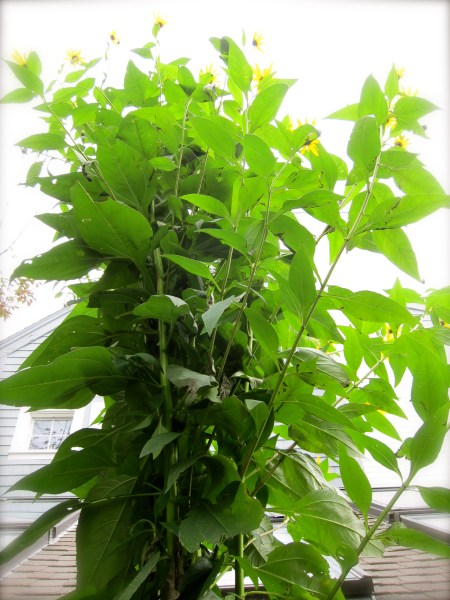
Sometimes the most casual of gifts can have the most impact, especially when it comes to plants. As part of putting in more perennial vegetables this year, we plunked two unassuming sunchokes into the ground, and watched in wonder as the darn things took root and shot up.
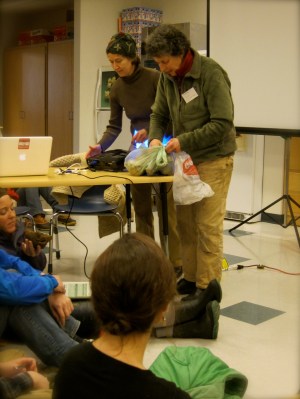
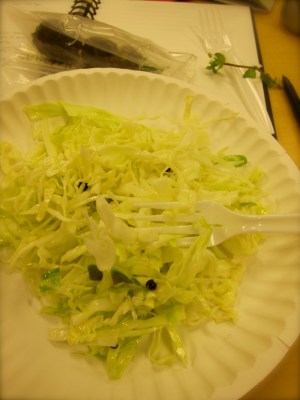
I’d attended Didi Emmon’s presentation on wild edibles during NOFA-NH’s Winter Conference back in March. Based on her book, “Wild Flavors: One Chef’s Transformative Year Cooking from Eva’s Farm”, Emmons was accompanied for the afternoon’s talk by Eva herself. They both held the standing-room-only crowd in thrall, passing out juniper berries, chicory root, and chickweed for us to sample, and sunchokes to take home and plant. Above left: Didi and Eva; above right: a winter salad of cabbage and foraged juniper berries, along with my bag of sunchokes and a sprig of chickweed.
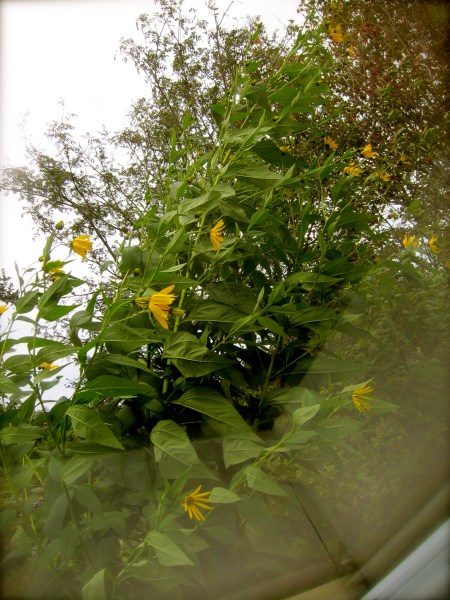
We kept the sunchoke tubers in a corner of the fridge until it came time to plant. A member of the sunflower family, we followed it all summer long as it grew, then grew some more. As the pair of them began to flower, they’d gotten so tall that the blooms were visible from the second story window.
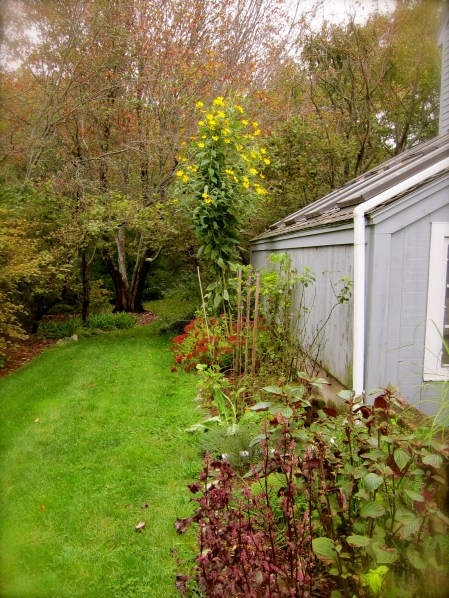
Friends who grow sunchokes themselves came over and marveled at its height: “They’re supposed to be tall, but we’ve never seen them grow this tall.”
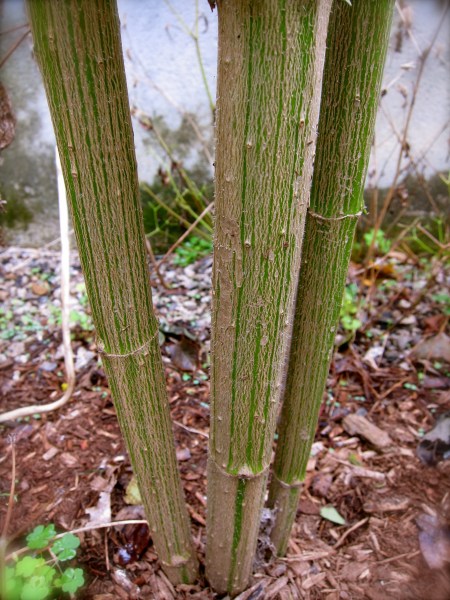
The stalks are thick as bamboo, we’re imagining they’re strong enough to build something sturdy with.
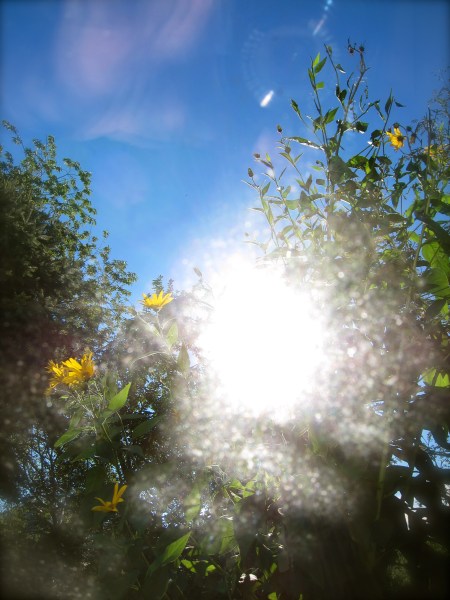
The tubers that grow underground are the edible part, and are better left in-ground for storing over winter. We’re waiting in anticipation to find out what we encounter when the time comes to finally them dig them up.
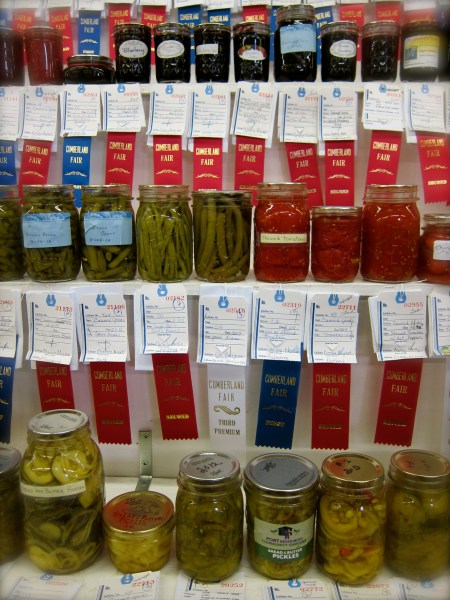
The last section of the Master Food Preserver Program was on judging canned goods at fairs, a fitting end to our training as one of the opportunities available to volunteer Master Food Preservers is fulfilling requests at different fairs. Each jar is judged against a standard, as set by The National Center for Home Food Preservation, and are often based on visual criteria alone, such as: type of container, uniformity, texture, pack, headspace, clarity/color, liquid to solids, and cleanliness. As it turns out, the Cumberland Fair was in full swing nearby, and I and a fellow student took a field trip there to see for ourselves what makes a blue ribbon winner.
As we learned, each fair determines what method of awards is to be used — the American method has a set number of ribbons, while the Danish method has no limit to the number of ribbons awarded. At the Cumberland Fair, which uses the Danish method, each jar is judged separately against a standard, and awarded accordingly.
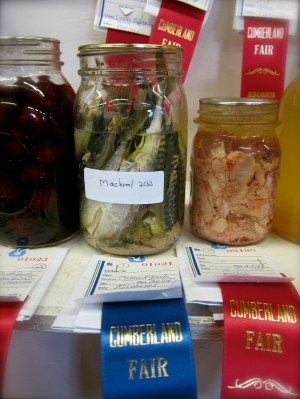

These two jars of canned mackerel and lard were in a class of their own and deservedly blue ribbon winners. Their very ambitious maker also submitted jars of canned chicken and stock.
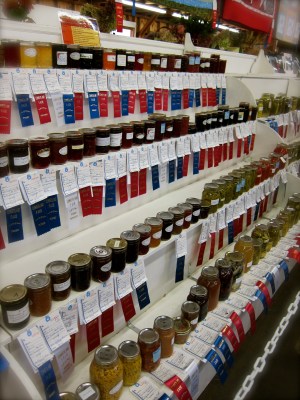

In addition to the home canned goods, there was a display on drying food. Steaming beforehand helped this cabbage retain its nice green color.

Of course, we couldn’t leave the exhibition hall before stopping by the vegetable display. The blue ribbon winning blue hubbard is a beauty.


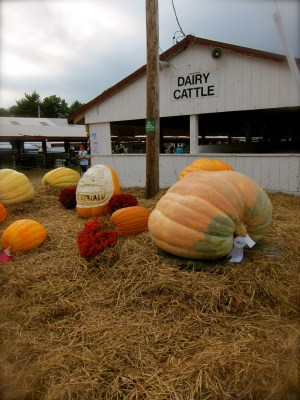

Outside of the exhibition hall, the giant pumpkins perched majestically.


While just a few steps away, we found the youngest member of the dairy cattle.
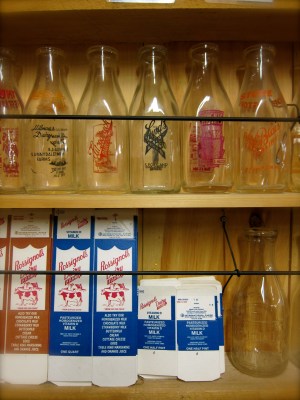

On the outskirts of the Midway stood a farm museum, housed in a permanent structure and alone worth the visit. Among the many displays was one of dairy-related equipment, including a collection of milk bottles.
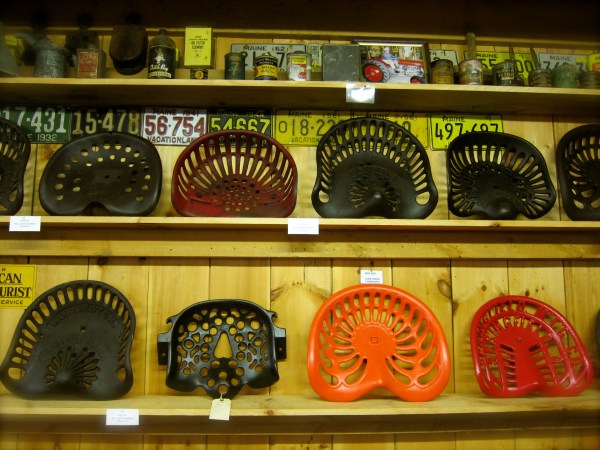
A wall of tractor seats.
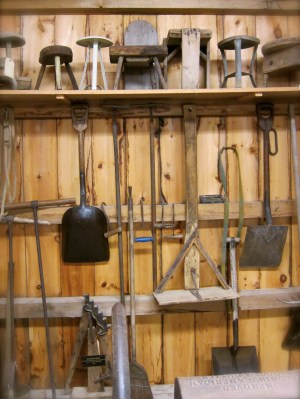

Milking stools, shovels and someone’s patiently mounted collection of Black Pine knots.
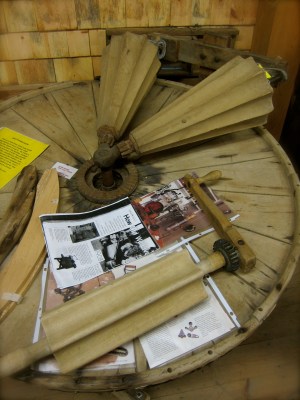
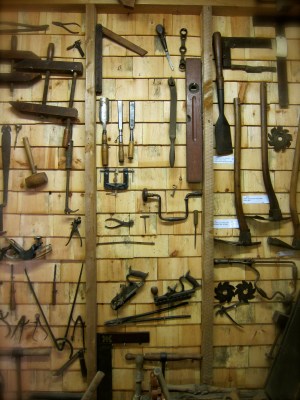
We were especially fascinated by this piece of equipment used to knead the water out of butter.

My favorite of all was this set-up for a summer kitchen, used to keep the main house cooler by moving the cooking into a separate building or outdoors. In place of the box oven, I’m imagining a couple of canning pots bubbling atop.
This series of posts follows the Master Food Preserver Program being offered through the University of Maine Cooperative Extension.

As the garden goes to seed, the fall garden has a kind of lushness of its own. We’d let half the fennel go, taking its time as it made the way from bulb to flower, and on to seed.

In the meantime, we discovered there’s a point when the seeds are still green that they taste exactly like Good & Plenty candy.

While down below, the roots left in the ground from the first time around have generously resprouted to allow us a another harvest.
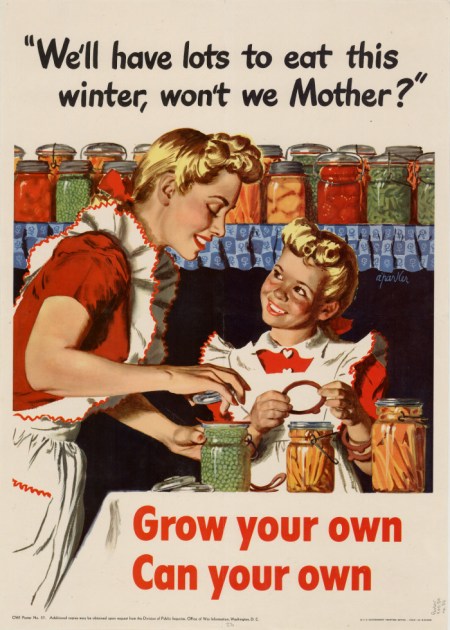
An important part of eating locally year-round in Maine is learning to store food for the winter. To further knowledge about this, the Master Food Preserver Program includes a section on Winter Storage Techniques. Kathy Hopkins, the Somerset County Extension Educator, was the evening’s guest and spoke about creating a root cellar of our own.
Root cellars are a way to store produce over winter, or until you have more time to can or freeze it. Storage conditions are dependent on three factors: temperature, moisture and ventilation. To help you navigate what can be a confusing range of storage requirements, here’s a general overview. Suggestions for indoor home storage are included, especially for when building a separate root cellar may not be an option:
1. Cold & very moist (32° – 36°F)
– Thin skin: Beets, kohlrabi, turnips, carrots, parnips, radishes, cucumbers.
– Leafy: Celery, cabbage, endive, kale, cauliflower, leeks.
– Cabbage and turnips should be individually wrapped in newspaper to prevent them from drying out and to reduce their strong odor from getting into vegetables stored nearby.
– Leave 1/2 inch of the stem attached to help retain moisture.
– Store in unheated cellar, basement storage room, or bulkhead.
2. Cold & moist (36° – 50°F)
– Potatoes: Cure in warm and dark environment for 10 days before storing
– Tomatoes: Leave short stem attached, store in single layer with newspaper on top to keep from drying out
– Apples: Store separately from potatoes and carrots.
– Store in unheated cellar, basement storage room, or bulkhead.
3. Cool & dry (36° – 50°F)
– Onions, garlic, hot peppers.
– Store in cool and dry attic, or unheated room.
4. Warm & dry (50° – 60°F)
– Pumpkins and winter squash (darkness not as critical), dry beans, ripening tomatoes.
– Store in house, or basement room with furnace.

In general, store fruits separately from vegetables. The image above shows areas in a house that could be used for storage (from Storing Vegetables and Fruits at Home). To control humidity, make sure it’s a space that can be ventilated, with access to fresh air.
In-Garden Storage
Storing food directly in the ground where they’re grown is another choice for saving food for the winter:
– Root Crops are good candidates: Carrots, turnips, parsnips.
– Do not mulch until soil is cool; trapped warmth can aid in decay.
– Carrots are damaged below 25°F.
– Light freezing improves flavor of parsnips, horseradish, and turnips.
– Can tolerate early light frost: beets, cabbage, cauliflower, celery, endive, kale, leeks, onions.
– Also consider storing in trenches, mounds, pits, or buried containers.
Harvesting Produce for Storage
– Select late-maturing varieties bred for long term storage.
– Harvest when ripe, not over or underripe; harvest as late in the season as possible, but before damaging frost.
– Harvest in the morning and/or in cool weather, after the dew is dry but before the afternoon’s heat; avoid harvesting when ground is muddy.
– Remove field heat by cooling down as quickly as possible.
– Cull out damaged produce and handle gently; nicks and bruises will cause decay and invite bacteria.
– Leave root crops in ground as long as possible before harvesting.
– Some crops require curing before storage, such as onions, garlic, potatoes, and winter squash.
Storing Canned Foods
From the National Center for Home Preservation:
Check jar lids for tight vacuum seal, remove screw bands, wash the lid and jar to remove food residue; then rinse and dry jars. Label and date the jars and store them in a clean, cool, dark, dry place. For best quality, store between 50 and 70°F. Can no more food than you will use within a year.
Do not store jars above 95° F or near hot pipes, a range, a furnace, in an uninsulated attic, or in direct sunlight. Under these conditions, food will lose quality in a few weeks or months and may spoil. Dampness may corrode metal lids, break seals, and allow recontamination and spoilage.
Accidental freezing of canned foods will not cause spoilage unless jars become unsealed and recontaminated. However, freezing and thawing may soften food. If jars must be stored where they may freeze, wrap them in newspapers, place them in heavy cartons, and cover with more newspapers and blankets.
Suggested Quantities (for family of four)
From Root Cellars: Safe and Secure from the Corporate Food Train:
– Apples: 5 bushels
– Carrots: 40 to 60 pounds
– Cabbage: green, 20 heads; red, 10 heads
– Beets: 20 pounds
– Celeriac (celery root, use instead of celery): 10 to 20 heads
– Leeks: 40 plants
– Potatoes: 100 pounds or more
– Jerusalem artichoke (sunchoke): 10 pounds
– Onions: 40 pounds
– Garlic: 10 to 20 pounds
– Winter radish: 10
– Parsnip: 20 pounds
– Squash: 40 ‘Delicata’ and 30 pounds butternut
– Pumpkin: 5 to 10
– Turnip and rutabaga: 10 or more
Lastly, check your stores frequently!
Resources
• Vegetable Storage in Root Cellars (University of Alaska Cooperative Extension)
• Storing Vegetables and Fruits at Home (Washington State University Cooperative Extension)
• Commercial Storage of Fruits, Vegetables, and Florist and Nursery Stocks (USDA Agriculture Handbook #66)
• Storing Garden Vegetables (MOFGA) – overview of individual vegetables
• Root Cellars: Safe and Secure from the Corporate Food Train (MOFGA)
• Using a Bulkhead as a Root Cellar (MOFGA)
Recommended Reading
• The Complete Root Cellar Book: Building Plans, Uses and 100 Recipes by Steve Maxwell
• How to Store Your Garden Produce: The Key to Self-Sufficiency by Piers Warren
• Preserving Food without Freezing or Canning by the Gardeners and Farmers of Centre Terre Vivante
• Root Cellaring: Natural Cold Storage of Fruits & Vegetables by Mike Bubel
This series of posts follows the Master Food Preserver Program being offered through the University of Maine Cooperative Extension.

 Diary of a Tomato