11.26.12 Daikon, tatsoi and winter radishes

IMG_2234

Overnight temperatures are predicted to fall below freezing for much of the week ahead. The daikon, green meat and watermelon radishes are only under a row cover, and we harvested what we could to transfer into cold storage. Though it was difficult to get the watermelon radishes to germinate this season, we were pleased with the daikon and green meat radishes, most of which will find their way into a wintery braise.

IMG_2216

As part of our season extension planting, we grew more tatsoi this year than last, and harvested some along with the winter radishes. We’ve been enjoying these greens cooked up in a soupy dish made with Northern shrimp.

IMG_2211

We left a few tatsoi in the ground to test their cold tolerance and see how they fare being protected by only a row cover.

IMG_2189

We don’t know how much longer the greens will hold on under their low tunnel of plastic. They’ve an extra cover of Remay blanketing them, enough protection we hope to enable us to continue harvesting through the end of the year.

Still harvesting, under low tunnels: salad greens, arugula, chicories, fun jen, kales, chard.
Stored in-ground, under low tunnels: carrots, parsnips, leeks, celeriac.

IMG_2235

With leftovers on hand, Thanksgiving marks the start of soup season for us. We were surprised to find we were still able to forage enough parsley and cutting celery from the garden to add to the broth. This will be turned into a steaming pot of turkey and rice porridge with lots of ginger, garnished with some freshly shredded fun jen on top — a comforting antidote to holiday excess.

Posted in cooking, garden | Tagged , , , , | 18 Comments

Thanksgiving interlude

IMG_2196

Though we still can’t agree on how many years it’s been, we once again joined friends and extended family to celebrate our favorite of holidays, Thanksgiving. We continue to be grateful to Carolyn and Vincent for gathering us together these many wonderful, laughter-filled years.

IMG_2202

Special thanks to Carolyn for presenting us with such a gorgeous feast, to Vincent for the animation and Normandy interludes, to Leslie and Paula for showing us your latest paintings, to Paul for giving us Art Thoughtz on the sublime, to Chris for explaining how to flood-proof a house and the intricacies of the Danish Parliament, to Justin for letting us practice our Italian with him, to Sonia for her thoughts on becoming a pensioner, warmest congratulations to Vivian and Darren, we missed you Virginia, and kisses to the youngest Justin for just being there and putting up with us all. We’re still not sure why the turkey had three legs. — xxoo

Posted in cooking, interlude | 1 Comment

Love expands

IMG_9964
We’re not big on milestone occasions, birthdays and anniversaries tend to be quiet affairs in our household. This fall was our 25th wedding anniversary and, in usual fashion, was celebrated in a low-key way, much as how we got married — a good bottle of wine, a heaping pile of steamer clams, and a big bag of salty chips at a nearby lobster pound only a bike ride away, with a beach walk afterwards. We look forward to the next 25 years together, though perhaps with it passing less quickly this time.

Congratulation to the good citizens of Iowa, Maine (hurrah!), Maryland, Minnesota, and Washington for recently passing marriage equality, and joining 16 other states that support this civil right.

Posted in interlude | 10 Comments

11.18.12 Planting garlic

11.18.12 Planting garlic

Monday was a holiday with glorious weather, a perfect day to plant garlic. We had problems with garlic mites, and each clove was painstakingly peeled in order to ensure that only the best seed went into the ground. 

11.18.12 Planting garlic

We planted both Music and Phillips, 48 cloves of each. Originally from Fedco seed, these hardneck garlic are now in their fourth generation.

11.18.12 Planting garlic

This year, we dropped the German Extra Hardy and planted 12 cloves of the Rossa di Sulmona in their place. This Italian hardneck is originally from Abruzzo, and known for their sweet taste and distinctive pink wrappers. 

11.18.12 Planting garlic

Once the cloves were planted, the garlic bed was give a cover of leaf mulch. Our last planting of the season was now done.

11.18.12 Planting garlic

A good day’s work rewarded by one of nature’s light shows.

Posted in garden | Tagged | 6 Comments

Local Food: Winter Farmers’ Market, Rollinsford

Winter Farmers' Market, Rollinsford - 11/17/12

Once summer’s over, people often forget that the fall harvest is a bounteous time. Here’s a glimpse of the rich variety that’s now being brought to market >

For more on the Seacoast Eat Local Winter Farmers’ Market, Annie from Breaking New Ground was also there!

Posted in local food | Tagged | 6 Comments

Spongano: Maritati con Pomodorini e Rucola (Wedding Pasta with Winter Tomatoes and Arugula)

IMG_0405

During our week cooking in Spongano, it was just a short stroll from the door of our kitchen to il fruttivendolo. Towards the rear of the shop, past the taralli biscuits and dried fave, a large array of tomatoes were on splendid display. Among them, we found these seemingly unripe pomodori insalatari (above), or salad tomatoes, which are considered best when eaten raw but still streaked with green. Silvestro, our maestro, instructed us to chose ones that were firm and not quite ripe. The higher acidity helps to balance the slight bitterness of the salad greens. As it turns out, all of those hard tomatoes we’ve been having in salads while traveling in Italy weren’t out of season; they were meant to be eaten that way.

IMG_0402

On the opposite end of the spectrum, pomodori da salsa are tomatoes meant for cooking, and are ready to be used when deeply red and fully ripe. These fiaschetto (above) have a characteristic point, il pizzo, at the end. Like a paste tomato, they’re perfect for making vats of tomato passata, or sauce.

IMG_0404

In a category of their own are the pomodorini d’inverno or appesi, or winter or hanging tomatoes. We’d explained to Silvestro that we’d been growing these back home, and were thrilled to have the chance to cook with them while in Puglia.

IMG_0409  IMG_0410

The yellow pomodorini were stored in bins and weighed out loose, while the red ones came strung up and sold as a whole hanging cluster. When asked how she used them, the proprietress simply shrugged, “Cooked, with pasta.”
IMG_0574

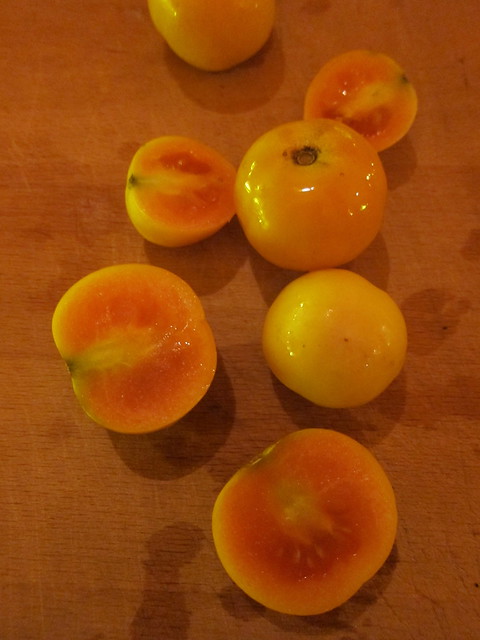
We bought several kilos of the pomodorini for the evening’s pasta. When cut open, the yellow ones looked exactly like our Ponderosa sel Oro — yellow-orange on the outside and red on the inside. We were familiar with their tartness, something that would transform with cooking into something bright and deep.

IMG_0568  IMG_0573

Careful as we were to disassemble the cluster of red pomodorini, it remained a mystery to us how they were strung together.

IMG_0569

The evening’s pasta was maratati, or wedding pasta, usually a combination of two shapes, the more suggestive the better. The pasta dough was a mix of semola rimacinata and farina di orzo, or semolina and barley flours, formed into orecchiette and the longer minchiarelli.

IMG_0601

The pomodorini are halved, then sautéed with garlic and a good amount of the peppery Salentese olive oil. The tomatoes collapse during cooking, with the oil taking on a rich red hue, becoming thick with their juices and almost jam-like.

IMG_0604

All the finished dish needed was a toss of arugula, and the maritati was ready to be served as the evening’s first course.

Spongano: Maritati con Pomodorini e Rucola

The recipe for Maritati con Pomodorini e Rucola is a based on Silvestro’s one for Orecchiette with Cherry Tomatoes and Arugula. It happened to appear in the New York Times that week, accompanying Florence Fabricant’s aptly titled article, “At Home in Italy, Wherever You Are.” If indeed Pugliese cuisine is the “ultimate home cooking,” perhaps there’s no better way to experience it then learning to cook it yourself.

IMG_0605
Note: Like so things in Italian cuisine, winter or hanging tomatoes go by many names, changing from one southern region to the next, even town to town. We first learned of them as pomodorini appesi in Locorotondo, where our original seeds are from. Other nomenclature for the pomodorini include d’inverno, invernali, eterni, and piennoli. Giuseppe, one of our friends at The Awaiting Table, tells us he grew up calling them m’pisa; we’ve since seen them also referred to as te m’pisa.

Posted in cooking, tomatoes / pomodorini | Tagged , , | 7 Comments

Assembling pomodorini appesi for hanging

Elizabeth Minchilli filmed these women from Puglia demonstrating how to string together hanging tomatoes, or pomodorini appesi, while attending Slow Food’s Salone del Gusto one year. Their technique differs markedly from that shown in another video. Here, the tomatoes are shown strung together individually and by their stem tops, rather than in small clusters of two or three tomatoes with a bit of vine attached between them.

Check out her post, “hanging tomatoes at the salone del gusto,” for more about these pomodorini. In addition to offering food workshops and tours of Rome, this year Elizabeth led a small group tour of this wondrous event. We can’t imagine a more fun person to go with.

Posted in tomatoes / pomodorini | 2 Comments