Kjötsúpa — Icelandic Lamb Soup

Kjötsúpa — Icelandic Lamb Soup

“Apart from taking lýsi (cod liver oil), kjötsúpa is the best cure for short-day depression and a vitamin boost for those suffering from a relentless cold.”
— “Winter Soup

Winter is the time to make kjötsúpa, a traditional lamb soup that’s like Iceland in a bowl, and we were impatient to recreate it following our trip there last spring. Fragrant with the sweet earthiness of winter vegetables packed into a nourishing lamb broth, this warming soup is a delicious sum greater than its humble parts. We’re always alert to dishes that can be localized with our own ingredients, and from the first spoonful, we knew we’d be able to source it almost entirely from the Winter Farmers’ Market. As for its claim as the best cure for the season’s short-day depression and relentless colds, all the better.

Kjötsúpa — Icelandic Lamb Soup

Like most traditional dishes, kjötsúpa is one based on home cooking, and what one would have on hand — a bit of lamb that’s left clinging to bones, vegetables that store easily over winter, and a broth that makes itself while the soup simmers away. Each ingredient is cut small enough to fit in the belly of a spoon, yet chunky enough to feel substantial when eaten, and is added in stages to keep the flavor of the individual vegetables clear. The rutabaga is important for balancing the richness of the lamb; turnips may be substituted, especially Gilfeathers if you can find them (they’re actually another rutabaga), but will contribute a different flavor. While this soup can be served when ready, letting it sit overnight allows you to skim the extra fat off, and the flavors to more fully develop. We’ve been imprinted to prefer kjötsúpa without grains, though, at the discretion of the cook, many suggest adding a handful of rolled oats, barley, or brown rice for a creamier, or more porridge-like texture.

Kjötsúpa — Icelandic Lamb Soup

A note on the dried herbs: We used Villikrydd, a wild herb mix that we happened to bring home with us. It contains Arctic thyme, birch leaves, bog bilberry, bilberry and juniper, and is meant to go well with lamb. There’s a deep culture in Iceland of using herbs medicinally, and we wonder if this is part of this soup’s legendary healing powers. More readily accessible substitutes would be parsley, thyme, bay, celery or lovage.

Kjötsúpa — Icelandic Lamb Soup

2 pounds lamb shoulder (preferably with some bone)
6 cups water, plus more if necessary
2 teaspoons sea salt
½ teaspoon freshly ground black pepper
1 onion or leek, chopped
1 – 2 tablespoons mixed dried herbs (see note above)
1 pound rutabaga (or turnips), peeled and chopped
½ pound carrots, peeled and chopped
½ pound potatoes, peeled and chopped
1 cup chopped green cabbage

– Trim some of the excess fat off the meat, and cut into chunks. Place it in a large pot, add 6 cups cold water and heat slowly to a boil. Skim the broth, then add salt, pepper, onion, and dried herbs. Simmer, partly covered, for about 45 minutes.
– Meanwhile, prepare the vegetables. They should be chunky, large enough that each piece is a separate spoonful. Add the rutabaga, carrots and potatoes to the soup, and continue simmering for 15 minutes more.
– Add the cabbage and simmer for 5 to 10 minutes, or until all the vegetables are tender. Lift the meat out from the soup, and separate out the bones, sinew and excess fat. Chop the meat up into bite-sized pieces and add them back into the soup. If needed, add a cup or two of more water, and adjust seasonings. Let soup sit overnight for flavors to develop. Garnish with fresh parsley or chives, if available. Serves 4 to 6 as a main course.

Adapted from “Icelandic Food & Cookery” by Nanna Rögnvaldardóttir, and “Into the North” by Inga Elsa Bergþórsdóttir and Gísli Egill Hrafnsson.

Local ingredients: Lamb from Riverslea Farm; rutabaga from Brookford Farm; cabbage from Meadow’s Mirth; onions from Black Kettle Farm; potatoes, carrots and celeriac greens from the garden.


Posted in cooking | Tagged , , , , , , , , | 25 Comments

1.13.14 Liebster + Illuminating Blogger Awards

1.13.14 Liebster + Illuminating Blogger Awards

“How we spend our days is, of course, how we spend our lives.”
— Annie Dillard

This past year presented a number of personal challenges, most of which, we’re glad to say, ended positively. It was also a time full of many lovely, wonderful and beautiful things to be thankful for, chief among them the kindness and thoughtfulness of others. Of special note was the nomination of Diary of a Tomato for the Liebster and Illuminating Blogger Awards. With the wealth of good work being put out in the blogsphere, we’re grateful to Lara at Noms The Word and Jenna at Delicious Day Dreams for thinking of us, and honored by this recognition from fellow bloggers.

liebster

While neither of these awards are specific to gardening blogs, it only seems fitting to share some of the edible ones that have inspired and encouraged us in our own endeavors:

1. Skippy’s Vegetable Garden: Before we became gardeners, we lived vicariously through Kathy and her 4-legged companion and blog namesake, Skippy. We followed avidly the progress of their garden through the seasons, closely studying the raised beds and their contents, and as it expanded to include an enviably large community garden plot. Located near Boston, this garden made growing our own vegetables seem possible. Make sure to scroll down the sidebar for an aerial view of how a garden changes from start to peak. We look forward to seeing Skippy create a new garden next season after their move.

2. Daphne’s Dandelions: Daphne generously hosts Harvest Monday, a place for gardeners, including novices and veterans alike, to share their own successes and failures. The weekly check-in gathers contributors from around the world, and it’s always heartening to see how many others have taken up growing their own. A scientist by training, she keeps a running tally by weighing meticulously each week’s harvest — from a sprig of parsley to the largest cucurbita, it all adds up. Like Skippy, Daphne’s garden is located near Boston, and, chances are if it grows there, it may grow here as well. Every season we particularly enjoy seeing her beautiful selection of dried beans.

illuminating blogger award

3. From Seed to Table: It was through a search for information on growing Italian vegetables that we came across Michelle’s blog. Her growing conditions on the coast of Northern California are surprisingly similar to our own, albeit without the interruption of a New England winter. The range and variety of  heirloom vegetables Michelle’s cultivates is outstanding, and her experiments well worth following, whether it be growing capers, saffron, or, more recently, wheat.

4. Suburban Tomato: At a time when our own garden is dormant, it cheers us up to visit Liz’s in Melbourne. Halfway around the world from us, her seasons are a lovely reverse mirror of our own. We’re particularly enamored of her capsicums and the chili sauce she makes with them, and frequently wonder what Top 5 things may be on her mind. Her posts on “Are Farmer’s Markets more expensive?” and “Top 5 — Ways in which Kitchen Gardening is a political act” are thoughtful reminders of the larger reasons for why we garden.

5. Garden to Wok: Whether it’s a growing a new vegetable or investigating different storage techniques, Norma approaches each with ingenuity — just see how she solved comparing three varieties of parsnips to find out which tasted the best. This Master Gardener’s special knowledge of Asian vegetables expands the possibilities of edible gardening for us, and has us considering growing and cooking bitter melon, sweet potato vines, and a Taiwanese lettuce called “A” choy.

At the beginning, Diary of a Tomato was meant as a way of recording our garden. Since then, it’s become more than just a place to store information. We’ve become part of a larger community, both virtual and real. We appreciate it when you drop by, dear friends, and though we may not be able to regularly respond to comments, we read each and every one with appreciation and delight. We hope you’ll continue to visit, and together we’ll see what the new year brings.

Posted in garden, interlude | Tagged , , , | 8 Comments

1.13.14 Taking Stock

1.13.14 Taking Stock

The Seacoast is well-populated with farmers’ markets, even in the depths of winter. Given the vagaries of New England weather, though, we can’t always make it to them at this time of year. In the past couple of weeks alone, we’ve had all manner of snowy and icy conditions, often leaving our dirt road impassable. For those times between trips to the market, a well-stocked pantry is an absolute necessity, especially for eating locally.

1.13.14 Taking Stock

This year, we put up fewer jams and pickles, and concentrated on canning vegetables, such as tomatoes and corn, and stocks. So far, we’ve worked through half our stores of  tomatoes and stocks (vegetable and chicken), both of which make up the base for frequent soups and braises. Of the lot, it’s the tomatoes we keep the closest tabs on, and canning more, especially tomatillos, tops the list for next season.

1.13.14 Taking Stock

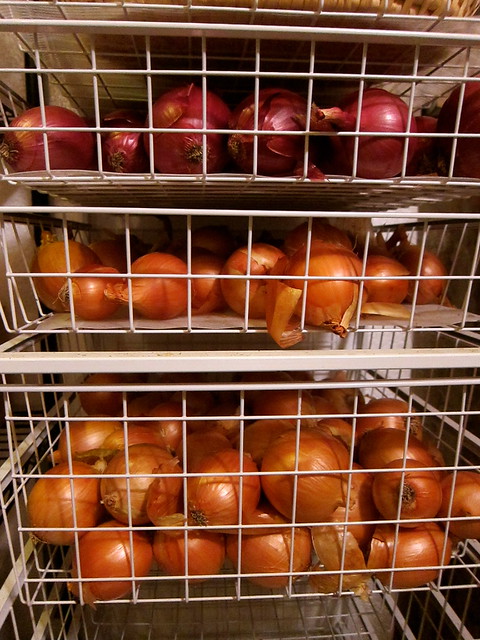
In a separate part of the basement, there’s a walled-off room that’s suitable for keeping onions, shallots and garlic at one end, and potatoes at the other. Though these vegetables prefer similar conditions, they don’t like to be stored too close to one another. Above: red and yellow storage onions from Black Kettle Farm and Stout Oak Farm, bought in bulk last fall.

1.13.14 Taking Stock

The winter tomatoes and squash are stored at a slightly higher temperature than the alliums and potatoes, and are kept in the main part of the basement. Compared to last year, we started out with much fewer pomodorini (left to right, Aprile and Ponderosa).

1.13.14 Taking Stock

For vegetables that need colder conditions and don’t fit in the basement refrigerator, we use the garage or bulkhead for bulk storage, where temperatures usually hover in the 30’s. However, a dip into the subzero range before we could insulate the bulkhead caught us by surprise this winter. Though we lost a bin of daikon and winter radishes, even more surprising was how well the other remaining vegetables tolerated the extreme cold.   Above: root vegetables (rutabaga, turnips and beets), apples, and cabbages.

1.13.14 Taking Stock

Celeriac from the garden, the last harvest of the year.

1.13.14 Taking Stock

Brussels sprouts from Heron Pond Farm — these were picked up at the Winter Farmers’ Market in December. Though it’s a bulky way of keeping them, we’ve learned leaving them on their stalks makes for longer storage.

1.13.14 Taking Stock

Macoun apples from New Hampshire Cider Works — we usually keep an extra bin on hand, though last fall’s bountiful crop should result in storage apples available through the winter.

1.13.14 Taking Stock

Rutabaga from Brookford Farm, and beets and Gillfeather turnips from Stout Oak Farm — we’ve become increasingly appreciative of these winter stalwarts. Overall, we’re not storing as much as last year, and the adjustment has made for less waste and upkeep. For more on keeping a winter pantry, see Mastering Food Preservation: Winter Storage Techniques >

Posted in preserving, tomatoes / pomodorini | Tagged , , , , , , , , , , , | 9 Comments

1.6.14 Pause

1.6.14 Pause
“Bare branches in winter are a form of writing.”
— Billy Collins, “Winter Syntax”

We always called this deciduous shrub Jacob’s Walking Stick. It turns out we were wrong on both counts — the walking stick belongs instead to Harry Lauder, a Scottish entertainer and “connoisseur of walking sticks,” and is a dwarf tree rather than a shrub. Though Harry is no longer with us, his fondness for crooked walking sticks lives on in this meandering ornamental. Corylus Avellana Contorta, or Corkscrew Hazelnut, really comes into its own after the leaves drop and there’s a fresh blanket of snow to show off its twisty demeanor.

Posted in garden | Tagged | 5 Comments

12.30.13 Wintry Welcome

12.30.13 Wintry Welcome

“Winter makes a bridge between one year and another…”
— Andy Goldsworthy

12.30.13 Wintry Welcome

12.30.13 Wintry Welcome

12.30.13 Wintry Welcome

12.30.13 Wintry Welcome

Wishing you all abundant peace, love and joy in the new year, dear friends.

Posted in garden | Tagged , | 9 Comments

12.23.13 Solstice Harvest

12.23.13 Solstice Harvest

One last harvest before the end of the year — a basketful of winter celeriac and leeks.

12.23.13 Solstice Harvest

After two back-to-back snowstorms, a week-end thaw allowed us to pull up the row covers and check on the beds after weeks of below freezing temperatures. In addition to hardy celeriac and leeks, the kale and escarole are beginning to resprout in anticipation of longer days. Arugula, a variety called Ice-Bred, still has some vigor left.

12.23.13 Solstice Harvest

The celeriac seem none the worse for wear, despite the fact we left them in the ground longer than we intended. The softball-sized bulbs are smaller than in previous years, though enough to cook with. We also made sure to save their leafy greens for soups, stews and garnishing.

12.23.13 Solstice Harvest

After peeling back a layer or two, the leeks clean up well. The longer we grow them, the more we appreciate their ability to overwinter in-ground and add variety to our winter table.

12.23.13 Solstice Harvest

Wishing you all a merry holiday and safe travels, dear friends.

Posted in garden | Tagged , , , | 8 Comments

12.16.13 Snowbound

12.16.13 Snowbound
Unscientific as it may be, we gauge the amount of snowfall by our deck accumulation. 

12.16.13 Snowbound

As for our cats, they relish the chance to play in whatever drifts into the screened-in porch. They pad about until their paws freeze, come in briefly to let them rewarm, then dart back out again.

12.16.13 Snowbound

We can expect to lose power whenever there’s high winds. Thankfully, the outage was short-lived and came while it was still light out — just long enough to heat up some water for tea, catch up on some reading, and enjoy the welcome quiet.

12.16.13 Snowbound

While the leeks should be fine, we should have harvested the rest of the celeriac earlier. Now, we’ll have to wait for the covers to unfreeze before we can see what’s left.

Posted in garden | Tagged | 5 Comments