5.5.14 Foraging Wild Garlic — Allium vineale

5.5.15 Wild Garlic — Allium vineale

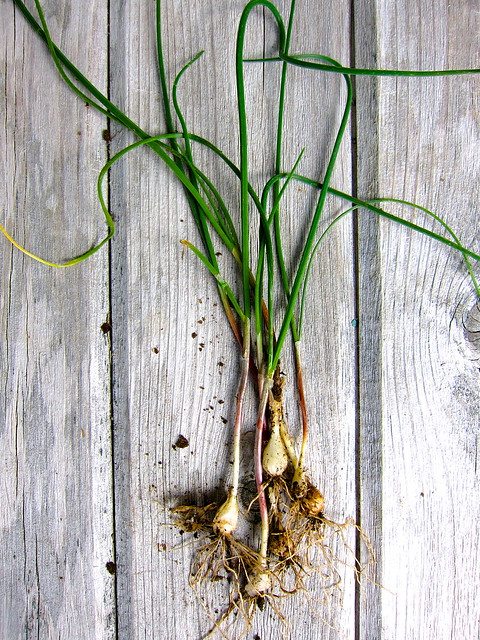
There’s a patch of garden next to the back door that’s a little less kempt and where straggly clumps of grass reappear every spring. In our sporadic attempts to tidy it, we’ve pulled these weedy plants up by the handful, only to notice their bulbous endings and pungent odor. As it turns out, we’d stumbled upon wild garlic, Allium vineale.

5.5.15 Wild Garlic — Allium vineale

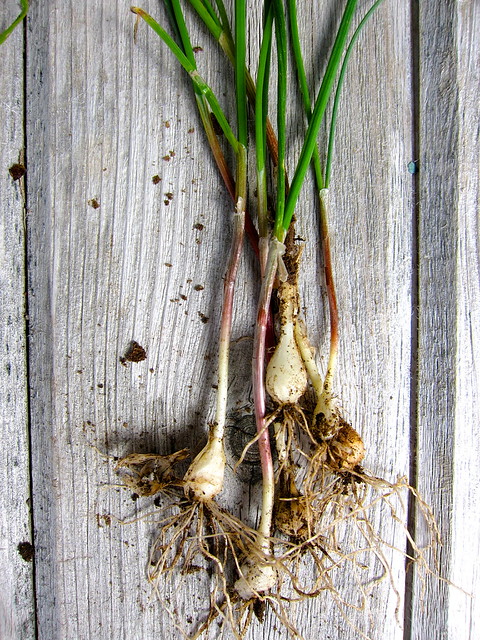
In addition to wild garlic, other common names for this herbaceous perennial are field garlic, crow garlic, or stag’s garlic. It’s easy to mistake it for the nearly identical wild onion, Allium canadense, save for a few differences — where wild garlic leaves are hollow and the bulb covered with a papery skin, instead, wild onion leaves are solid and the bulb has a netted sheath. Other than that, they’re virtually interchangeable in terms of culinary use, and all parts of both plants are edible. Note: Ramps (Allium tricoccum) and ramsons (Allium ursinum) are also commonly referred to as wild garlic or wild onion, and are identified by their broader leaves.

5.5.15 Wild Garlic — Allium vineale

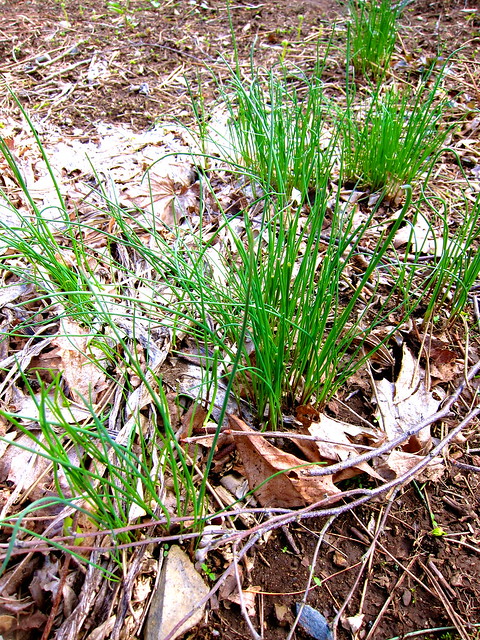
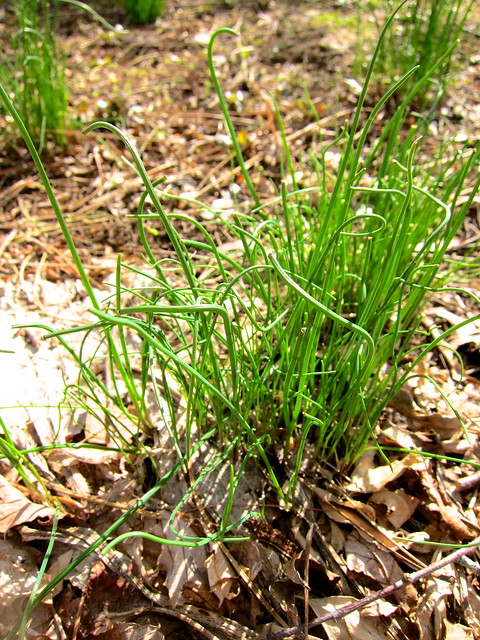
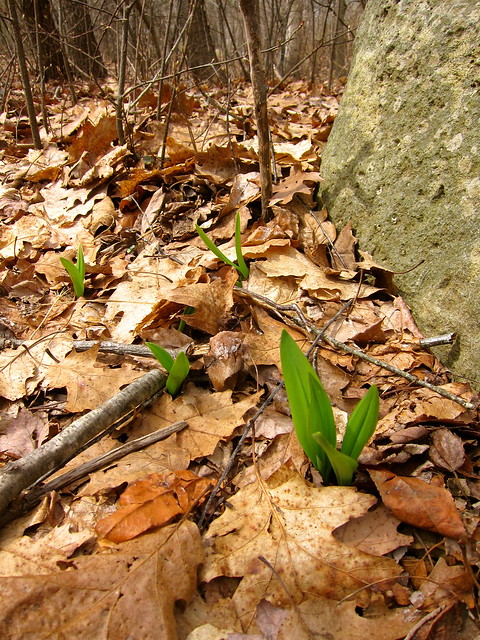
Wild garlic thrives on the edges of forests and fields, and this particular patch (above) resides where the garden transitions to woodland. These forageable alliums are also common to lawns and other grassy areas, but may be obscured if the area is frequently mowed. They can be a particularly unwelcome presence in pastures where dairy cows are kept, as its ingestion can taint the milk and spoil it with an garlicky flavor. Unlike ramps, wild garlic is certainly in no danger of being over-foraged; do avoid foraging in roadside areas or other places that have been chemically treated.

5.5.15 Wild Garlic — Allium vineale

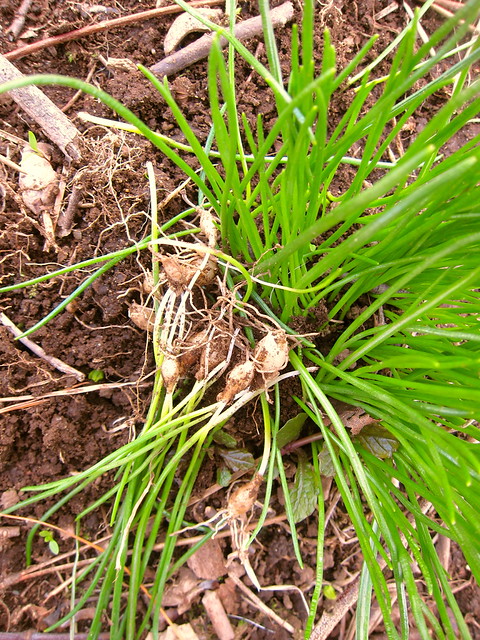
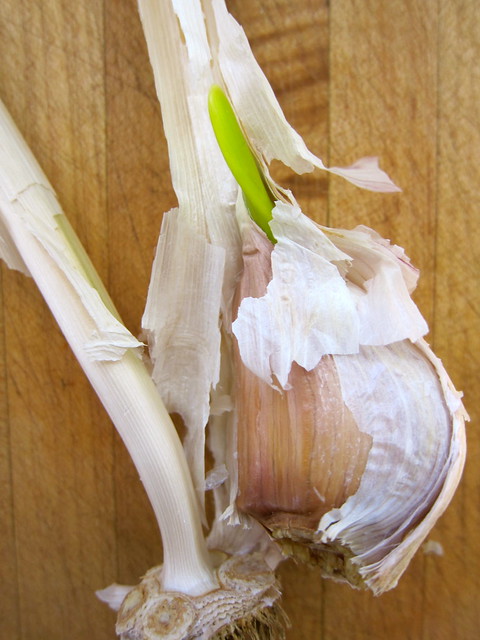
All parts of wild garlic and onion have a strong aroma, especially when broken or torn, and is a reassuring way of identifying it as edible. Be aware there are a few toxic look-alikes, such as the descriptively named death camas (Toxicoscordion venenosum). Avoid grass that has even ends, flat stalks, and, most importantly, a lack of onion or garlic smell; if there’s any doubt, it should not be eaten. We dug up a patch of similar-looking grassy vegetation to test this, and found the bulbs scentless when crushed (above), a distinct difference from the wild garlic near it.

5.5.15 Wild Garlic — Allium vineale

Like other edible alliums, the entire plant may be eaten either raw or cooked, and it’s appearance in early spring provides a multitude of vitamins and minerals. The versatile stalks may be snipped atop a salad and tossed with a lemony dressing, chopped into a tonic soup, blended into a vibrant pesto, fried into crispy pancakes, baked into a cheesy bread, fermented into a tangy kimchi, and the bulbs used for crunchy pickles or to infuse a tangy vinegar. As the season progresses, our attention will turn elsewhere; for now, however, this oft overlooked wild edible is having its moment in the garden. 

Resources
Backyard Foraging by Ellen Zachos
Foraged Flavor by Tama Matsuoka Wong
Northeast Foraging by Leda Meredith

Posted in garden | Tagged , , , , | 6 Comments

4.29.14 Pea seedlings and other garden sightings

4.29.14 Peas and other garden sightings

“Though other crops in their season — fine lettuces and radishes, green beans, tomatoes ripened on the vine, or fresh-picked corn — justify the vegetable garden and all the labor it entails, peas, really fresh peas picked at the briefest second of perfection, seem to us almost the garden’s entire reason for being.”
— Joe Eck & Wayne Winterrowd, “Living Seasonally”

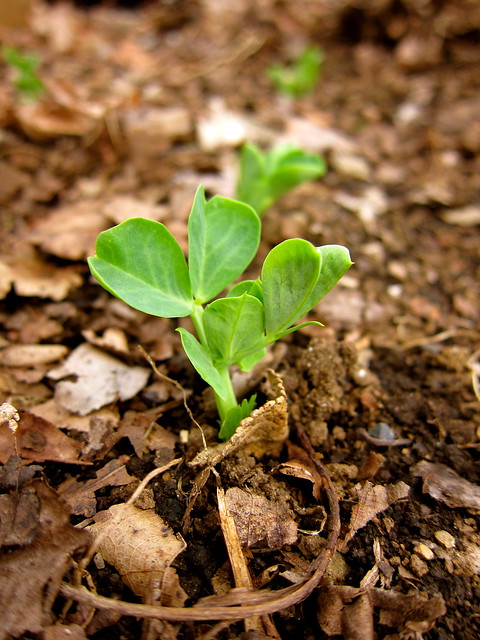
It’ll be June before the peas are ready, but the sight of these tender seedlings excite us all the same. It’s as if by planting a seed and watching it grow, one gets the sense that everything is in their proper order and all is right with the world.

4.29.14 Peas and other garden sightings

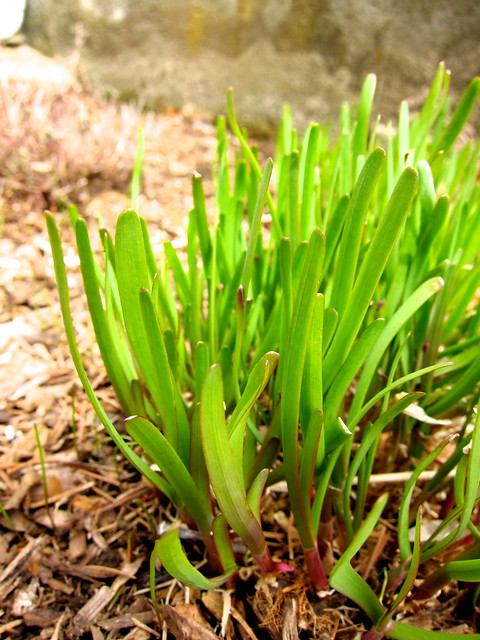
There’s not much in the garden yet, mostly alliums. Along with garlic chives (above), we’ve begun foraging chives and green Egyptian onion tops to add to our meals.

4.29.14 Peas and other garden sightings

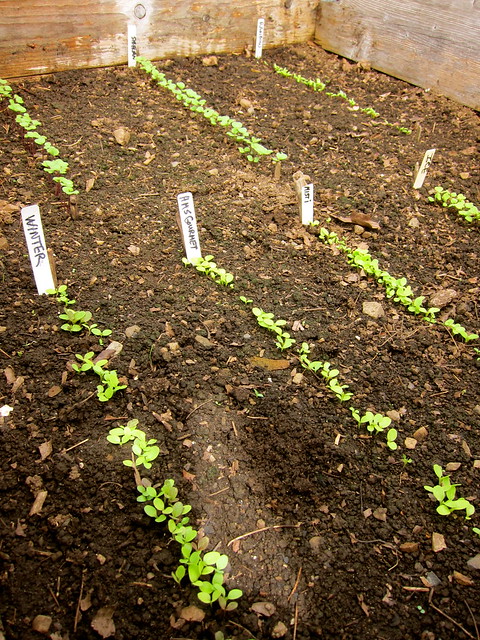
Overnight temperatures remain in the 40’s, and covering the raised beds warms the soil enough to give the salad greens, chard and kale (above) a boost. Until these are ready to eat, we rely on local farmers’ markets, which begin a new season this week.

4.29.14 Peas and other garden sightings

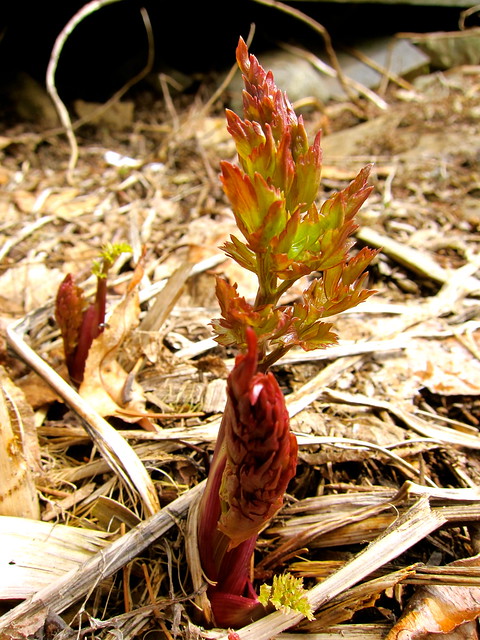
Cleaning out the herb bed gives us a chance to check on what has made it through the winter. The lovage (above) has pushed it’s way through, like a tiny flame from sleeping embers, and is a welcome sight.

4.29.14 Peas and other garden sightings

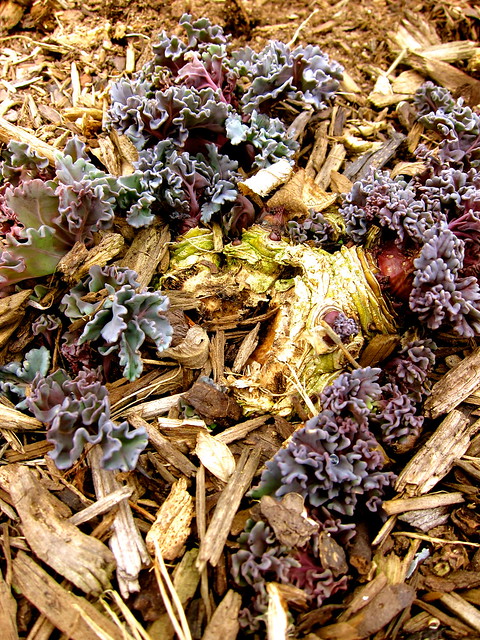
The sea kale is another edible perennial now emerging. We’re keeping a close watch on it this year in hopes of catching this gnarly looking mass at a more palatable stage.

Posted in garden | Tagged , , , , , , , , | 12 Comments

Spekkoek — Thousand Layer Spice Cake

Spekkoek — Thousand Layer Spice Cake

My mother used to make something we would call 10-Egg Cake, a name based on the number of eggs baked into it. Spekkoek, or Thousand Layer Spice Cake, is a similarly egg-laden concoction. Though the name is more poetic than actual, it’s composed of multiple layers, almost crepe-like in consistency, and subtly flavored with a blend of fragrant ground spices. The striated appearance of this Dutch-Indonesian specialty is formed layer by layer through the unusual method of baking each one under a broiler before adding the next.

Spekkoek — Thousand Layer Spice Cake

Requiring almost a whole dozen eggs, this is a celebratory sort of cake. Though Spekkoek is culturally most often associated with such holidays as New Years, Christmas or Ramadan, it seems perfect for welcoming spring with given the abundance of farm-fresh eggs that mark the commencement of the season.

Spekkoek — Thousand Layer Spice Cake

The eggs are separated and the whites beaten into fluffy peaks, then folded into a mixture of egg yolks, butter, sugar, and a minimal amount of flour. Though the number of eggs could be reduced, we like the custardy, moistness from using the full amount.

Spekkoek — Thousand Layer Spice Cake

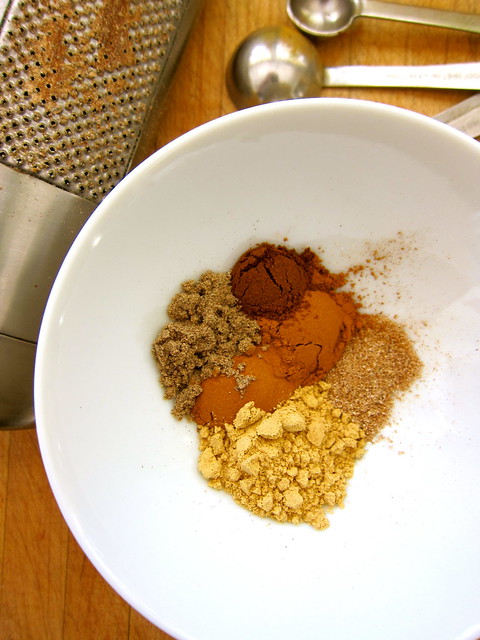
A mixture of ground cinnamon, ginger, nutmeg, cardamom and cloves is folded into half the batter for a contrasting hue. As the flavor is utterly dependent on the freshness of your spices, this may be a good time to update your supply. Given the small amount of flour called for, we imagine this cake would take readily to the many gluten-free substitutes now available.

Spekkoek — Thousand Layer Spice Cake

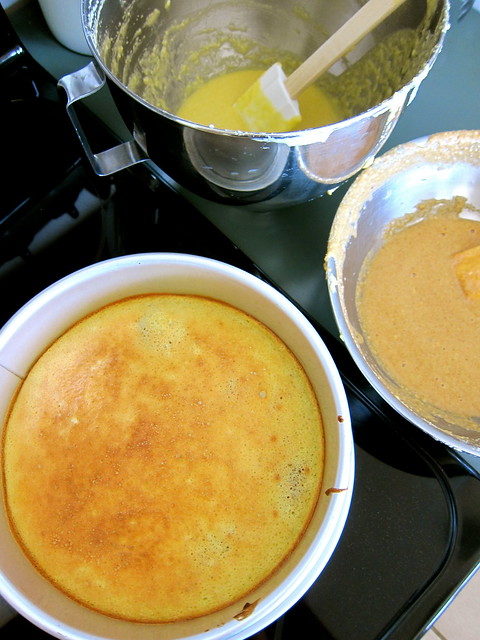
Alternating between spice and egg batters, a thin layer is poured one at a time into a cake pan, then placed under the broiler to set before adding the next. To help keep track of cooking time, setting a timer for 2 minutes per layer eases the process, which can take from 45 minutes up to an hour, depending on one’s patience and agility. As the layers cooked, we noticed a few bubbles forming; for more even-looking stripes, they may be poked and deflated before moving onto the next layer.

Spekkoek — Thousand Layer Spice Cake
Instead of a 9 inch pan, we used an 8-inch one for a taller version. While 12 layers is the mark of a well-made cake, it may be a matter of practice but the batter seems to allow for only 8 layers. The richness of this cake calls for it to be sliced thinly, and is especially amenable to being served alongside a strong cup of coffee, regardless of the time of day.

Spekkoek — Thousand Layer Spice Cake

10 large eggs, separated
1 pinch salt
½ pound butter, softened
1 cup | 7 ounces sugar

1 cup | 4.25 ounces all-purpose flour, sifted
2 teaspoons ground cinnamon
1 teaspoon ground ginger
½ teaspoon ground nutmeg
½ teaspoon ground cardamom
¼ teaspoon ground cloves
2 tablespoons confectioners’ sugar

– Using an electric mixer, beat the egg whites with a pinch of salt until stiff peaks form. Transfer the beaten egg whites to a clean bowl and set aside. Next, cream the butter and sugar together with the electric mixer until light and fluffy. Beat in the egg yolks one at a time until smooth, then gently fold the flour into the egg yolk mix.
– Add 1/3 of the beaten egg whites into the egg yolk mix, and gently fold together. Continue adding and folding in the remaining egg whites, one third at a time. Divide the batter between two bowls. Combine the spices, then add to one of the bowls; fold the spices into the batter until well-mixed.
– Line the bottom of a buttered 9″ round cake pan (or springform pan) with parchment paper. Pour about 1/2 cup of the spice batter into the pan, spreading to form a thin layer. Place pan under a preheated broiler until the layer is firm and very lightly browned, about 2 minutes. Spread 1/2 cup of the plain batter over the top and broil until firm. Repeat layering and broiling until all the batter is used, approximately 8 layers total.
– Let the cake cool, then remove from pan. Sprinkle top with confectioners’ sugar. Serve in thin slices. May be kept covered in an air-tight container or in the fridge for a week, or wrapped in foil and frozen.

Adapted from Food.com. Submitted to Weekend Herb Blogging, hosted this week by Simona at BricioleThough technically Spekkoek doesn’t contain herbs, which refers to the leafy parts of plants, they’re often grouped with spices, which are the roots, bark and seeds.

Local ingredients: Eggs from Brandmoore Farm; and organic cultured butter from Casco Bay Butter Co.

Posted in cooking | Tagged , , , | 28 Comments

4.21.14 Cultivated Shiitake Mushrooms + Ramps

4.21.14 Cultivated Shiitake Mushrooms + Ramps

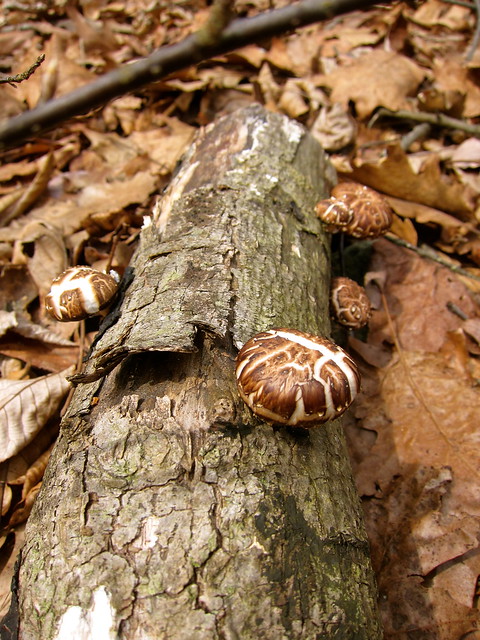
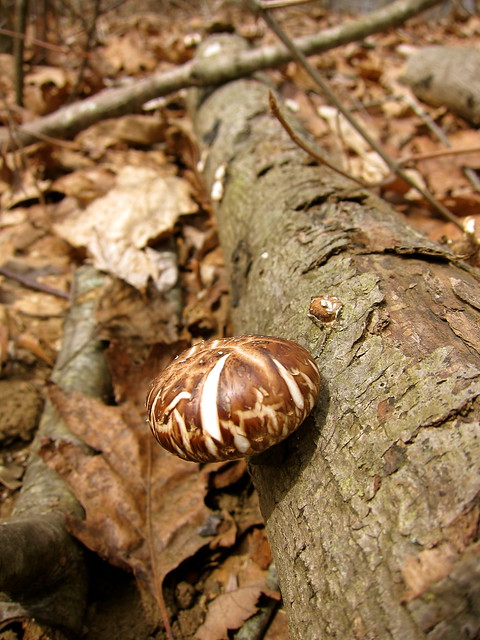
As soon as last week’s snow melted, we poked around the garden and came across one of the shiitake logs fruiting. We’d long given up on them, but they’ve proven tenacious.

4.21.14 Cultivated Shiitake Mushrooms + Ramps

Two logs were inoculated in 2010 and left in wooded part of our garden. They usually last 1 to 2 years, and up to four years if unsoaked.

4.21.14 Cultivated Shiitake Mushrooms + Ramps

A tiny patch of ramps have also reappeared — still not enough to harvest, though encouraging just the same. We buy ramps sold with their roots attached to use as planting stock, and will be on the lookout for more to add to the garden.

Posted in garden | 5 Comments

4.14.14 Sprouting Garlic + Planting Peas and Favas

4.14.14 Sprouting and Seeding: Garlic, Peas + Favas

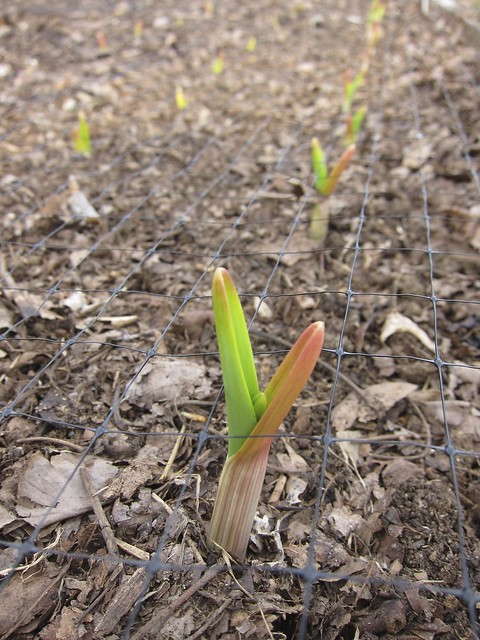
The last clove of Music garlic, sprouting, an intimation of what’s happening in the garden.

4.14.14 Sprouting and Seeding: Garlic, Peas + Favas

When we poked through the garlic bed, we found the ground still frozen. The top mulch was removed to give it a chance to thaw, and we found the garlic well on its way. With near freezing overnight temps expected in the week ahead, the garlic will get another protective covering of mulch. Above: Music garlic sprouting.

4.14.14 Sprouting and Seeding: Garlic, Peas + Favas

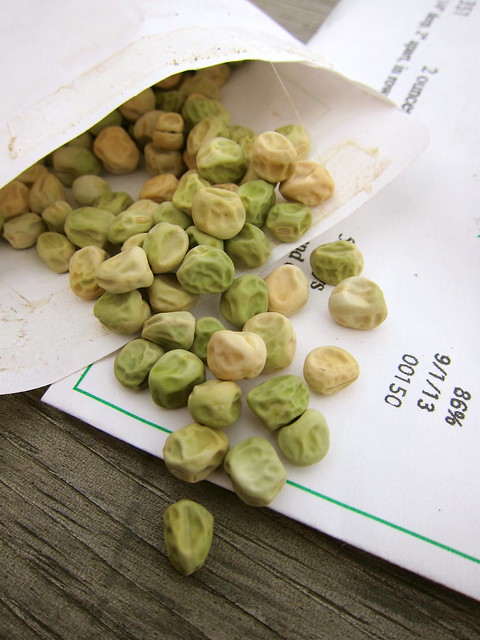
According to biodynamic methods, the second quarter phase of the moon is an ideal time to plant above ground crops such as peas. It also coincides with our removing the snow stakes from the driveway. Above: Green Arrow shell peas.

4.14.14 Sprouting and Seeding: Garlic, Peas + Favas

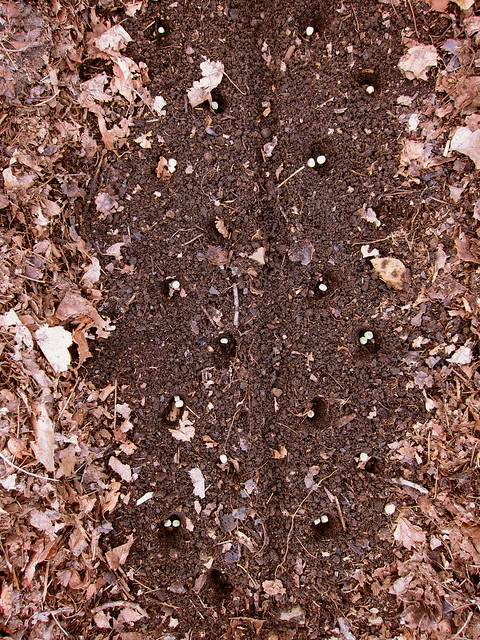
In the ground they go, the first planting of the season. Alongside the Green Arrow, we’ve also planted Coral shell peas, an early pea that we’re trying out this year and is meant to be harvestable before the 4th of July.

4.14.14 Sprouting and Seeding: Garlic, Peas + Favas

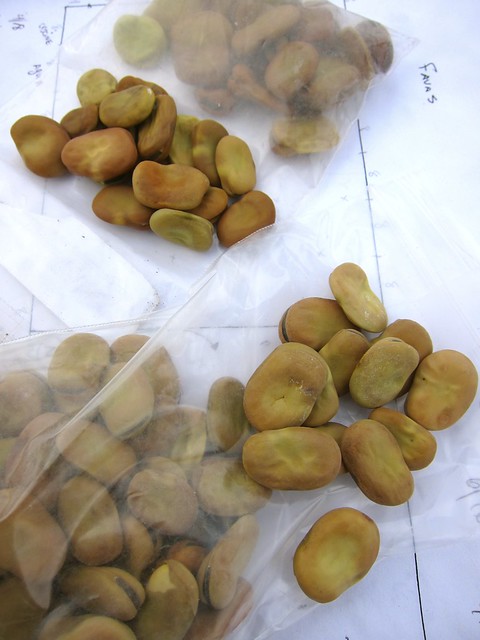
Above: Cascine and Superaquadulce favas. Like peas, we never seem to have enough, and we’ve been incrementally increasing their allotment of space in the garden.

Posted in garden | Tagged , , | 9 Comments

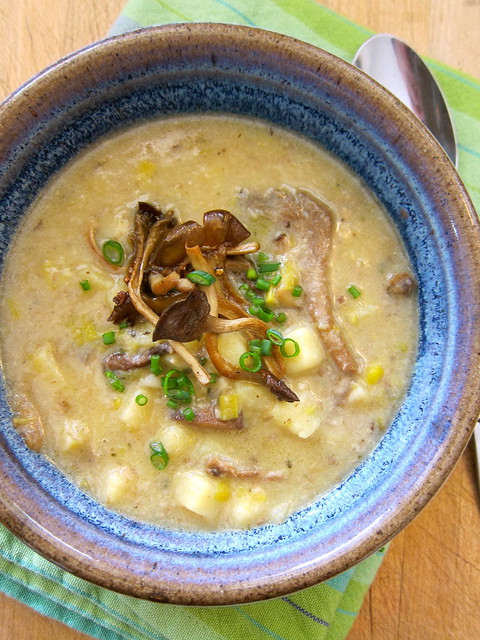
Roasted Mushroom Soup with Potatoes and Leeks

Roasted Mushroom Soup with Potatoes and Leeks

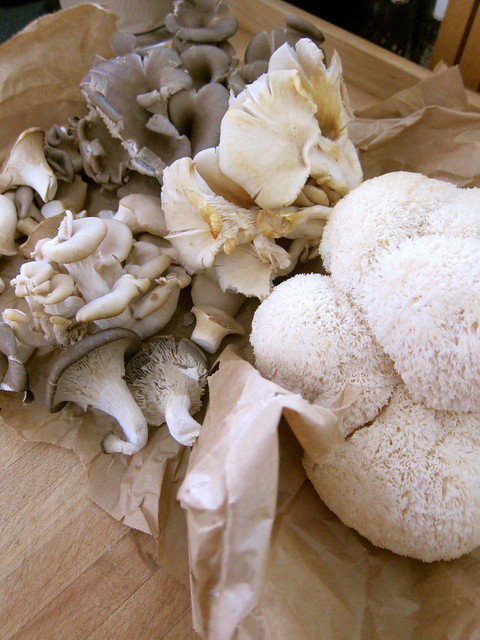
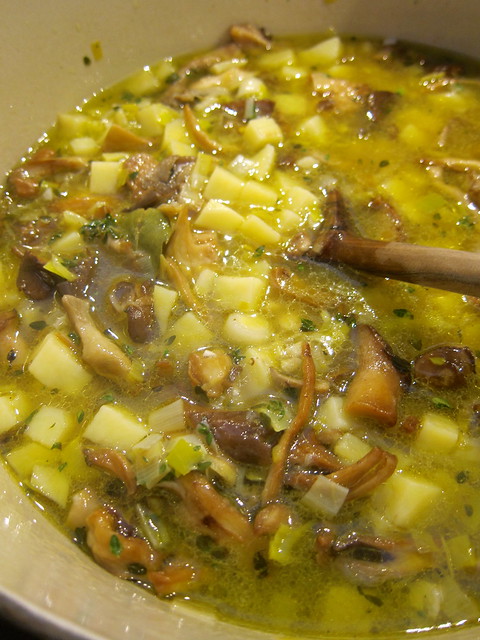
The thing we like best about soup is how well it takes to improvising, and a recent visit to the farmers’ market had us imagining a rustic mushroom soup, almost chowder-like, with chunks of potatoes and curly leeks rounding things out. The appearance of a new vendor, the New Hampshire Mushroom Company, and the wide selection of mushrooms they brought provided the inspiration, and we couldn’t resist buying up a sampling of several of their different varieties on display.

Roasted Mushroom Soup with Potatoes and Leeks

Above: Oyster, Blue Oyster, Elm Oyster, King Oyster, and Bears Head (or Lion’s Mane) mushrooms. We’ve grown shiitake mushrooms in the past, but weren’t able to produce enough to satisfy our needs, and are thrilled to see New Hampshire Mushroom Company filling in the gap in local supply. Specializing in both cultivated and foraged varieties, their mushrooms are frequently featured on the menus of Seacoast restaurants, and can be found at Golden Harvest and Rising Tide Natural Foods in Kittery, or Philbrick’s Fresh Market in Portsmouth. Of note, their Tamworth, NH, facility is open to the public every Sunday, with tours on the half hour from 12 to 3:30 pm.

Roasted Mushroom Soup with Potatoes and Leeks

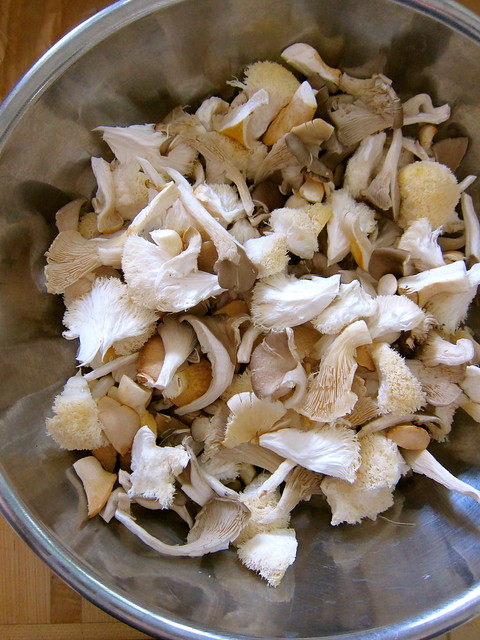
To start off, we tore the mushrooms into large but still bite-sized pieces — NH Mushroom recommends no smaller than 1/2″ thick — and keeping in mind they will shrink by half. If need be, anything still too large after roasting can be torn into smaller pieces later.

Roasted Mushroom Soup with Potatoes and Leeks

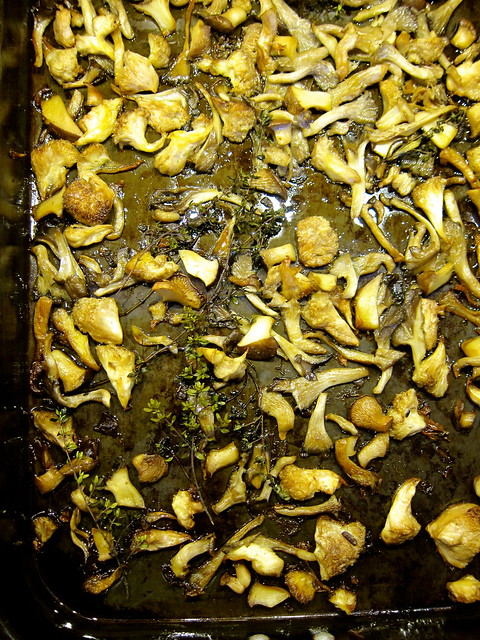
Once the mushrooms are roasted, nibbling is hard to resist. This medley gave us a chance to taste the different varieties, each with its own delicate notes of earth and forest air. We were glad to be able to use thyme from the awakening garden, just be sure to pull out the twiggy sprigs before adding the mushrooms to the soup. The roasted mushrooms were scooped out and put aside, and the pan deglazed with stock to pick up the caramelized bits. Seriously, though, we could stop here and be perfectly happy eating the mushrooms straight from the pan, on a toasted piece of crusty bread, or even topping a salad.

Roasted Mushroom Soup with Potatoes and Leeks

After the soup is combined and left to simmer until its contents have just reached the point of tenderness, you can decide to puree or not. We like a soup with a robust texture, and blend a cup or two to thicken the rest. To finish, we had just enough crema leftover to add a hint of creaminess, a dollop of creme fraiche or mascarpone, or even thick yogurt would also do; either way, this is entirely optional if you want to keep it vegan. In adjusting the seasonings, it may need a freshening shot of fortified liquor, or a splash of lemon to balance the richness. If you have the time and patience, you will be rewarded by letting the soup sit overnight, and garnishing with foraged chives adds an extra touch of spring.

Roasted Mushroom Soup with Potatoes and Leeks

1½ pounds mushrooms, torn or cut into pieces
1 tablespoon chopped fresh thyme
Good olive oil
6 cups chicken or vegetable broth
2 to 3 leeks, or an onion, chopped
3 garlic cloves, minced
2 to 3 potatoes, peeled and diced
½ cup Madeira, Marsala, or dry sherry
Creme Fraiche or Mascarpone, to taste
Lemon juice, to taste
Minced chives for garnish

– Heat oven to 400°F. Toss mushrooms with the thyme and enough olive oil to lightly coat. Season with salt and pepper, place in a large roasting pan, and roast for around 20 to 30 minutes, stirring midway, until the mushrooms begin to brown. Turn off the oven, remove the mushrooms to a separate bowl and set aside. Pour the stock into the roasting pan, scraping up the bits, and place back in the oven to deglaze in the residual heat.
– Take a heavy soup pot and add enough olive oil to slick the bottom. Saute the leeks or onions until soft, add the garlic, and continue cooking until fragrant but not browned. Stir in the potatoes, then deglaze with the Madeira. Add the stock and reserved mushrooms, and simmer for about 15 to 20 minutes, until the potatoes are just cooked.
– To finish the soup, adjust the seasonings with extra Madeira and a spritz of lemon juice. If desired, blend 1 to 2 cups for a thicker consistency, or add more stock for a thinner one.

Local ingredients: Mix of mushrooms from New Hampshire Mushroom Company; Yukon Gold potatoes from Riverside Farm; leeks from Two Farmers Farm; crema from Wolf Meadow Farm; homemade chicken broth; garlic, thyme and chives from the garden.

Posted in cooking | Tagged , , , , , | 14 Comments

4.7.14 Growing Duborskian Upland Rice in Maine

3.31.14 Duborskian Upland Rice

“Whether grown with Western machinery or Eastern backbone, rice is not the easiest grain to produce. It prefers a long growing season and warm humid weather. It is grown profitably in our country only in the Southwest, mostly in Arkansas, Louisiana, Texas, and California. However, rice could probably be grown farther north, at least for home use. The Japanese have learned how to grow it successfully as far north as Hokkaido, which has a climate similar to our southern New England.”
— Gene Logsdon, “Small-Scale Grain Raising”

We’d heard rumor that rice was being grown successfully in New England, and went on alert when we spotted it on the menu at T.J. Buckley’s while passing through Brattleboro a few years back. After a sumptuous dinner skillfully prepared from local ingredients, we had the chance to speak with chef-owner Michael Fuller. He told us that the rice was from Akaogi Farm, and that if we were still in town, we’d be able to find them at the Brattleboro Farmers’ Market. It was our chance meeting there with Linda Akaogi that launched our interest in growing this semi-aquatic annual ourselves.

3.31.14 Duborskian Upland Rice

Following Logsdon’s observation on growing rice in northern climes, the Akaogi’s began experimenting with a short-grain rice from Hokkaido. To accommodate this grain’s need for water, they built up a model system of paddies that’s the focus of a series of annual conferences held there.  As a way of duplicating this condition at home, we planned to grow rice in buckets. After some research, however, we read about Roberta Bailey’s experience with growing Duborskian Rice (Oryza sativa) in Maine, and how this upland variety offered a more manageable approach than paddy rice in that it doesn’t require flooding in order to grow. Even more compelling, the resulting grains were being offered through Fedco Seeds, which would ensure a head start on adapting to local conditions.
3.31.14 Duborskian Upland Rice

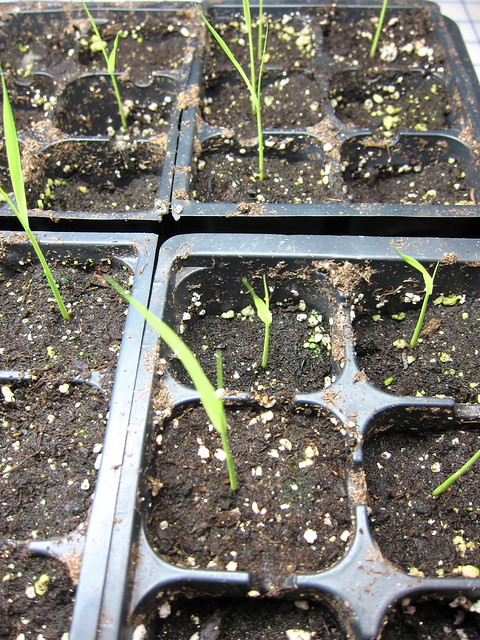
Mid-May (above): Seedlings started indoors under lights, and beginning to form first leaves. Rice can be direct seeded, especially in warmer climes, or transplanted. Our first year’s batch failed soon after transplanting, and we learned to plant only one seed per plug to lessen the shock. Though we didn’t pretreat, it’s recommended that they be soaked for 12 to 24 hours before planting, and started 4 to 5 weeks before transplanting into warm soil, which, here in Maine, isn’t until early June. According to Sara Pitzer in Home Grown Whole Grains, rice needs at least 40 continuous days with temperatures above 70°F, a challenge in our short season.
3.31.14 Duborskian Upland Rice

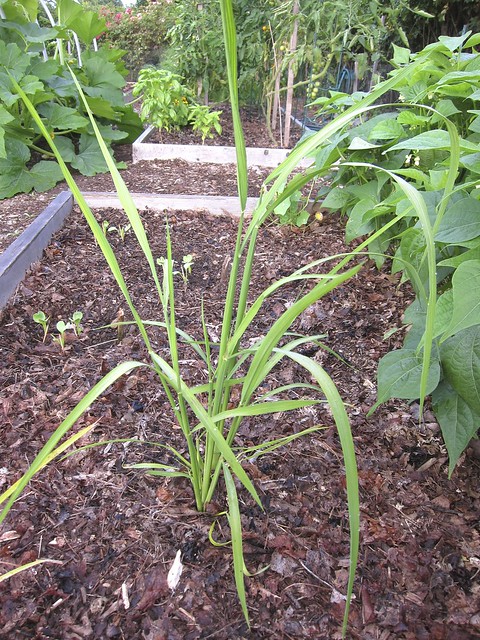
Mid-August (above): With a little experience, our second attempt last year brought us better luck. Out of the 9 seedlings transplanted, 3 survived, and two of them long enough  to set multiple stems called tillers, each destined to produce a seed head, or panicle. Though Duborskian is referred to as a dry-land rice, it still needs constant moisture and plenty of it, which we helped along with a thick layer of mulch.
3.31.14 Duborskian Upland Rice

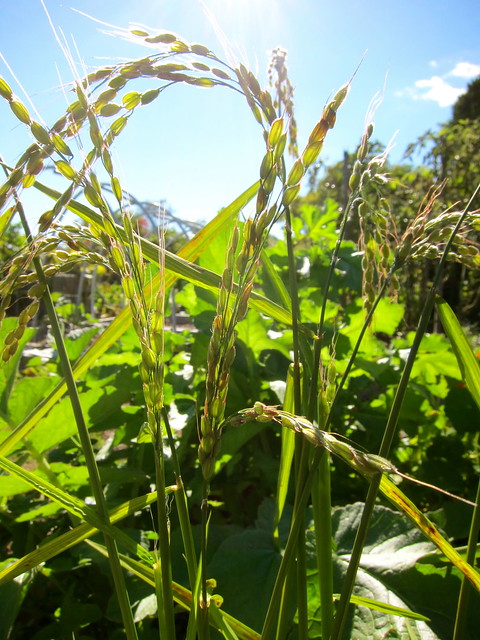
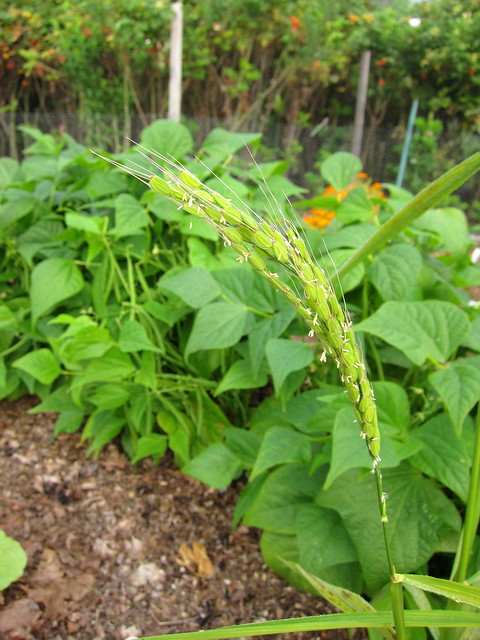
End of August (above): The panicle towards the end of flowering, with some stamens still attached. As the rice plant flowers and sets seed, this is especially the time to ensure the plant has enough moisture to keep its energy up.
3.31.14 Duborskian Upland Rice

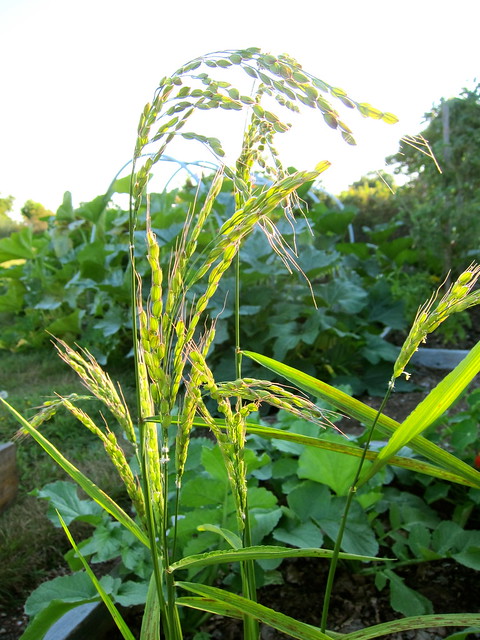
Early September (above): Though it may have been little more than watching grass grow, we are ridiculously excited to finally have something recognizable as rice. Seeing these seed heads nodding as they mature made the entire effort worthwhile.
3.31.14 Duborskian Upland Rice

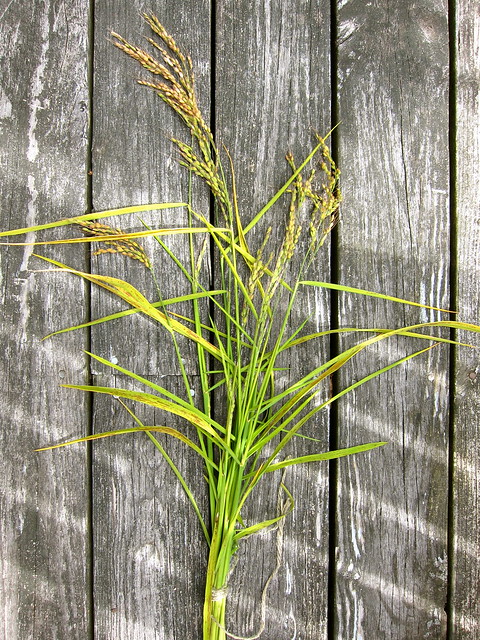
Early October (above): By the first week of October, we harvested the rice by clipping the tillers and hung them to finish drying. On further reading, we found that rice is ready to harvest when the seed heads look brownish gold and look heavy. These probably should have been left longer before harvesting, and, though they can tolerate a light frost, we’d didn’t want to run the risk of having them rot on the plant.
4.7.14 Duborskian Upland Rice

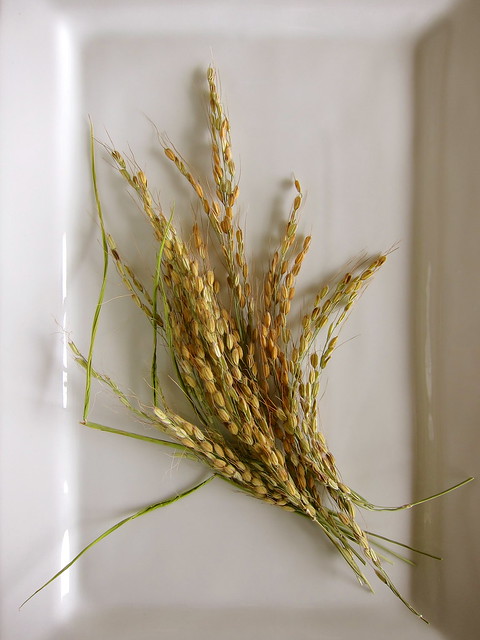
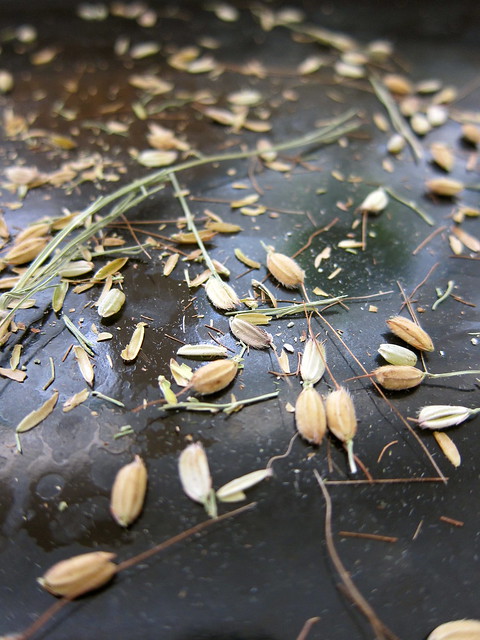
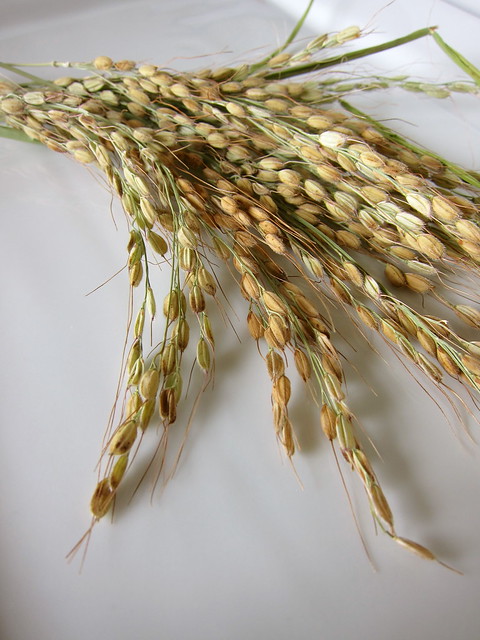
Upland rice may not be as productive as paddy varieties, each plant can average up to as much as 18 tillers each, and our two rice plants produced over a dozen tillers total. After drying, the grains are separated out, usually through threshing and winnowing to produce what is known as rough rice. At this point, the rice is still encased in a hull, and can be saved as seed for 10 years.
4.7.14 Duborskian Upland Rice

Next to growing it in the first place, the biggest obstacle to home growers is extricating the rice from its notably tough hull. Unless you have access to a mechanical huller, one of the traditional methods is to pound the grain with a mallett. We opted for a more domestic approach by baking the rice for 1 hour at 180°F, letting it cool, then rubbing the hulls off each individual grain.
4.7.14 Duborskian Upland Rice

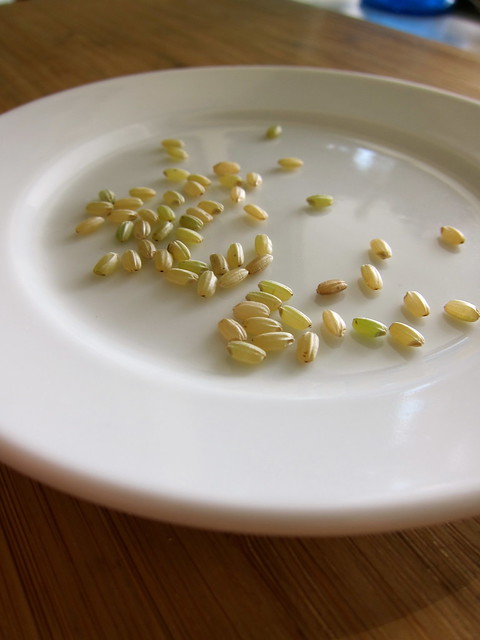
Hulling rice by hand is a painstaking process, for sure. One tiller produced about a half teaspoon’s worth of grain (above), and gives new meaning to the phrase “every grain of rice,” of which we’ll never think of quite the same again. It’s not enough to make a meal, however, it’s given us a more intimate understanding of what it may take to produce it locally. With last season’s success, we now leave growing it to our local farmers, such as our friends at Stout Oak Farm who have plans this coming season to grow out several varieties of rice, including Duborskian, as part of a regional effort to increase and expand the supply of available seed.
4.7.14 Duborskian Upland Rice

Resources
• Fedco Seeds: Duborskian Rice — Organic seed grown in Central Maine; 115 days from transplanting.
• Sherck’s Heirloom Vegetables, Plants & Seeds: Duborskian Rice — Seed from Northern Indiana, includes link on growing it out.
• Kitazawa Seed Co.: Koshihikari Rice — May be also grown as an ornamental; 128 days.
• Ecological Rice Farming in the Northeastern USA, Cornell — Collaboration between Akaogi Farm and Cornell to support small-scale rice growing in the Northeast; annual summer conference. 
Harvest Kitchen: Growing Rice in Central Maine, MOFGA — Roberta Bailey’s account of growing Duborskian rice from seed sourced from Seed Savers Exchange.
• Homegrown Whole Grains by Sara Pitzer — Accessible information on growing rice and other grains for the home gardener, plus instructions for growing rice in a bucket.
• Small-Scale Grain Raising by Gene Logsdon — More in-depth information on growing rice and other “pancake” grains for the small-scale grower.

Posted in garden | Tagged , , | 10 Comments