12.17.12 Snow, dried beans, and chicory

12.17.12 Snow, dried beans, and chicory

“It was evening all afternoon.
It was snowing

And it was going to snow.”

— Wallace Stevens, “Thirteen Ways of Looking at a Blackbird”

12.17.12 Snow, dried beans, and chicory

The garden snug under its covers and an extra blanket of newly fallen snow.

12.17.12 Snow, dried beans, and chicory

Indoors, we take this quiet moment to shell beans and think of what we’ll plant next season. 

12.17.12 Snow, dried beans, and chicory

While in the background, the pressure cooker makes a constant, gentle knocking sound, as we replenish our stores of canned beans.

12.17.12 Snow, dried beans, and chicory

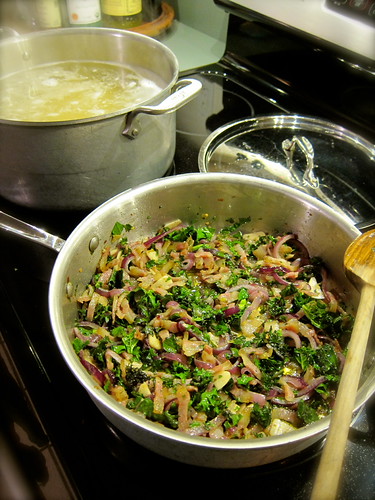
The shelled Dragon Langerie beans are cooked long and slow, until they dissolve into a soft puree. A mix of Brindisina and Galatina chicory, harvested before the snow, will accompany the beans.

12.17.12 Snow, dried beans, and chicory

Their long stalks are cut down into hand-sized lengths, and left to soak in water to draw out some of the bitterness.

12.17.12 Snow, dried beans, and chicory

A simmer in a bath of salted water tempers their bite, turning them tender. Paired with the earthy bean puree and generously dressed in some peppery olive oil and local sea salt, we made a homegrown version of Fave e Cicoria, just what the day needs.

Posted in garden, preserving | Tagged , , , , , | 20 Comments

Savory Sausage and Kale Tart

Savory Sausage and Kale Tart

It’s hard to follow a recipe exactly. I once did a stint testing recipes as it sounded like fun, I wanted exposure to a new range of recipes, and, mostly, I was curious to see if they would work using local ingredients. What I discovered was that testing recipes requires the ability to follow directions, a greater challenge than I’d first realized. This Savory Sausage and Kale Tart is a case in point, serving to remind me how difficult it is to write a recipe in the first place. Here’s a sampling of the many decisions made along the way in following another’s recipe.

IMG_2704

Depending on the season, most of what we cook begins with what’s in the garden. The mild weather this December has left us with an abundance of fresh kale, and while searching for a new recipe to use it in, I came upon one for Sausage and Kale Dinner Tart. A quick scan of the ingredient list showed that I had most everything already on hand, and what I didn’t could be easily substituted. This is where I’d usually start to veer wrong. Precision is a requirement in testing recipes, and prohibits much swapping of ingredients, a necessity when cooking locally.

IMG_2700

Starting with the tart dough: The recipe calls for a 1½ cups of all-purpose flour. Whenever possible, I replace some of the white flour with about a quarter to a third locally-grown whole wheat flour. The amount of water then needs to be adjusted to compensate for how much more the whole wheat flour absorbs. The original recipe further directs wrapping the dough in plastic wrap to let it rest; to avoid using plastic, I just place the dough in a covered container before putting it in the fridge.

IMG_2713

In blind-baking the tart shell, if the dough sticks to the parchment when lifted, I give it another 5 minutes before removing the parchment and weights. Recipes often forget to mention this tip: Make sure to press the dough into the pan and avoid stretching it to fit, or it will shrink during baking and leave you with a smaller tart shell than what the recipe calls for.

IMG_2708

On to the tart filling: I used red onions instead of yellow; they lent sweetness and color to the finished tart. For the cheese, I used feta and thought it would go well with the kale and sausage. Basil’s out of season, and some chopped marjoram took its place; thyme or oregano are also good choices. I neglected to dry the kale after washing it, which resulted in more liquid in the pan than could be cooked off. To avoid the tart from becoming soggy, I left most of the pan juices behind. Another tip: Remember to remove the casing before browning the sausage.

IMG_2728

To go with the suggested accompanying salad, I roasted up a Delicata squash. The slices looked a little anemic, and were further browned under the broiler. The Delicata ended up nicely caramelized and was delicious with the tart. However, by the looks of it, we were lucky the parchment didn’t catch on fire. Note to self: Remove the parchment before broiling.

IMG_2733

In the end, cooking is much like driving a car, calling for constant adjustments to the actual conditions encountered along the way. This satisfyingly flavorful tart was forgiving of my substitutions, including doubling the amount of sausage only because it was what the package held, and adding another egg to help bind the extra sausage. The next time, I’d try using lard instead of butter in the crust, or brush the shell with some garlic-infused olive oil. Some other variations to consider: add a diced apple or red bell pepper to the filling; flavor it with nutmeg or lemon zest; some cubed potato or winter squash in place of the sausage; a small handful of toasted pine nuts wouldn’t be out of place and make it your own.

Savory Sausage and Kale Tart

Tart Shell:
1 1/2 cup all purpose flour (1 cup all-purpose + 1/2 cup whole wheat)
1/2 cup unsalted butter, chilled (cultured if available, or lard)
1 pinch salt
3–4 tablespoons ice water (4–5 tablespoons if using whole wheat flour)

– Cut the butter into small cubes. Combine butter and flour in the bowl of a food processor, pulse until butter is pea-sized. Slowly drizzle water through the top of the food processor while pulsing. Enough water is added when dough sticks together when pressed. Remove dough from processor and shape gently into a disc. Place disc in covered food container and chill for at least 30 minutes.

– Remove dough from refrigerator, and place disc on a lightly floured board. Roll dough into a circle 12 inches in diameter. Place dough in 10 inch tart pan with removable bottom. Dock dough with a fork. Let dough rest another 30 minutes in the refrigerator.

– Heat oven to 400°F. Lay parchment paper or foil over dough and fill with beans or pie weights. Blind bake the tart shell (with pie weights) for 20 to 25 minutes. Then remove parchment and weights and bake an additional 5 minutes until the crust begins to brown. Remove from oven and set aside on cooling rack.

Sausage and Kale Filling:
2 tablespoon olive oil
2 cups red onion, minced
2 garlic cloves, minced
1 pound Italian sausage
1 large bunch kale, stemmed and roughly chopped
1/4 cup white wine
Herbs (thyme, marjoram, or oregano), to taste
2 eggs
½ cup feta, crumbled
Salt and pepper

– Heat oil in pan on medium heat. Add onion and garlic and reduce heat to medium-low. Cook until onions are soft and light brown. Season with salt and pepper. Remove onions from pan and set aside. Increase heat to medium and add sausage to pan. Brown sausage and break into small pieces. Remove sausage from pan and set aside. Drain all but 1 tablespoon of oil from pan.

– Add kale with a splash of cider vinegar to pan. Scrape any bits from the pan and cover. Cook 3-5 minutes, until kale is wilted. Season with salt and pepper. If kale is still very wet, cook uncovered for a minute or two. The overall mixture should be fairly dry. Remove kale to a large bowl. Toss cooked kale with cooked sausage and onions. Allow to cool for 5 minutes. Toss mixture with herbs, eggs, and feta. Season with salt and pepper.

– Spoon sausage and kale mixture into cooked tart shell. Be sure to evenly cover the bottom of the tart shell. Bake the tart on a baking tray for 10-15 minutes at 400 degrees. Remove tart from oven when the filling is set and the tart shell is nicely brown. Cool tart slightly on a wire rack before slicing and serving.

Adapted from My Pantry Shelf, via Food52.

Local ingredients: Butter, feta and whole wheat pastry flour from Brookford Farm; hot Italian sausage and eggs from Meadow’s Mirth; red onion from Wake Robin Farm; kale, garlic and marjoram from the garden.

Posted in cooking | Tagged , , | 5 Comments

Local Hero: Russell Libby

Russell Libby

“We have to challenge the idea that contamination is just the price of living in the modern world. Our bodies don’t have systems to process plastics or flame retardants or pesticides. If contamination is the price of modern society, modern society has failed us.”

Russell Wayne Libby
August 16, 1956 – December 9, 2012

One could not be involved in local food and agriculture in the state of Maine without knowing who Russell Libby was. Through his good work at Maine Organic Farmers and Gardeners Association — which under his leadership became the country’s largest state-level organic association — and countless other organizations as well, his influence stretched from one end of the state to the other, and beyond. We count Russell Libby among our personal heroes, and the news of his passing greatly saddened us, knowing that we’ll no longer have his wise voice weighing in as we face the challenges of building a sustainable and just food system. He gave credence to the saying that one person can make a difference, and serves as an inspiration to do the same.

“When I imagine the future for Maine, the place I am lucky to call home, it’s a mixture of all the best things I’ve seen – and what we also know to be possible: Farmers in their fields, checking on newborn calves. Orchards in full bloom. Alewive runs up streams where they haven’t been seen in generations. Fishing fleets returning safely to harbors all along the coast. Foods of the season in every store and restaurant because it’s what’s available, and these are the foods wanted and expected by all.

This is the food system we can have.”

A sampling of Russell Libby’s vision and range:
Putting the Pieces Together — Our Next Food System
Beyond the Roadrunner Economy
1212 Farmer to Farmer Conference, Keynote Address
New Food Safety Practices: What do they mean for your farm?

Posted in interlude | 6 Comments

12.10.12 Season extension greens, composting

12.10.12 Season extension greens, composting

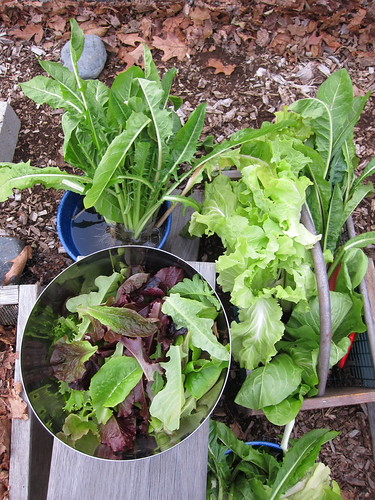
The greens under cover are holding on — this week’s harvest includes puntarelle, fun jen, pan di zucchero chicory, and salad greens.

12.10.12 Season extension greens, composting

A few of the puntarelle were left in the ground to see how long they’ll survive the cold. We’re also joining Amber in her experiments with forcing them. A couple of the puntarelle with their roots attached were plunked into a bucket of water, and are now residing in the garage. We hope to have some pods form after a couple of weeks. 

12.10.12 Season extension greens, composting

One of our winter garden chores is tending to the compost bins, the contents of which gets turned twice a year. Kitchen and garden scraps go into the working bin, and then transferred progressively into the next of two bins.

12.10.12 Season extension greens, composting

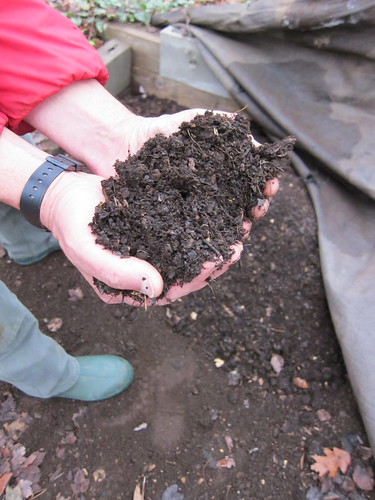
Above, the compost in the working bin is being moved to the next bin, and is full of earthworm activity breaking plant matter down.

12.10.12 Season extension greens, composting

After a year, the composting process is complete. The rich results are ready for the next planting season.

Posted in garden | Tagged , , , , | 16 Comments

Spaghetti with Guanciale and Kale

IMG_2544
This riff on Spaghetti alla Gricia sprang from seasonal necessity. This seemingly spartan yet voluptuous pasta dish from Rome is a reliable standard in our house. We usually finish it with a garnish of parsley but have yet to set up any indoor herbs, and it was just too dark and cold to go foraging in the garden. Thinking on what was in the fridge that could substitute, we remembered the bin of chard and kale we harvested earlier.

IMG_2535

Spaghetti alla Gricia is also known as Amatriciana in Bianco, a “white” version of another traditional Roman pasta, with the tomatoes omitted. In her authoritative book, The Food of Rome and Lazio, Oretta Zanini de Vita’s recipe for Spaghetti alla Gricia lists garlic among its ingredients. However, whether to include garlic and/or onions is a matter of dispute. Purists feel these ingredients mask the delicate flavor of the guanciale, which, along with the peperoncino, or hot chili pepper, and Pecorino cheese make up its essential components. Here, we’ve strayed by adding kale, and the garlic and onions turn this dish into something hardier. We like to believe that by using what’s at hand, we’ve at least kept to the spirit of Italian cuisine.

IMG_2537

As for the guanciale — also known as cured pork jowl or cheek (la guancia) — it’s a favored form of cooking fat of the region around Rome. Its particular flavor comes from the herbs found in that area, infused through the animal’s diet and in the curing. Pancetta or bacon may be used it its place, the less smoky the better. For a more aromatic flavor, sauté the pancetta or bacon with a few juniper berries, removing the berries once the fat is rendered. Or, better yet, make it yourself.

IMG_2543

We think of this pasta bianca as midnight pasta, for after an imagined evening out carousing with friends and when over-indulgence calls for something settling. It can be made up quickly from pantry staples, and Popper’s Artisanal Meats provides us with guanciale made in-house and from locally-grown sources. If you’re lucky enough to have access to guanciale, this dish is the perfect showcase for it, imbuing it with a sweetly herbaceous porky flavor. The kale adds a mineral-rich counterpoint to the unctuousness of the dish, and we used a mix of Red Russian and Siberian. The idea of using Lacinato, an Italian variety, is particularly appealing, and ensures we’ll be adding kale to Spaghetti alla Gricia again soon.

Spaghetti with Guanciale and Kale

1/4 cup extra-virgin olive oil
8 ounces guanciale (or pancetta or bacon), cut into strips
1/2 teaspoon red pepper flakes
1 red onion, cut into 1/4-inch half-moons
3 cloves of garlic, thinly sliced
2 cups chopped kale
1 pound spaghetti
Grated Pecorino cheese
Sea salt and freshly ground black pepper

– Heat the oil in a large frying pan, add the guanciale and red pepper flakes, and sauté until the guanciale begins to crisp. Stir in the onions and garlic, and continue sautéing until tender. Add the kale and cook briefly, until wilted. Remove pan from heat.

– Boil spaghetti in salted water until al dente. Add the drained pasta to the frying pan, and toss together, sautéing over medium heat for about a minute. Turn off the heat and stir in a handful of grated Pecorino cheese to finish. Serve at table with more Percorino on the side.

Local ingredients: Guanciale from Popper’s Artisanal Meats; red onion from Wake Robin Farm; garlic and kale from the garden.

Posted in cooking | Tagged , , | 5 Comments

12.3.12 Early December Harvest: Celeriac, leeks, carrots, and greens

IMG_2453
The garden trug sits by the back door, mostly unused as of late. With an inch of snowfall this past week-end, we considered bringing it in and retiring it for the season. Monday, though, brought a bounce in the weather, warm enough to get out in the garden, poke around, and see what’s survived thus far.

IMG_2510

Temperatures were in the high 50°F’s, bright and sunny. We opened all of the covers over the raised beds to air them out. Given how short the days are this time of year, being able to putter in the garden was an instant mood enhancer.

12.3.12 Celeriac, leeks, carrots, and greens

After the extra row cover was slipped off, the greens beds soaked up the sun and began to recover from the effects of the cold. Above: chicories, fun jen, kales, chard, arugula and salad greens.

IMG_2507

Last season’s chard and kale were left standing in the corner of their raised bed, their bare stalks looking like a Dr. Seuss drawing. It was time to pull them up in order to finish mulching the bed with seaweed.

IMG_2502

There’s really not much left to the old planting of chard and kale. They’d been left uncovered through the fall, and suffered from the exposure.

IMG_2496

Despite snow and freezing temperatures, though, they tenaciously continued to push out new growth.

IMG_2506

We salvaged what chard and kale we could, and were surprised how much it amounted to. There’s certainly enough here for a meal or two.

IMG_2492

We’re still learning how to use the fun jen, and harvested half the heads to cook this week. When we went to clean them, we found a fat caterpillar tucked down between the leaves. It was deposited in the kitchen scrap bowl, however, after we’d finished washing, we went to look and the caterpillar had disappeared. It moved surprisingly fast for something we thought half-dead, and we’re hoping it took refuge amongst the compost and not our kitchen cabinets. 

IMG_2512

The celeriac, a variety called Brilliant, are being stored in-ground, snugly covered with a blanket of leaf mulch and protected by hooped plastic.

IMG_2481

As we’re discovering, it’s difficult to harvest once things are covered with snow. We pulled some of the celeriac to store inside, and have on hand to cook with as needed.

IMG_2487

Same with the tatsoi and King Seig leeks — there’s still some left stored in-ground, while these are destined for the kitchen. 

IMG_2518

The Napoli carrots were the prima donnas of the harvest, timing their shot for the magical light that comes as the day wanes. We’d pulled up about half of them and, at this point, they’re as sweet as can be. The rest we left in-ground with the parsnips, as a test to see how they’ll over-winter.

Posted in garden | Tagged , , , , , , , | 20 Comments

Smoky Tomato and Bacon Chowder

IMG_2244

“All chowders were born of necessity. They were invented by humble working people, who made them with local, inexpensive ingredients from the sea or the land.”
— Jasper White, “50 Chowders”

Most think of clams or fish when it comes to chowder. For when the sea is distant, farmhouse chowders omit the seafood, and make use of what’s on hand and in season. Still falling within the bounds of a true chowder, it starts with a savory base of salt pork or bacon, onions, and potatoes. After that, it’s all a matter of where one’s imagination — or larder — takes you.

IMG_2240

In this case, Smoky Tomato and Bacon Chowder was the result. We’ve a basement full of winter tomatoes and, as we move deeper towards winter, managing them in storage is a matter of use them or lose them. To go with the tomatoes, we were imagining something warming for these cold nights, rich without the heaviness of cream, and thick with flavors deep enough to stand up to the season’s dark days.

IMG_2241

Adding flour after the vegetables are cooked resolves the problem of choosing milk over cream, and the risk of it breaking. Don’t worry if the flour looks pasty (middle photo) after being stirred into the vegetables. It will smooth out when the liquids are added, and also help to thicken the chowder. Think of this recipe as a base and customize it yourself; just make sure that whatever you’re adding is cut into similar size as the other ingredients, which allows for everything to cook evenly. At the last minute, we slipped in some leftover braised fennel and a handful of frozen corn, which added some sweetness while making extra room in the fridge.

Smoky Tomato and Bacon Chowder

4 to 6 bacon slices, diced
1 onion, diced
1 green pepper, diced
2 stalks of celery, including leaves, chopped
4 cups diced tomatoes, with their juices (or quart of canned tomatoes)
2 potatoes, peeled and diced
1/4 cup flour
2  cups stock
2 cups milk
1 bay leaf
Several pinches of smoked paprika, to taste
1 cup of grated cheddar
Spoonful of mustard

– Cook the diced bacon in a heavy soup pot over medium low heat, until enough fat has rendered to sauté the rest of the vegetables in. Stir in the diced onion and pepper, and cook until beginning to soften. Add the tomatoes, continue cooking until they begin to collapse. Next add the diced potatoes and stir to coat.

– Sprinkle the flour on top of the vegetables, and mix in. Don’t worry if it looks pasty (see middle photo above), the flour will keep the milk from breaking and help thicken the chowder. Once the flour is thoroughly incorporated, slowly pour in the stock then the milk, stirring all the while to prevent the liquid from becoming lumpy. Bring to a simmer, and let cook until the potatoes are tender. Stir in the grated cheddar, a spoonful of mustard, and season to taste. Garnish with something green such as minced parsley or scallions, and, if desired, a shot of hot sauce for piquancy. For extra luxury, a pat of butter  let to melt and slick the top of the chowder.

Local ingredients: Bacon from Meadow’s Mirth; onion from Black Kettle Farm; pepper from New Roots Farm; cheddar from Brookford Farm; milk from Harris Farm; tomatoes, potatoes, and cutting celery from the garden; homemade stock.

Posted in cooking, tomatoes / pomodorini | Tagged , , , , , | 7 Comments