5.6.13 Asparagus, Spring Onions and Chard

5.6.13 Asparagus, Spring Onions and Chard

Enough of the asparagus has finally made it’s way up to warrant harvesting. Along the way, we picked some of the over-wintered Fordhook chard, a handful of spring onions ( chives, walking onion, and garlic chives), and a couple of leaves of garden sorrel — dinner in the making.

Posted in garden | Tagged , , , | 6 Comments

Duck Confit with Ginger-Braised Red Cabbage, and Pan-Fried Potatoes

Duck Confit with Ginger-Braised Red Cabbage

Despite the hardy souls we see walking around in shorts (we mean you, Mr. UPS Man) and sandals, it’s still considered early spring here and evenings can be downright chilly. We find ourselves craving such warming foods as this duck confit, served up with a side of red cabbage braised with ginger and apples. Truth be told, though, this week-end meal was just an excuse to make a pile of potatoes pan-fried in duck fat.

We started with the red cabbage, and sautéed it with a chopped onion, a couple of apples, and some chunks of ginger. For a braising liquid, we used hard cider with a splash of tart cider vinegar and, for some balancing sweetness, apple molasses; maple syrup would serve just as well. We keep a stash of Popper’s duck confit on hand, and after searing it in a cast iron pan a crust formed, we set the legs aside and finished cooking the potatoes in the remaining duck fat. The secret to crunchy potatoes: Blanch the cut pieces briefly in unsalted water, drain until dry, and, if possible, let them cool down before finishing frying; the sugars and starches drawn to the surface through par-cooking work to form a crispy shell surrounding an almost souffléd texture within.

Local ingredients: Duck confit from Popper’s Artisanal Meats; red cabbage from Red Manse Farm; onion from Black Kettle Farm; canola oil from Coppal House Farm; hard cider from Nottingham Orchard; apples from Hackleboro Orchards; cider vinegar from Sewall’s Orchard; sea salt from Maine Sea Salt; homemade apple molasses, and the last of our storage potatoes from the garden.

— For Seacoast Eat Local.

Posted in cooking | Tagged , , , , , | 10 Comments

Green Almonds + Sour Plums

Green Almonds + Sour Plums

“Another, even more important day for you will be… when Mercury will connect to benefit Jupiter in a very friendly way. This is a day a friend may go out of his or her way for you.” — Horoscope for Gemini

I’ve been reading about something called the happiness set point. It’s thought to be partly encoded in our genes — if something good happens, your sense of happiness rises; if something bad happens, it falls.

Green Almonds + Sour Plums

These are just temporary fluctuations, though, and through “hedonic adaption,” the idea that we get accustomed to things, we reset back to our own usual set point. 

Green Almonds + Sour Plums

Unexpectedly, this particular day was to swing our set points in both directions. We’d attended the funeral of a relative who, judging by those who were close to him, led a full and satisfying life. We were saddened by his passing and, afterwards, couldn’t help but think about the arc of our own lives, far from finished. 

Green Almonds + Sour Plums

On the drive home, we’d stopped at the end of our road and found a small package tucked into our mail box. A glance at the return address and I knew it contained something special.

Green Almonds + Sour Plums

 Packed with care, this delightful gift of green almonds and sour plums had arrived a day early, and at what turned out to be the best possible time. We opened it immediately, and felt joy in receiving another’s thoughtful gesture.

Green Almonds + Sour Plums

Biting into one of the almonds, we were filled with a kind of borrowed sense memory, the taste of spring and someone else’s childhood. Thank-you, Azita, you gladden our hearts and helped set right the day.

To find out more about these ephemeral spring-time treats, visit Fig & Quince, where the ever-ebullient Azita spins her tales of modern Persian cookery with infectious glee.

Posted in interlude | 11 Comments

4.29.13 Preserving the New Season

IMG_4911

While inspecting our stores and planning this year’s garden, we’re making a mental list of things to preserve in the coming season:

Freezing peas — One of the earliest tasks; as with tomatoes, we can’t imagine not having some stored away year-round.

Strawberry jam — Unless it’s a bad year, we generally try to preserve fruit on a yearly basis for best flavor. If time is short, fresh strawberries can be frozen for canning later.

– Pickled garlic scapes — Whenever friends serve these, we vow to make them the next time the scapes are up.

Quick pickled snap peas — Of all of the things we quick-pickled last summer, the snap peas were by far our favorite.

– Quick sour pickles — Last summer’s lab on pickling introduced us to these; be sure to serve cold for maximum snap.

Canned tomato sauce and paste — There was a year when there were no tomatoes because of Late Blight, and now we can tomatoes in two-year cycles to ensure we’re stocked. We’ve still plenty of jars of crushed and whole tomatoes, and catsup; we’re out of tomato sauce, and tomato paste is low.

Sweet pickled cherry tomatoes — For when the freezer’s already stuffed full of the season’s roasted cherry tomatoes, this pickled version’s a nice alternative. We tried these  initially last year, and they were the first of our pickle stores to vanish.

Pickled jalapenos — We usually freeze hot peppers whole, but were reminded of how good they are pickled when we had them in a recent lunch.

– Lacto-fermented salsa — Another one of our staples, it’s easy to make a jar at a time when tomatoes are in season, and gets better with age. We adjust for spiciness when we’re ready to use a jar, and add some chopped up (defrosted) jalapenos to taste.

– Freeze ratatouille — The vegetables for ratatouille (zucchini, eggplant, and peppers) can be frozen on their own, however, we find freezing up batches of ratatouille a more convenient way of preserving them. Using Julia Child’s recipe, the vegetables retain texture and hold their shape, and we discovered it makes for a terrific Pasta al Forno.

– Rose hips — The squirrels and chipmunks seem to always get to the rose hips first. Maybe this will be the year we’ll beat them to it, and make roseberry catsuprose hip leather or rose hip soup.

Vegetable stock — It makes sense to put up some vegetable stock later in the season, when ingredients are readily available and the kitchen’s cooled down. We also have this bouillon earmarked.

Fermented kimchi and sauerkraut — We’ll be ready to replace the couple of jars of these left in the fridge by the time napa and head cabbage reappear at the farmers’ markets. We’ve heard there are varieties of cabbage particularly suited for making sauerkraut, and keep meaning to add napa cabbage to the garden list.

Resources
• Approximate Yields for Canned and Frozen Fruits and Vegetables
How Much Canning Do You Need for a Full Year?
How to Plan a Farm and Garden to Feed a Family
Growing a Garden for Canning

Posted in cooking, garden, preserving | Tagged , , , , | 25 Comments

The Science, Art and Lore of Pickling

Science, Art and Lore of Pickling and Preservation

“On a hot day in Virginia, I know of nothing more comforting than a fine spiced pickle, brought up trout-like from the sparkling depths of the aromatic jar below the steps in Aunt Sally’s cellar.” — Thomas Jefferson

Early one clear Sunday morning, a group of us filled Stoodley’s Tavern at Strawbery Banke Museum in Portsmouth, to hear botany professor Judith Sumner bring her vast knowledge of ethnobotany, foodways and historic cookery to the subject of pickling.

Science, Art and Lore of Pickling and Preservation

Looking back, pickling has long been an essential way of preserving food for storage, especially before the advent of refrigeration. The basics of pickling hasn’t changed much since then — it’s simply the preserving of food in acid (vinegar), brine (salt), or through lacto-fermentation (a bacterial process that produces lactic acid). As for etymology, the word “pickle” is rooted the Dutch one for brine, pekel.
Science, Art and Lore of Pickling and Preservation

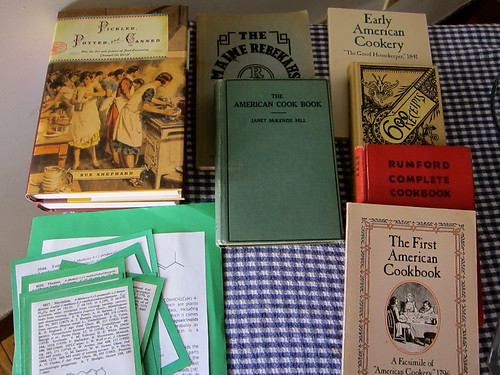
Dr. Sumner examines the history of pickling in America through “receipts” gathered from such early New England cookbooks as Amelia Simmons’ American Cookery (1796), Lydia Child’s The American Frugal Housewife (1833), and Catharine Beecher’s Miss Beecher’s Domestic Receipt-Book (1858). Paging through these, one is struck by the diversity of foods used for pickling. There are instructions for pickling barberries, nasturtium seeds, green walnuts, and something called martinoes or devil’s claw. This distinctive annual was originally brought over from Africa, and its young fruit, when preserved, is said to resemble pickled peaches.

Recipes for pickled mangoes also abound, an outgrowth of early trade in tropical fruit. Rather than just the fruit, it can also refer to a method of pickling. “To mango” consisted of filling a fruit’s cavity — such as melons, peaches or peppers — with spices; tying the two halves back together, then brining. One senses this would have made for a quite special preserve, something to show off in one’s best cut-glass pickle dish when guests arrived.

Science, Art and Lore of Pickling and Preservation

Many of the herbs and spices associated with pickling are rich in antimicrobial phytochemicals, providing an extra measure of safety as well as flavor, and were chosen according to tradition and availability. Clockwise from upper left: Cinnamon, bay leaves, mustard seeds, allspice and cloves, dried garlic, and turmeric. Other enhancements include nutmeg and mace; ginger, horseradish, onions, dill, and red or black pepper.

Science, Art and Lore of Pickling and Preservation

Reflecting time and place, pickles were very much a vernacular food, and varied according to locale and family tradition. The sharing of pickling recipes would have been common and, much like that of quilt patterns, passed on from one household to another. The morning ended with a tasting of Judith’s own delicious homemade pickles, a sampling of bread and butter pickles, pickled red onion, sauerkraut, dill pickles, and pickled sweet peppers from her jewel-like jars. With the current revival of interest in these foodways, each bite, as friend and host John Forti reminds us, connects the past with the future, as well as the present.

Science, Art and Lore of Pickling and Preservation

“Pickles and relishes, so much a part of our heritage, have given a lift to many a homely meal.” — Joy of Cooking, 1964

Resources
Judith Sumner, The Natural History of Medicinal Plants and American Household Botany: A History of Useful Plants
John Forti, The Heirloom Gardener
Strawbery Banke Museum, Portsmouth, NH

Posted in cooking, preserving | Tagged , | 7 Comments

4.24.13 Storage Tomatoes + 5 Links

IMG_3978

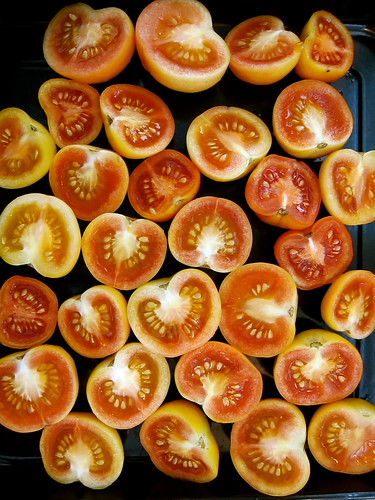
Our Italian winter tomatoes — pomodorini appesi — made it through late-April, when we finished up the last of them. Until then, we’d been enjoying them roasted on pizza, sautéed for pasta, tossed into scrambled eggs and stuffed into frittatas, ending up ceremoniously with a grand caramelized tomato tarte tatin. Above: A mix of red Aprile and yellow Ponderosa pomodorini in March, ready for roasting. Below: The last batch, mostly Ponderosa, in April and set aside for the tarte tat in.

4.24.13 Storage Tomatoes + 5 Links

With a new season upon us, the idea of kitchen gardening is much on our minds:

~ to dream: 10 kitchen gardens, what’s on your list?
~ to consider: kitchen gardening as a political act, it’s more than just feeding ourselves
~ to watch: a subversive (garden) plot, how gardening can save the world
~ to experience: Jefferson’s revolutionary garden, get your hands in some historical dirt
~ to read: Vegetable Literacy and The Four Season Farm Gardener’s Cookbook, inspiration plus recipes

Posted in garden, tomatoes / pomodorini | Tagged , , , | 12 Comments

4.22.13 Garden Emerging

4.22.13 Garden Emerging

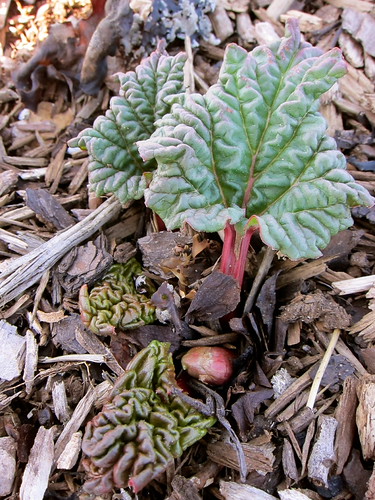
This week’s sunny weather is giving us days that range in the 50’s, with chilly overnight temperatures still in the 30’s. We’ve been patiently awaiting for the rhubarb to emerge, a sign to take stock of what else in the garden has survived the winter.

4.22.13 Garden Emerging

The first harvest of the season will go directly into making our favorite rhubarb galette. After that, we’ll feast on rhubarb scones and rhubarb curd, or a savory Persian rhubarb stew.

4.22.13 Garden Emerging  4.22.13 Garden Emerging

Two of the puntarelle chicories resprouted from plants that had died back mid-winter — Galatina (left), and Brindisina (right). They’ve been transplanted into another bed to see what if they’ll develop fully and with central points.

4.22.13 Garden Emerging

The lovage (above) along with the perennial alliums — walking onion, and garlic and regular chives —  appear dependably every year, and we count on them to provide some herbal freshness to meals still based on storage crops.

4.22.13 Garden Emerging

Last season we planted a number of edible perennials to give us a jump on spring, and we’re happy to see that most of them made it through their first winter. Traditionally, sea kale (above) shoots are covered to blanch them, and served steamed like asparagus.

4.22.13 Garden Emerging

The skirret (above) is getting established. Under its growing mass of leaves, the roots are the edible part and are rumored to taste like parsnips. They may never become a major staple of our diet, however, it’s nice to have more of the garden be edible.

4.22.13 Garden Emerging

Last stop was to check on the flowering quince, tucked into its own corner of the garden. As gardeners we’re never short on hope, and maybe this will be the year we’ll have some harvestable fruit.

Happy Earth Day!

Posted in garden | Tagged , , | 20 Comments