Celeriac & Leek Chowder

More often than not, what we cook is inspired as much by the weather as what’s in the garden. We’ve plenty of leeks and celeriac on hand, and the damp, cold evenings had me thinking of something warming like soup. This riff on a chowder from Vegetable Soups by Deborah Madison, replaces the rutabaga with celeriac, and is given a bit of heft and substance with the addition of jowl bacon, bringing it back to its New England roots.

Celeriac & Leek Chowder

6 slices jowl bacon, cut into 1/4 inch wide pieces
1 to 2 tablespoons unsalted butter
2 medium leeks, chopped
1 1/2 pounds celeriac (1 to 2 bulbs), peeled, and diced
1 potato, peeled and diced
1 to 2 sprigs of fresh thyme, or hefty pinch of dried
1 bay leaves
Salt and pepper, to taste
4 to 6 cups stock (vegetable or chicken)
1/2 cup cream or half-and-half
Celeriac leaves, minced, for garnish

– Choose a heavy soup pot, and saute the jowl bacon with the butter, until the bacon has given up some of its fat. Add the leeks, and continue sauteeing until tender and fragrant.
– Stir in the celeriac, potato, thyme, and bay leaf, and season with salt and pepper. Saute together briefly, about 5 minutes, to start the vegetables cooking. Add 4 cups of stock, bring to a boil, then reduce heat to low and simmer 20 minutes. Add the cream or half-and-half, and continue simmering until vegetables are tender.
– Remove bay leaf. Puree 1 to 2 cups of the chowder, and return to pot. Adjust the thickness of the chowder by adding more stock. Taste for seasoning, and garnish with minced celeriac leaves.

Note: I usually make chowders ahead of time, an overnight rest lets the flavors develop. If you want to use less cream or skip it altogether, pureeing a cup or two adds enough creamy texture. By pureeing it all, this chowder can be transformed into a silky bisque-like soup. For instructions on how to peel celeriac, see here.

Recipe adapted from “Vegetable Soups” by Deborah Madison.
Posted in cooking | Tagged , , , | 4 Comments

Baking interlude: Breakfast breads & pastry

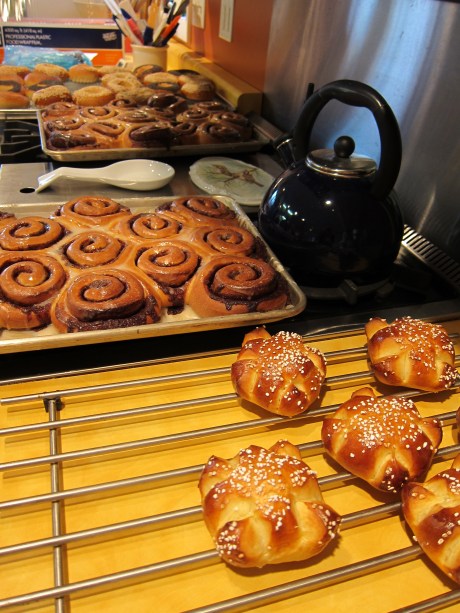
I spent the weekend attending a workshop on “Breakfast Breads and Pastry” with Chef Ciril Hitz, hosted by the Stone Turtle Baking and Cooking School in Lyman, Maine. The hands-on class was fast paced, and the amount of baked goods we produced was staggering. Both Ciril, who holds workshops in Rehoboth, Massachusetts, and Michael Jubinsky at Stone Turtle are outstanding teachers of the craft; class schedules are available on their websites, and are suitable for home bakers as well as aspiring professionals. To see more from the workshop click hereIn photograph: First of August Swiss Brioche, Cinnamon Buns, and Bagels.

Posted in cooking, interlude | Tagged | Leave a comment

11.8.11 Celeriac

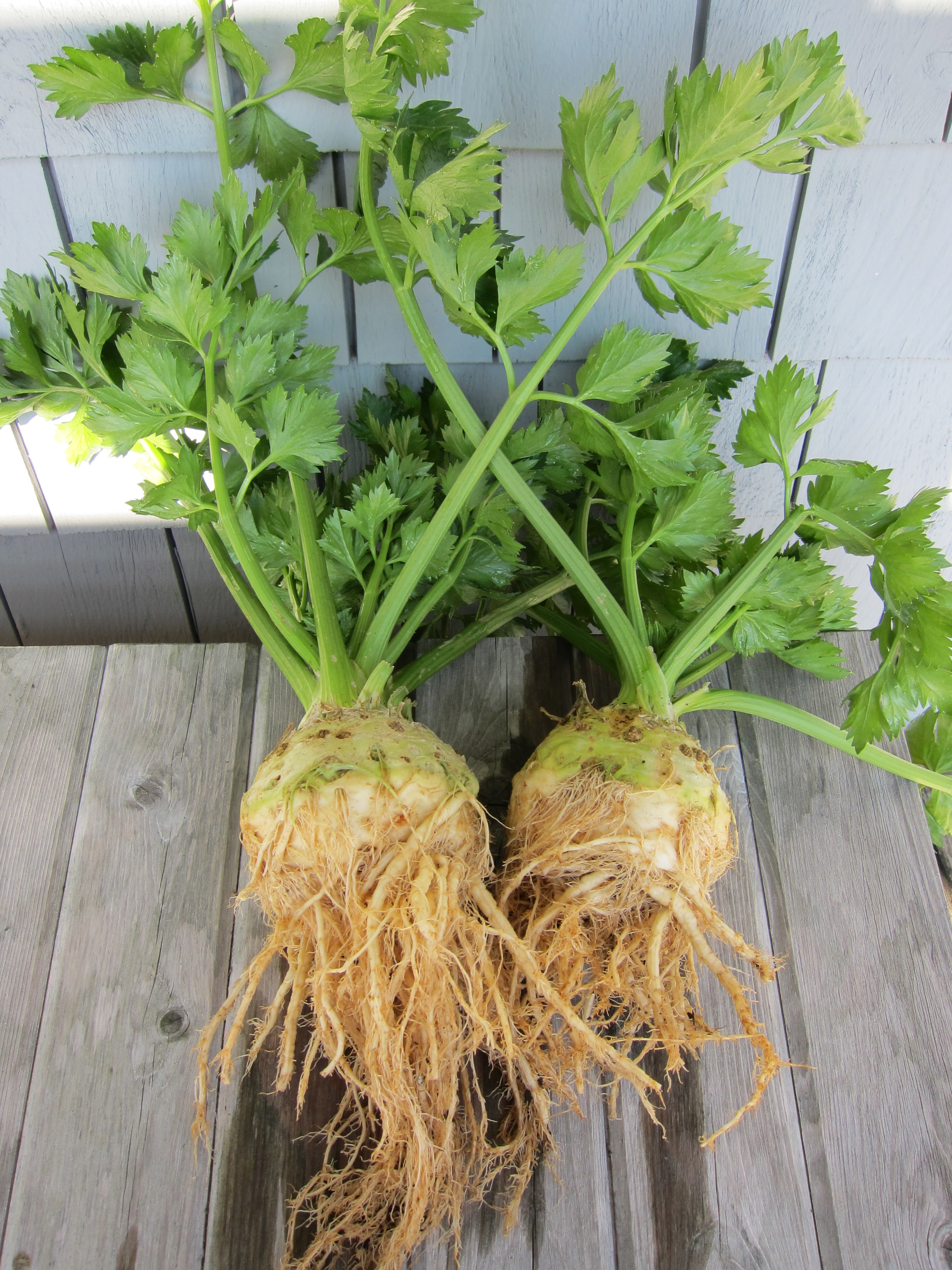
We can’t bear to toss out leftover seedlings once the rest of their seedling siblings are planted. These two bulbs of Brilliant celeriac were the result of plunking a couple of these extra seedlings in a spare bed. 

The first time we grew celeriac, we ended up with hairy, root-bound masses. We’ve learned since not to hill the bulbs up, giving us cleaner bulb formation.

Visit the weekly harvest party at Daphne’s Dandelions

Posted in garden | Tagged | 11 Comments

Wood-fired pizza with eggs

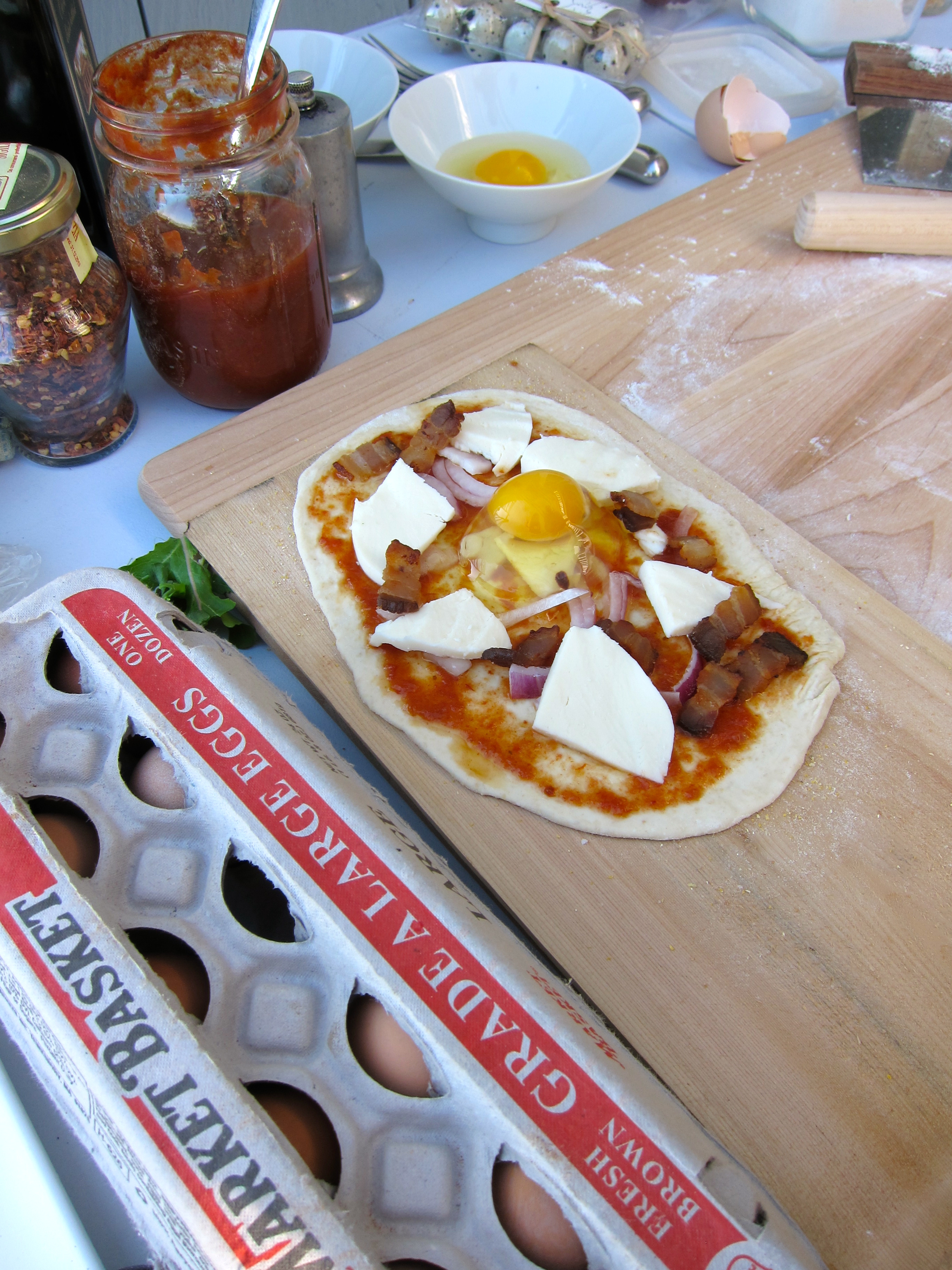
We’ve enjoyed a run of sunny weather this week, and took advantage of it with a break from the many fall garden clean-up tasks by firing up our little practice clay oven. We had in mind to make pizza with egg, after the one we had at Da Baffetto in Rome.

I’m tempted to call these breakfast pizzas. We start with homemade dough made partially with local whole wheat flour, then layered it with tomato sauce and slivers of red onion, bacon, and mozzarella. We used the toppings to form a “nest” that helped to contain the egg, and made a series of pizzas: one topped with a pullet egg, another with two quail eggs, and the last with a regular chicken egg. Don’t be alarmed by the egg carton — all of the eggs were from the local farmers’ market; the quail eggs from Mona Farm can be glimpsed at the upper edge of the photo, the pullet egg sitting on top of the pizza is from Hurd Farm.

The pizzas were finished with some torn arugula clipped straight from the garden. It took us several attempts to get the temperature right — too high and the pizza burned before the egg could set; too cool and the crust would bake too slowly, becoming doughy. I was able to get a photo of this last pizza — the regular sized egg on this one was almost too big for it, and made it difficult to get off the peel into the oven. This one, like the others, was scarfed down immediately. We didn’t eat for an entire day afterwards, but it was well worth the effort to figure out how to make these.

Posted in cooking | Tagged , , | 5 Comments

Crunchy Pappardelle with Broccoli and Mushrooms

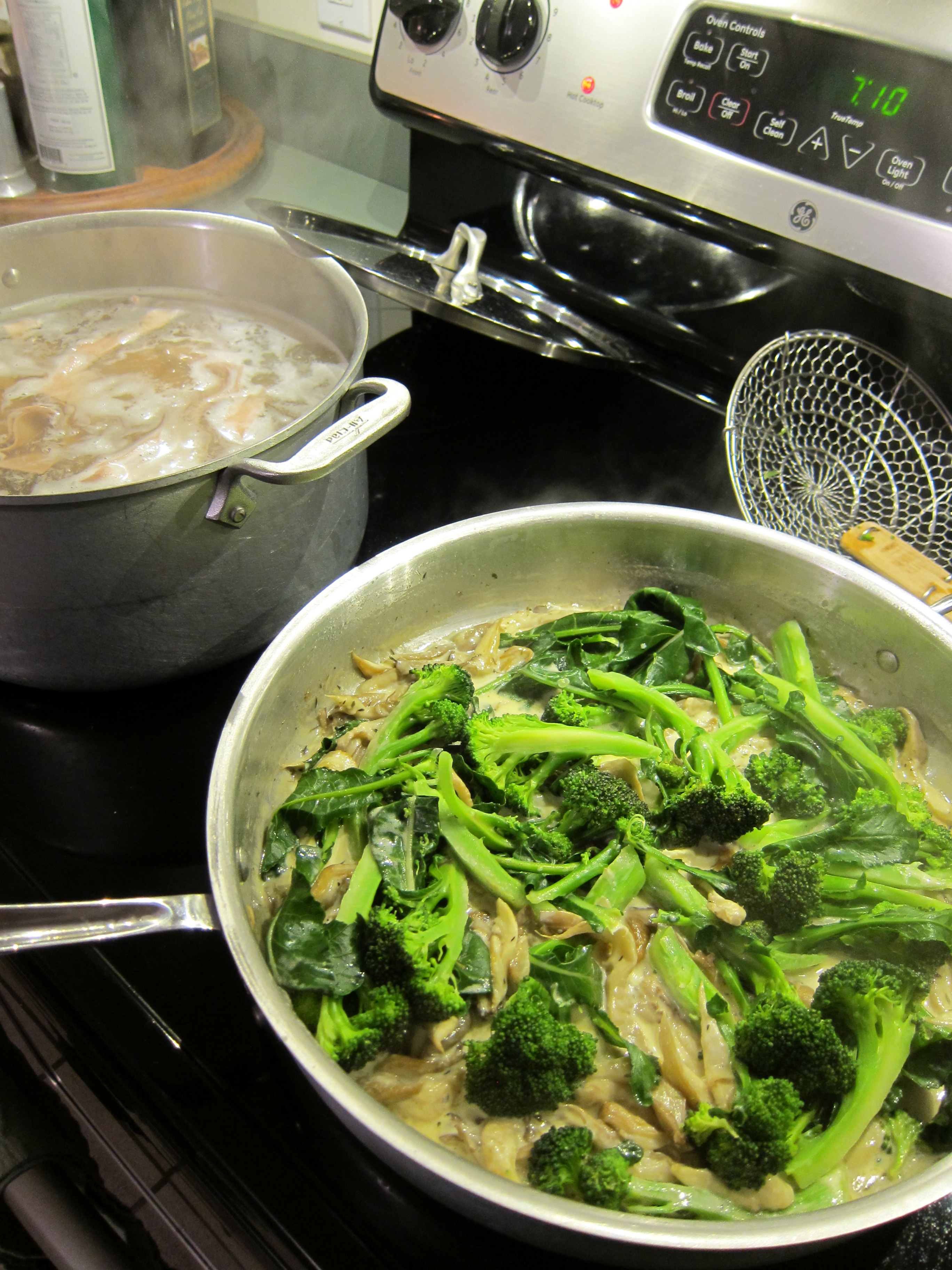
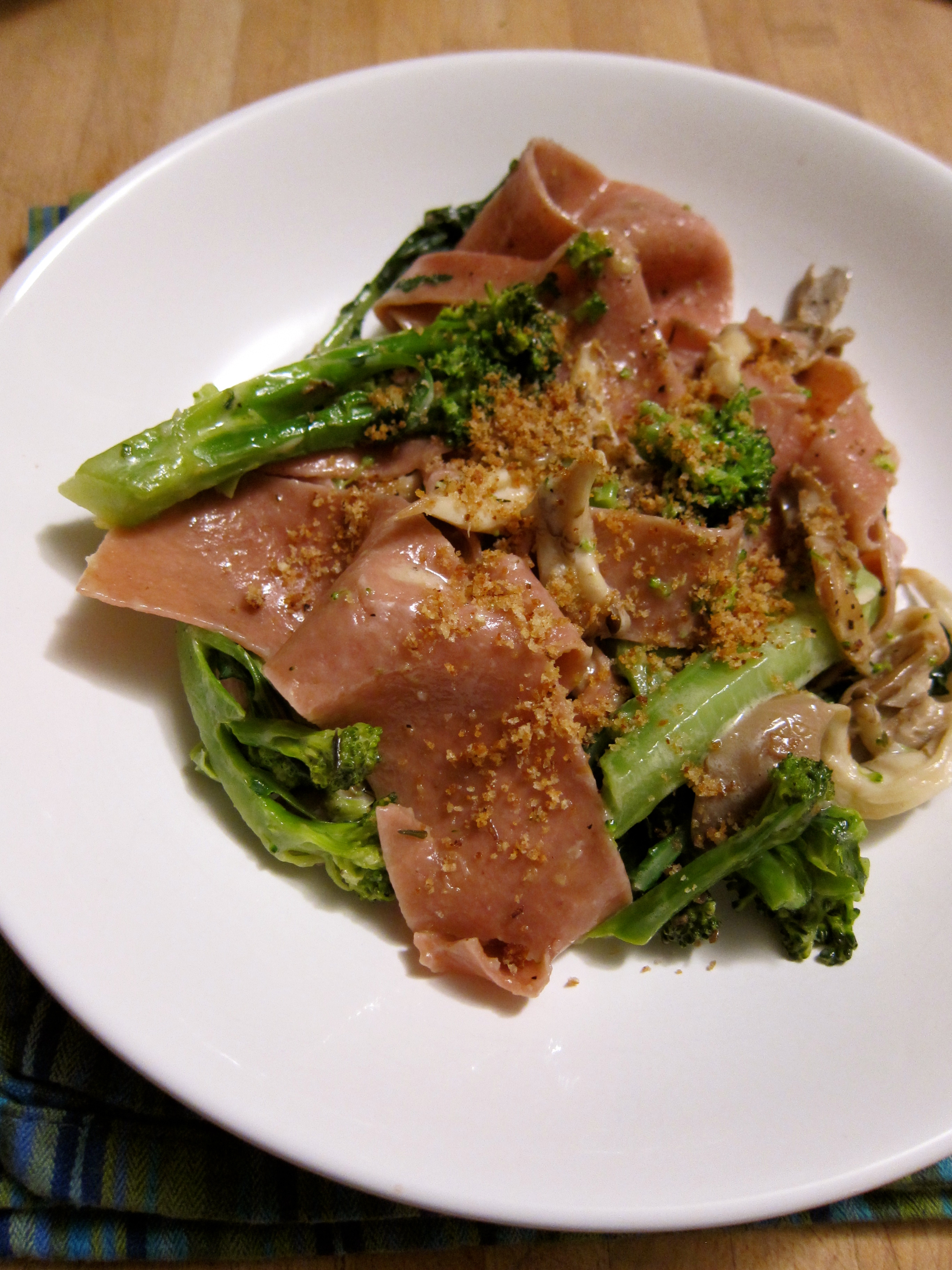
We haven’t had much success growing broccoli, so when it shows up at the farmers’ market I buy as much as I can. It becomes especially sweet with cooler weather, and I’m usually content with a simple plate of it steamed, and dressed with some salt and really good olive oil. However, with masses of it, along with some oyster mushrooms and red wine pappardelle already on hand, how could I resist trying out something called  “Crunchy Pappardelle”?

I discovered this recipe while working my way through Yotam Ottolenghi’s second cookbook, Plenty. There’s something about having a shared sense of taste, and this is one of those rare cookbooks where after trying just one recipe, I knew I could trust the rest. The recipes in Plenty are deceptive; they’re uncomplicated yet full of unexpected combinations. The fact that all of the ingredients, save for the olive oil, wine and black pepper, came from local sources is an added delight.

Crunchy Pappardelle with Broccoli and Mushrooms

Serves 2
1/2 pound broccoli
1/2 pound oyster mushrooms, torn into bite-sized pieces
1/4 cup olive oil
1 cup white wine
1 bay leaf
3 thyme sprigs, leaves picked and chopped
1 cup cream
Grated zest of 1 lemon
1 garlic clove, crushed
3 tablespoons chopped parsley
3 tablespoons breadcrumbs
12 ounces fresh pappardelle (9 ounces dried)

– Separate any leaves from the broccoli, and cut stalks and florets into two to three inch-long pieces. If the stalks are thick, cut along the center. Blanch stalks, florets, and leaves in boiling salted water for two minutes and drain.
– In a large saucepan, sauté the mushrooms in the hot oil until they start taking on color. Add the wine, bay leaf, and thyme, reduce to a third, then add the cream. Season to taste and keep warm.
– Mix together the lemon zest, garlic and parsley. In a hot pan, toast the breadcrumbs until golden, stirring occasionally.
– Cook the pappardelle in salted water. When just ready, add the broccoli to the cream sauce to reheat. Drain the pasta and mix with the sauce and half the parsley mix. To serve, mix the rest of the parsley with the breadcrumbs and garnish generously.

Local ingredients: Broccoli  from Meadow’s Mirth, blue oyster mushrooms from Pawtuckaway Mushrooms, and red wine pappardelle from the pasta wizards at Valicenti Organico. We have small bay and lemon trees growing indoors, the plants sourced from the wonderful folks at Wentworth Greenhouses. The original recipe calls for Panko, but homemade breadcrumbs are a pantry staple for us and do just as well.

Recipe adapted from “Plenty” by Yotam Ottolenghi.

Posted in cooking | Tagged , | 2 Comments

11.6.11 Thinning and storing carrots

We planted carrots in early August for harvesting late fall into winter. The bed needed a second thinning and we ended up with mostly Napoli, a type of nantes carrot that’s reportedly one of Eliot Coleman’s top choices for over-wintering, and a handful of stubby Red Cored Chantenay, a French heirloom, to the right. To get them ready for cold storage, I make sure to snip off the taproot along with the tops. This seems to prevent them from rotting at the root end, and helps them keep longer.

Posted in garden | Tagged | Leave a comment

11.5.11 Garlic tasting

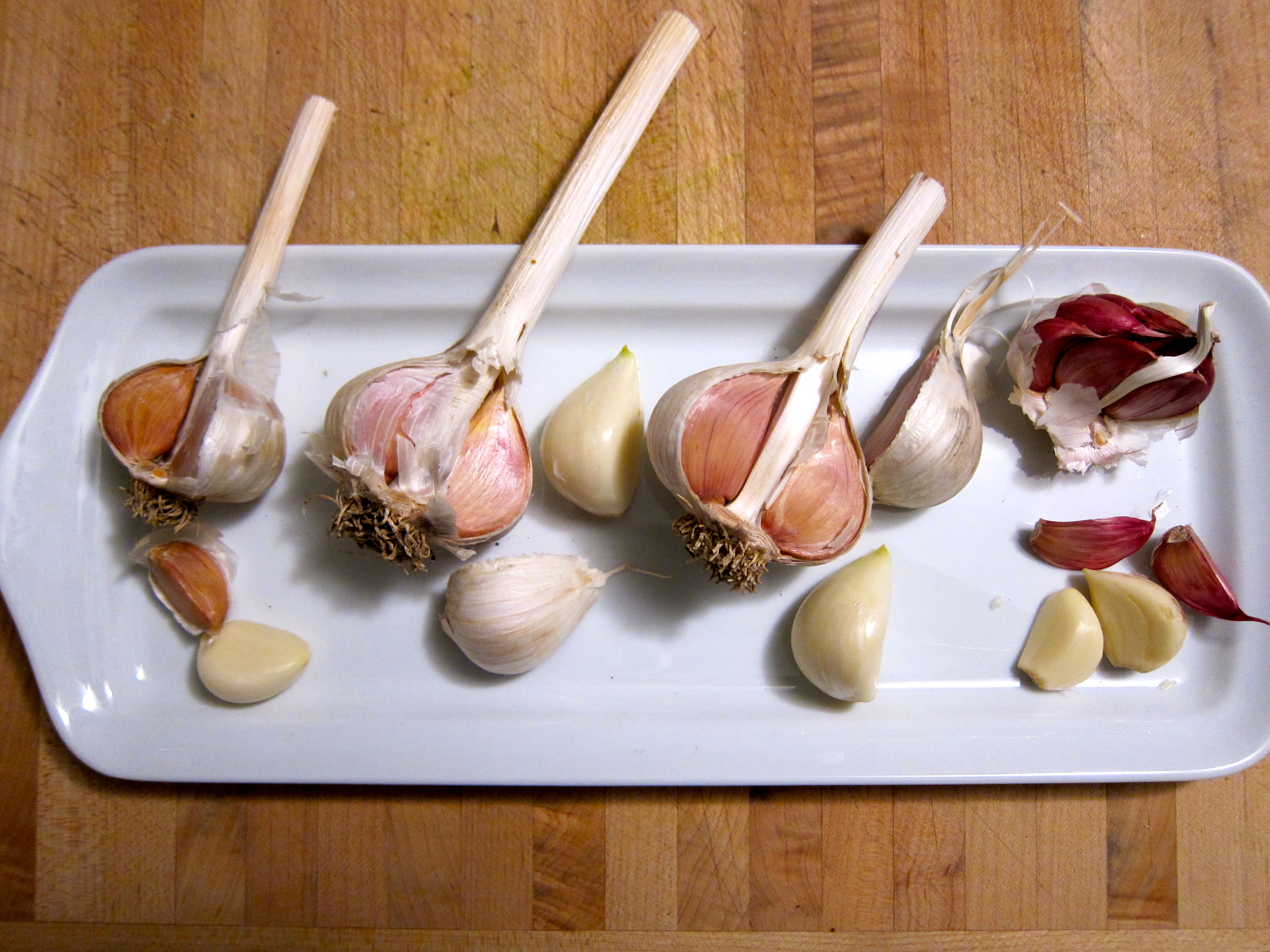
Left to right: Phillips, Music, German Extra-Hardy, and Rossa di Sulmona

This will be our fourth year of planting garlic — the Phillips, Music and German Extra-Hardy garlic all originally came from Fedco Seeds, also in Maine, and were originally chosen for their cold-hardiness, as well as taste. Now in their third generation, they’re acclimated to our garden’s conditions. The Rossa di Sulmona, also a hardneck, is something new we’re trying out this year.

• Phillips: This heirloom garlic is known for its large bulbs, winter hardiness, and good storage qualities, and is gaining popularity here in Maine. Fedco Seeds“Molly Thorkildsen and Will Bonsall obtained this vigorous Rocambole from Raymond Rowe of Phillips, ME. Each bulb contains 6-8 large cloves with a milder flavor than Russian Red. The tan exterior skins and purple mottled clove coverings are substantial, making this an excellent keeper. Slow to emerge in spring, so don’t be alarmed when these take an extra two weeks to appear. They catch up quickly and mature at the same time as other varieties.”

Music: A porcelain variety, stores well up to nine months. Fedco Seeds“Similar to German Extra Hardy, with large succulent cloves. Our supply comes from Wellspring Farm in central New York state, where folks have been growing NOFA-certified organic since 1991 and are founding members of the Garlic Seed Foundation.” Seed Savers“Italian variety brought back to Canada by Al Music in the 1980s from his homeland. Hailed as one of the best varieties for consistent production. Sweet pungent flavor, very tight, durable heads.”

German Extra-Hardy: Also a porcelain variety. Fedco Seeds“Selected for size. Big bulbs yield huge cloves, each equivalent to about two or three cloves of supermarket garlic. Perfect for production pesto-making or avid garlic fans. White outer skin, red inner skins. Excellent storage. May be the same as German Stiffneck and German White.” Seed Savers“Vigorous grower with long roots that enable it to overwinter without heaving out of the ground. Outside skin is ivory-white, but the clove skin is dark red. Strong raw flavor, high sugar content, one of the very best for roasting.”

Rossa di SulmonaSeeds of Italy: “A wonderful red hardneck variety from the Abruzzo region of Italy. It is a favorite of Italian cooks because it has an assertive garlic flavor, yet is somewhat sweeter than other garlics. That means it holds its flavor in long-cooking dishes like marinara sauce, but it can also be eaten raw on bruschetta. Like all hardnecks, Rossa di Sulmona has large, easy-to-peel cloves arranged in a circle around the central stem. It is a very cold hardy variety (Abruzzo is a mountainous region) but the tradeoff is that it does not store as well as softnecks.”

We try to taste new garlic before committing to planting it. As in past taste tests (rubbed raw on toasted bread), the Music was by far our favorite, but with only 4 to 5 cloves per bulb, it has taken us awhile to build up enough stock for both storing and planting. We’d planned to plant only two varieties this year — the Phillips and the Music — but couldn’t bring ourselves to skip the German Extra-Hardy after spending several years adapting it to our garden. As for the Rossa di Sulmona, I have to confess it was an impulse purchase. I was beguiled by its magenta colored wrappers and its Italian provenance, so we’ll plant a couple of rows of it and see how well it fares here.

Posted in garden | Tagged | 5 Comments