
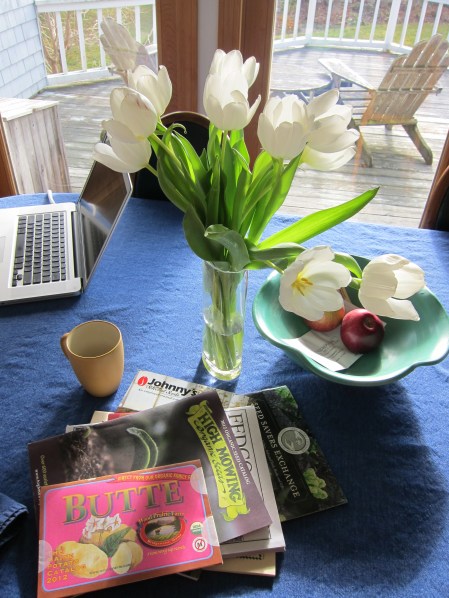
My shelf is bulging with seed catalogs
and all I can see ahead is
abundance.
— Russell Libby, “Spring”
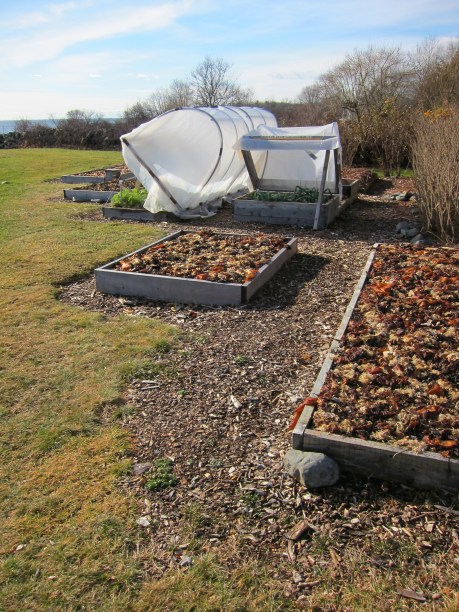
We harvested the last of the celeriac and watermelon radishes during a run of days last week, when temperatures never ventured above freezing. There are still a few things left under cover — carrots, parsnips, leeks, some tatsoi and kale, and other test greens — but for the most part, gardening chores are done for the season. We took advantage of this pause to assess last year’s growing season and plan for the next. The following list shows what we planted in 2011, and what will be dropped for 2012. New varieties to be added for 2012 are listed under notes. We were pleased with this year’s season extension, and will expand our range of winter hardy varieties. Special thanks to the wonderful Harvest Monday gardeners at Daphne’s Dandelions for introducing us to so many tempting new varieties to add to our wish list.
Some new vegetables for the 2012 season: Surrey Arugula, Spring Broccoli Raab, Hon Tsai Tai Flowering Broccoli, Fun Jen Chinese Cabbage, Fordhook Giant Chard, Pan di Zucchero Chicory, Catalogna Emerald Endive, Catalogna Brindisina Chicory, Galantina Chicory, Rossa di Sulmona Garlic, Scottish Kale, Andover Parsnips, Green Meat Radishes, and Sibley Winter Squash.
After meeting the innovative farmers at Akaogi Farm, we look forward to trying to grow rice in a bucket; we also found a dry-land rice called Duborskian to test a plot of. In addition to the wooden planters we used last year, we’ll test growing potatoes in fabric containers. Like Liz over at Suburban Tomato, we’ll see if hilling up or not makes a difference in production. We purchase seeds primarily from Fedco and High Mowing, and our seed potatoes from Wood Prairie Farm, three New England companies that primarily produce much of their own seed or source regionally. Other seed came from John Forti, who, in conjunction with Slow Food Seacoast and the Heirloom Harvest Project, is dedicated to promoting biodiversity through saving heirloom seed.
Key
BI – Botanical Interests
F – Fedco Seeds
J – Johnny’s Selected Seeds
JF – John Forti
HM – High Mowing Organic Seeds
PG – Pinetree Garden
SI – Seeds of Italy
SS – Seed Savers
WP – Wood Prairie Farm
Alliums
– bunching onions
– Notes: Now we know why locally grown scallions are difficult to find; they take up a lot of space and growing time for very little return. We’ll continue to use chives, garlic chives, and Egyptian Walking Onions in their place. We’ve some ramps (wild leeks) we planted a couple of years ago; we’ve been told it takes five years for them to get established.
Arugula
– Rocket (F), Ice-Bred (F), Apollo (SS), Sylvetta (SI), Astro (HM)
– Notes: We’re out of seed for the Apollo and Astro, and found they’re similar enough to the Rocket that we won’t replace them. We’re still tinkering with matching the variety of arugula to the time of season, and will replace the Apollo and Astro with Surrey (HM); maybe add Wild Olive Leaf Rucola (SI) to satisfy our arugula fixation.
Asparagus
– Jersey Supreme (PG), Purple Passion (PG)
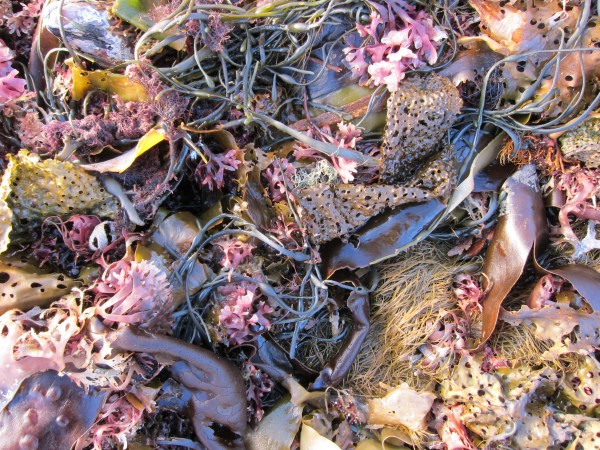
– Notes: This was the fourth season for the asparagus bed and production has increased as it gets established; purple seems to be thriving more than the green Jersey. We’ll continue working on soil fertility; the bed is now covered with a thick layer of seaweed, cow manure, and compost.
Beans
– Dragon Langerie Wax (F), Masai Haricot Verts (F), Windsor Fava (F), Cascine Fava (SI)
– Notes: We use Dragon Langerie as a fresh wax bean, and as a shell and dried bean. We planted saved seeds from Masai with success, and saved more seed for 2012. Last season, we started the favas early, at the same time as the peas. We protected them from the wind by surrounding the fava plants with a two-foot high wood frame; we still had problems with aphids but had our best harvest in what was our third year of growing them.
Beets
– Early Wonder (F), Bull’s Blood (HM), Detroit Dark Red (HM)
– Notes: We’ve found beets are great for small gardens, providing edible greens as well as roots. Second year for Early Wonder, produced well. Bull’s Blood great for producing beet greens. Detroit Dark Red are a fall crop, need to start them earlier.
Brassicas
– Cima di Rapa Quarantina (SI), Arcadia (F)
– Notes: Arcadia broccoli seedlings were an impulse buy; we’d heard broccoli was difficult to grow and should’ve known better. They failed to thrive, the roots eaten up by ants. The cima was easy to grow, but tended to bolt beforethe florets had time to develop. We’ll try the Broccoli Raab from High Mowing, it may be better adapted to our climate. For 2012, add Broccoli Raab (HM), Hon Tsai Tai (HM), and Fun Jen (F); maybe Sprouting Broccoli.
Carrots
– Napoli (HM), Nantes (F), Red Cored Chantenay (HM)
– Notes: A plot of winter extension carrots are still in the ground. Add White Carrot (JF) from saved seed.
Celeriac
– Brilliant (F)
– The long fall last season made it difficult to know when to harvest the celeriac. For next season, consider harvesting at a smaller size, and store in fridge until the bulkhead cools down enough to move to storage there.
Chard
– Rainbow (HM)
– Notes: The white stemmed chard in the Rainbow mix seemed to last the longest under cover. For season extension, add Fordhook Giant (HM).
Chicory
– Catalogna Puntarelle a Foglia Stretta (SI)
– Notes: The Puntarelle didn’t turn out to be the one for the Roman salad of the same name; it was bitter as a salad green, better as a cooking green. Catalogna Brindisina or the Galantina appear to be what we’re looking for. For 2012, add Catalogna Emerald Endive (HM), Catalogna Brindisina or Galantina (SI), and Pan di Zucchero (F); maybe Misticanza (SI) because it’s too difficult to chose just one radicchio.
Cucumber
– Boothby’s Blonde (F)
– Notes: Saved seed for 2012.
Eggplant
– Fairy Tale (J), Orient Express (J)
– Notes: Purchased seedlings from Wake Robin Farm; plan to purchase seedlings for 2012.
Fennel
– Perfection (HM), Finale (HM)
– Notes: Slight differences in flavor, keep growing both varieties as a biodiversity hedge.
Garlic
– German Extra-Hardy (F), Phillips (F), Music (F)
– Notes: All three garlic are originally from Fedco and, after three years, are now adapted to our microclimate. We considered reducing to our two favorites — Music and Phillips — but didn’t want to lose the German Extra-Hardy now that it is adapted; continue using saved seed. Add Rossa di Sulmona (SI); planted it separate from the other garlic to avoid contamination. Remember to let the leaves of next year’s garlic die back more before harvesting; clean garlic directly after harvesting by peeling outer layer; don’t cure in garage (too moist, cures too slowly). Problems with mites with this season’s stored garlic; need to avoid successive allium and garlic crops.
Kale
– Siberian (HM), Red Russian (HM), Lacinato (HM)
– Notes: A half row of each provided for the entire season; white cabbage moths not as problematic as in previous years. The Siberian held up the longest in season extension. Add Scottish or Curly Kale (JF) from saved seed; maybe Winterbor (F), Beedy’s Camden (F), or Vates (HM) for season extension.
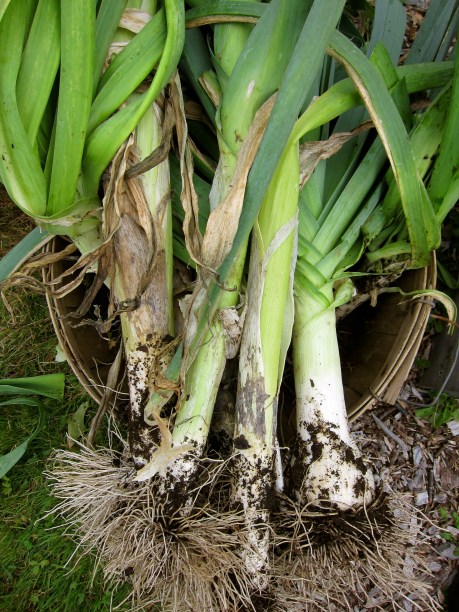
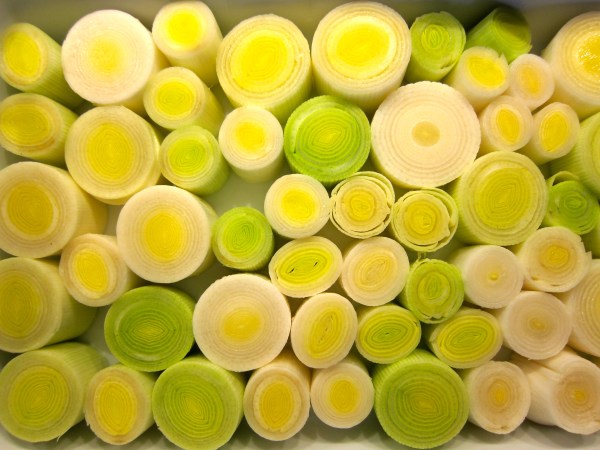
Leeks
– King Sieg (F), King Richard (F), Giant Musselburgh (SS)
– Notes: All varieties performed and stored well with season extension; a plot of leeks still in the ground. Purchased Giant Musselburgh and King Richard seedlings from Wake Robin Farm; started King Sieg and more King Richard from seed. You can never have too many leeks.
Lettuce, Salad Mixes
– Gourmet Baby (BI), Q’s Special Medley (BI), Gourmet Lettuce (HM), Red Planet (HM), Winter Lettuce Mix (F)
– Notes: Thinned Q’s Special Medley for Tatsoi to use in season extension. Add Sorrel (HM).
Parsnips
– Lancer (F)
– Notes: Andover sold out in 2011. Experienced poor germination with Lancer. Add Andover (F) and saved seed variety (JF).
Peas
– Green Arrow Shell Pea (HM), Dwarf Grey Snow Pea (F)
– Notes: We’ve yet to have much success with planting peas in fall; will try again with the snow peas for a fall crop of pea shoots.
Potatoes
– Swedish Peanut Fingerling (WP), Red Cloud (WP), Rose Gold (WP), Yukon Gold (WP)
– Notes: Planted potatoes in pots for first time; it made it easy to harvest and freed up garden space, but resulted in low yields which may have been due to erratic weather. For 2012, reduce varieties, and trial using a Smart Bag, and hilling vs. direct planting.
Radishes
– Valentine’s Day Mix (HM), French Breakfast (HM), Cincinnati Market (SS), Watermelon (HM)
– Notes: Add Green Meat (F), another winter radish, and grow with Watermelon radish for season extension.
Rhubarb
– Chipman’s Canada Red, MacDonald (F)
– Notes: Of the three varieties we planted originally — Chipman’s Canada Red, Crimson Red, and Valentine — only the Canada Red survived. It comes up early and, once established, is a dependable producer. The Macdonald rhubarb, which replaced the others, comes up later and is still getting established. Looking for a third variety to add.
Rice
– Notes: Trial growing rice in a bucket. Add Duborskian Rice (F), a for a dry-land plot.
Sunflowers
– Autumn Beauty (HM)
– Notes: Ubiquitous as they seem, it’s surprisingly difficult to grow sunflowers here. First they failed to germinate, next the seedlings were mowed down by cutworms, then those that made it were blown over by Tropical Storm Irene. Replace Autumn Beauty with Italian White and Sunrise Lemon (HM), shorter and paler varieties.
Squash
– Costata Romanesco (F), Zephyr (J), Zeppelin Delicata (F), Burpee’s Butterbush Butternut (F)
– Notes: This was the second year of growing the Butterbush with poor results; probably due to the short growing season here. Time to move on. Replace Butterbush with Sibley (F), also known as Pike’s Peak; recommended by Amy Goldman in The Compleat Squash. Zephyr now available through Fedco.
Tomatoes
– Sun Gold, Black Cherry, Principe Borghese (SI/F), Grappoli d’Inverno (SI), Ponderosa sel Oro (SI), Aprile
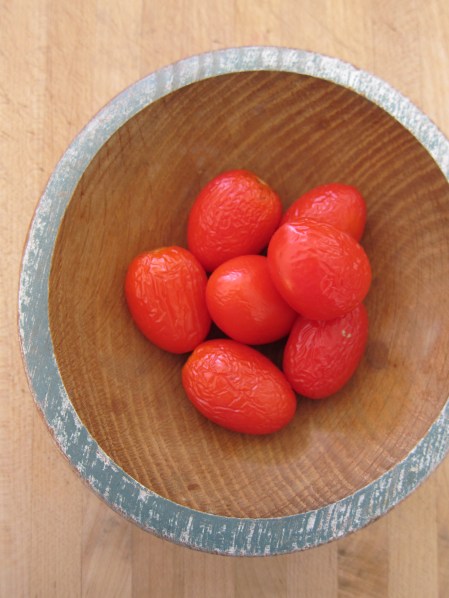
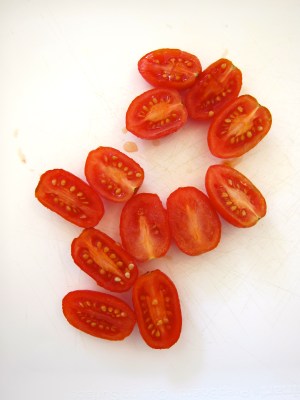
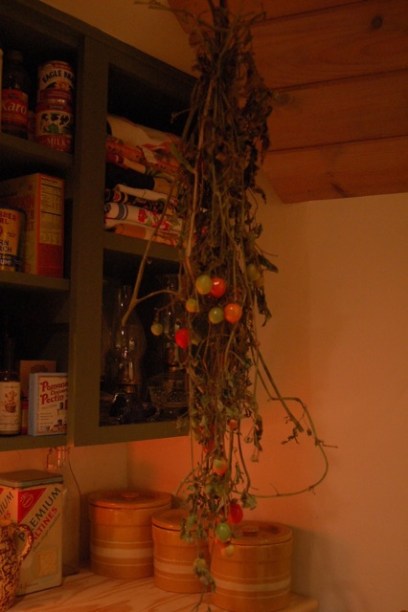
– Notes: Sun Gold and Black Cherry sourced as seedlings from New Roots Farm; Principe Borghese (SI), Ponderosa, and Grappoli as seedlings from Stout Oak Farm; started our own seedlings from Aprile and Principe Borghese (F). Erratic weather and Tropical Storm Irene prevented winter tomatoes from ripening fully before storing; we plan to continue trialing the Italian varieties, particularly for winter storage.





 Diary of a Tomato