Whole Wheat Bagels

Except for a restaurant job that required me to make 30 apple tarts a day, my experience has mostly been at the savory end of things. In the kitchens that had them, pastry cooks seemed a separate breed from those of us on the line. They came in during the early hours when it was quiet, and seem to rely primarily on drinking herbal tea to get them through their day. They would patiently mix dough, roll out pastry, and check the progress of the ovens — quite unlike the hectic pace of the short-tempered, adreneline junkies around me cooking for service.

I’d always thought I’d turn to baking once I got older and, presumably, became more patient. It’s still not my metier, the place where I’m most skilled, but I’ve learned to enjoy the slower rhythm and step-by-stepness it requires. Last week-end’s snow day afforded me the welcome chance to practice making bagels, something I’ve been wanting to do since learning how to last fall.

Opinion varies when it comes to bagels, and a quick search of my library yielded 38 different recipes alone. The one from my teacher’s book, Baking Artisan Pastries and Breads, seemed a safe place to start, and yields a nicely chewy version. I’ve never gotten accustomed to the idea of bagels with cinnamon and raisins, and chose to leave those out. Other than that, I followed the recipe as directed and found it perfectly suited to the home kitchen — just the right amount of dough to fit in my mixer, just the right number of bagels to make at one time, and just the right size to eat without guilt. Most importantly, the overnight proofing allows the home cook to make the dough the night before then bake them in the morning, just in time for a Sunday breakfast to beat all.

Baking notes:

    • The recipe for Whole Wheat Cinnamon Raising Bagels by Ciril Hitz can be found here and here.
    • For a simple whole wheat bagel, omit the cinnamon sugar and raisins.
    • There’s a misprint, it should be diastatic “malt” instead of “milk.” I used organic malt syrup, about 1 to 2 tablespoons.
    • If you don’t already have one, get a kitchen scale. Weighing ingredients simplifies and quickens the process of assembling the dough, and makes it easier to portion.
    • After mixing, I hand-kneaded the dough slightly before shaping.
    • The accompanying video shows how to shape the bagels. The next time I’ll remember to review the video before diving in, rather than finding out what I did wrong afterwards.
    • To avoid using plastic bags, I proofed the shaped bagels in parchment-lined shallow food bins with covers.
    • When using honey for blanching, make sure to skim any impurities out before proceeding. The honey may be replaced with maple syrup or malt.
    • Use a light hand when blanching; a longer blanch results in a thicker skin, or crust.

Local ingredients: Whole wheat flour from Brookford Farm; honey from Harrison’s; and salt from Maine Sea Salt.
Posted in cooking | Tagged | 7 Comments

1.21.12 Blue afternoon

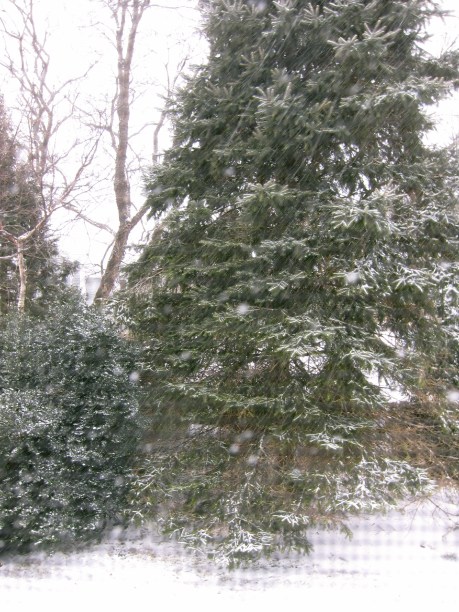
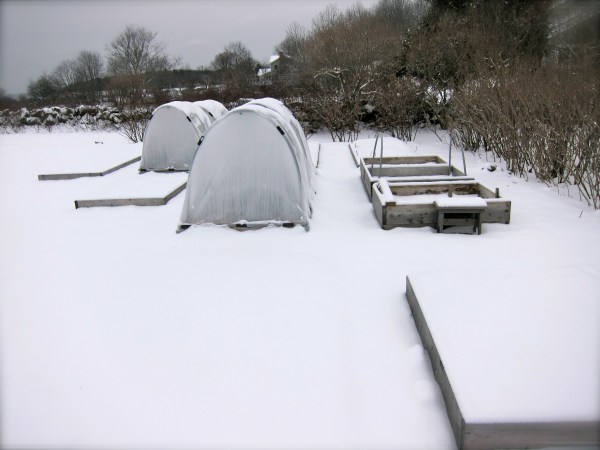
Once it stopped snowing, we checked on the covered beds to make sure they hadn’t collapsed. Only a couple of inches of accumulation.

It was late afternoon and everything was cast in a blue light. We took a walk…

…down to the rocky beach and found it looking like this.

Posted in uncategorized | 9 Comments

1.21.12 Snow day


“What are you doing?”

“I’m doing a snow dance to make it snow.”

“Oh. Looks like it’s working.”

Posted in garden | 7 Comments

Farfalle with Northern Shrimp and Pistachio Pesto

I often include shrimp when making pasta with pesto, so when I came across a Sicilian one based on pistachios, it seemed natural to add shrimp to it also. This has since strayed far from the original and, like all much-loved recipes, has been adapted over the years to suit our kitchen. The combination of “butterflies” and shrimp is a playful one, resulting in an elegantly rustic dish. The tender shrimp lend contrast to the toasted pistachios, with just enough cream to give it weight as a winter meal. Once the days lengthen into more summery weather, we’ll leave out the cream, returning the dish to its southern Italian roots.

Farfalle with Northern Shrimp and Pistachio Pesto

1 cup shelled pistachios (unsalted)
¼ cup olive oil
1 medium onion, finely chopped
Red pepper flakes
1 cup heavy cream
White wine
Dried basil
1 pound farfalle pasta
1 pound peeled Northern shrimp

– Toast the pistachios lightly, and let cool. Process the pistachios until coarsely ground — not too fine, keep some larger pieces for texture — and set aside.

– Heat the olive oil in a large saute pan over medium heat, add the chopped onion with a pinch of red pepper flakes, and cook until the onions are translucent but short of browning. Add the ground pistachios and, if necessary, more olive oil to moisten it to a paste-like consistency. Continue cooking while stirring for another minute, until the pistachios begin to release a toasty aroma.

– Add a splash of white wine, cook briefly, then stir in the cream and some crushed dried basil. Cook for another minute for the sauce to come together, and remove from heat.

– Cook pasta until al dente, add the shrimp in with the pasta and cook briefly, then drain immediately. Add the cooked pasta and shrimp to the sauce, tossing everything together until well coated. If needed, pasta cooking water may be added to loosen the sauce. Season with sea salt and freshly ground black pepper, and serve.

Note: I often stir in a heaping spoonful of basil or garlic scape pesto in place of the dried basil. If in season, some chopped fresh basil can be stirred in at the end. Almonds are a good substitute for some or all of the pistachios.

Recipe adapted from Pinch My Salt.

Local ingredients: Northern shrimp from the F/V Rimrack, onion from Pickpocket Farm, cream from Harris Farm, basil from the garden.

Posted in cooking | Tagged , | 4 Comments

Field Trip: Northern shrimp from the F/V Rimrack

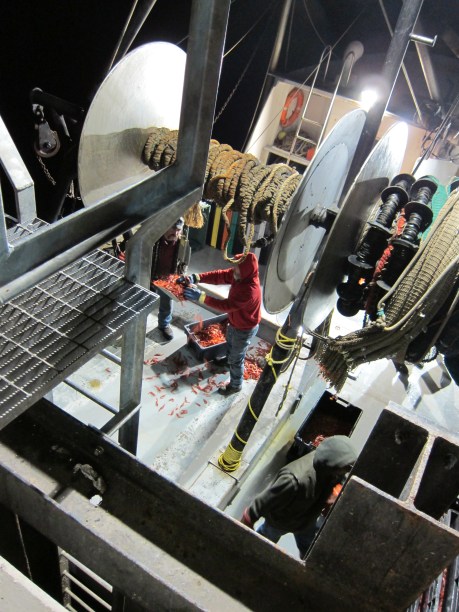
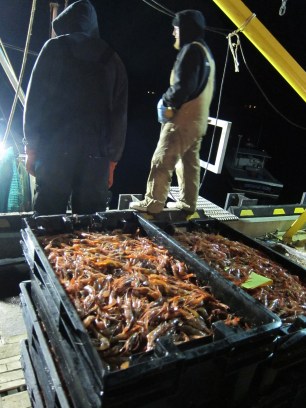
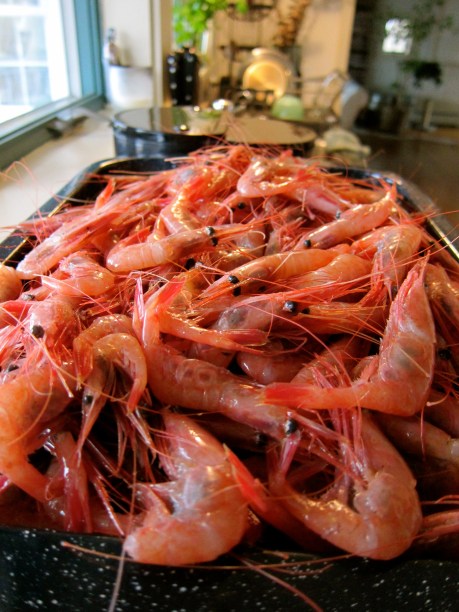
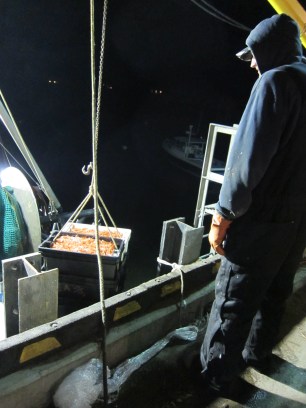
Northern shrimp (Pandalus borealis) is available fresh only while in season, and when it’s here we freeze enough to supply us for the coming year. We buy it directly from the F/V Rimrack based at Rye Harbor, one of New Hampshire’s few remaining working waterfronts. By the time the Rimrack comes in from a day of shrimping, it’s after 5 p.m. and dark out, with temperatures hovering around freezing. The boat has just docked and large totes filled with shrimp are waiting to be unloaded (lower righthand corner).

Customers have driven in from all distances to pick up a supply. The shrimp is weighed out for smaller orders, or portioned out by the five gallon bucketful.

The rest of the shrimp is unloaded and goes to the Yankee Fisherman’s Cooperative, with each tote holding about 100 pounds of shrimp.

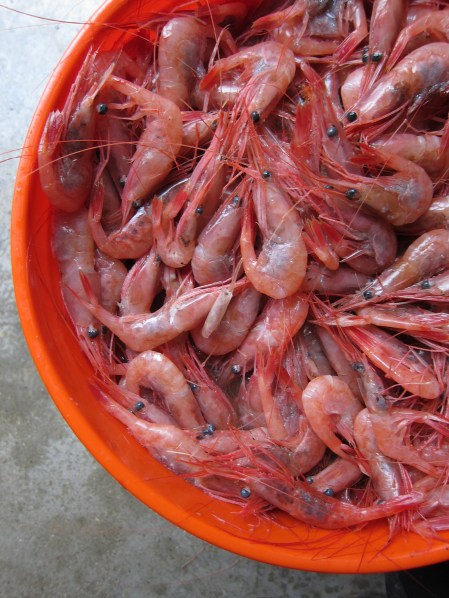
This five gallon bucket holds about 28 pounds of shrimp, and yielded 12 pounds after peeling. While the season lasts, northern shrimp is available direct off the boat through the F/V Rimrack in Rye Harbor, and Eastman’s in Seabrook; call ahead to confirm landing times and availability.

Posted in field trip | Tagged | 13 Comments

Northern Shrimp with Tomatoes and Yellow Eye Beans

The season for Northern Shrimp — a sweet, delicate wintertime treat — has finally arrived. We buy buckets of them straight off the boat, so fresh they’re still wriggling around. Left overnight to calm themselves down, we then roll up our sleeves and get to peeling. It’s a simple technique that differs somewhat from dealing with their larger brethren, but one well worth learning. Soon our freezer will be restocked and we’ll continue to enjoy them long after their brief season has passed.

I like the play of seafood’s briny flavors against more earthy ones and, with a pot of yellow eye beans already made, this pairing of two quintessential New England ingredients came together quickly. Not quite a soup nor a stew, this particular medley of Northern shrimp and beans reminded me more of a deconstructed chowder. Some chives from the windowsill and a glug of good olive oil was all that was needed to to bring this dish together. What began as a mid-week meal of gussied up leftovers turn out unexpectedly reviving. As a winter storm lashed the windows, we barely paused between spoonfuls and then, only to murmur to one another how good it was.

Northern Shrimp with Tomatoes and Yellow Eye Beans

Olive oil or other cooking fat
1 clove garlic, chopped
Pinch of red pepper flakes
1 small tomato, diced
1 pound peeled Northern Shrimp
Sea salt and freshly ground black pepper
4 cups of Yellow Eye beans and turnips (recipe in archive), kept warm
Chives for garnish

Start by sauteing the chopped garlic and red pepper flakes in some good olive oil in a fry pan until fragrant. Once the garlic has begun to color, toss in the diced tomatoes, and cook until they’re beginning to relax. The shrimp come last, a quick stir until they’re barely opaque. Season and scoop atop a warm bowlful of warm beans.

Local ingredients: Northern shrimp from the F/V Rimrack, storage tomatoes from Moondance Gardens, Yellow Eye beans from Baer’s Best Beans, turnips from Stout Oak Farm, garlic and chives from home.

11/12 update: Submitted to My Legume Love Affair #53, organized by The Well-Seasoned Cook.

Posted in cooking | Tagged , , , | 12 Comments

Cheddar and Ale Gougères

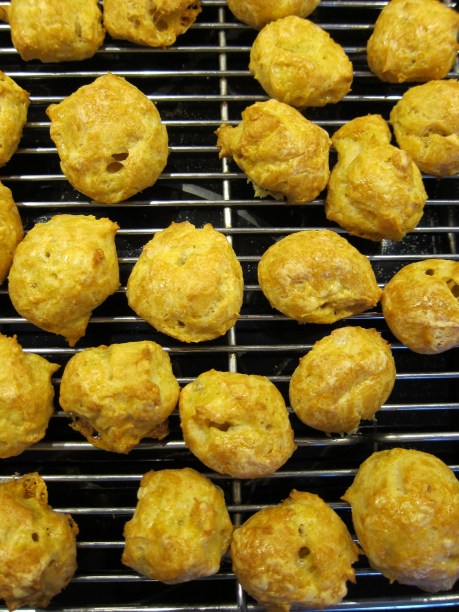
When I had an unexplicable urge to make gougères, I wondered if I was channeling something. All of a sudden they seemed the right thing to make. Light as air with tops shellacked by melted cheese, their crackling crust give way to a soft, slightly eggy interior enriched by yeasty ale. Think cream puffs but without the cream, transformed into a savory tidbit. Passed around at gatherings, they quickly disappear at the mention of two words, “cheese” and “beer” — brilliant additions that left us thinking, “Like Cheetos for grown-ups.”

With their French provenance, Gougères can seem intimidating to produce. Never fear, it’s a sturdy dough and thoroughly satisfying to make. Ale, milk and butter are brought just to the point of boiling, and fill the kitchen with the sweet scents of dairy and malted barley mingled together. Quickly, the flour is stirred in and a soft paste forms. Classic instruction guides one to pay attention at this point: keep stirring the dough over heat to dry it out slightly; it will take on a dullish cast, with a thin skin of toasted flour coating the bottom of the pot. Now you are ready to beat in the eggs, one by one with vigorous intent. The mixture will be slippery but then absorbs each addition, taking on a satiny sheen in the process. Grab a handful of grated sharp cheddar, and stir it in at the last.

The next step is a nice excuse to play with a pastry bag, but a dough scoop works just as well for portioning out each bite-sized puff. If neither is on hand, a simple spoon will suffice. This is the moment to take one’s time and enjoy the quiet rhythm of placing dough to parchment, topping each with a few more strands of cheese. Next, a fast start in a hot oven, then the temperature is lowered to a more moderate level. Be sure to rotate the pans around for even browning, though — and here’s a baker’s secret — opening the oven also gives excess steam the chance to escape, ensuring a crisp exterior. Once they’re done — another baker’s secret — sample it straight from the oven and also as it progressively cools. Discover how the flavors develop, round out, become more pronounced as the gougères wind their way down to room temperature.

For the recipe, visit Heidi at 101 Cookbooks, it’s about perfect. I left out the fennel and made mine smaller than she suggests, otherwise I’ve made several batches and each turned out better than the one before. If you’re using unsized eggs, 4 large equals ¾ cup plus 1 tablespoon (a hair above the ¾ mark on a glass measuring cup). For a spicy note, I’m thinking some cayenne or smoky pimenton wouldn’t be out of place here.

Local ingredients: Whole wheat pastry flour, cultured butter and raw milk cheddar cheese from Brookford Farm; whole milk from Harris Farm; Bar Harbor Real Ale from Atlantic Brewing Company; eggs from Mona Farm; and salt from Maine Sea Salt.
Posted in cooking | Tagged , , | 3 Comments