11.12.12 Winter tomato, pomodorini harvest

IMG_1980

We selected two types of pomodorini appesi — Italian winter or hanging tomatoes — to grow this season. The Aprile, named after the masseria in Puglia where the seeds came from, are now in their second year.

IMG_9753

The Ponderosa del Oro, another pomodorini from Puglia, are also a repeat from last year.

IMG_9676

The growing conditions this year seemed particularly favorable, and both varieties of pomodorini produced insanely prodigious amounts of fruit. Above: Laden vines, 9/15/12.

IMG_0069

Some of the pomodorini had started ripening by mid-September, and we began bringing them in for storage. The main harvest was on October 2nd, when the bulk of them were picked. Above: Trays of harvested Aprile pomodorini, 10/2/12.

IMG_0068

The Ponderosa sel Oro ripened much later than the Aprile. We were about to be away for three weeks and, with the cold fast approaching, we were forced to harvest the pomodorini while still green.

IMG_0082  IMG_0080

We now have two tables full of pomodorini on newsprint-lined trays stored in the basement, all from just 4 plants. Above: The pomodorini after harvest, 10/2/12.

IMG_1963

So far, these pomodorini harvested in September are storing well. We go through them about once a week and remove the damaged ones.

IMG_1961

It’s been six weeks since these were harvested. The Ponderosa (above, top) are slowly turning orange as they ripen; only a very few appear to be damaged. The late-harvested Aprile (above, bottom) seem to be more compromised, and aren’t holding up as well as those harvested earlier.

Posted in garden, tomatoes / pomodorini | Tagged , , | 17 Comments

Orecchiette with Braised Greens

IMG_0389

This second trip to Puglia gave us the opportunity to delve deeper into the region’s cuisine, and revisit such canonical dishes as Orecchiette con Cime di Rapa. Above: The fruttivendolo in Spongano, with chicories and cime di rapa (bottom) in season and on prominent display.

IMG_0442IMG_0428

Spongano resides in the southern portion of Puglia, and we were there for a week attending one of The Awaiting Table’s cooking courses. Especially arranged for returning students, it was a wonderfully engaging blend of the old and the new. We were already familiar with making orecchiette, and adding farina di grano arso, or flour from “burnt grain,” was an unexpected treat. The dough, a blend of 2/3 semola rimacinata (semolina flour) with 1/3 grano arso, was a delight to work with — soft yet resilient, and highly workable.

IMG_0472

Grano arso, a particularly Pugliese example of cucina povera, is traditionally made from the leftover grain gleaned from fields burned following the harvest. More typical of northern Puglia, some mills now offer a contemporary version and toast the semolina flour to replicate the smokiness of the original, a characteristic that marries perfectly in this dish with the bitter cime di rapa, salty anchovies, and peppery local olive oil.

Orecchiette with Braised Greens

Our trip afforded us many chances to sample different variations of this particular dish, including our last night spent at the airport hotel in Bari, not a place one usually thinks of as a gastronomic opportunity. However, with Italian business people as their main clientele, the hotel restaurant took pride in offering more than the standard airport fare. In this sleekly modern environment, we had a final, memorable plate of orecchiette di cime di rapa — plain semolina pasta heavily dressed in a bright green, almost a pureed, sauce, with just enough anchovy to balance the bitterness, but not so much as to mask the freshness of the cime di rapa.

IMG_1831

On return and before we’ve had chance to even unpack, we assuaged our phantom homesickness by making a jet-lagged batch of orecchiette. Our hands were eager to get back into the rhythm of making pasta, and put into practice some of that which we learned while away.

IMG_1824

We somehow neglected to plant cime di rapa this fall, but had a number of other brassica greens that readily took their place. We picked a couple of bunches of hon tsai tai to combine with the radish tops we saved just for this dish. The bright magenta of the hon tsai tai faded with cooking but, in the end, served fine as a substitute and added just the right amount of bitterness so integral to this dish.

IMG_1834

The recipe for Orecchiette con Cime di Rapa can be found in a previous post. This time, though, we blanched the greens in salted water before chopping them up finely. We then sautéed a clove or two of minced garlic with a pinch of pepperoncino in olive oil, then added 4 to 6 anchovy fillets, cooked until they dissolved into the oil. The chopped greens are added to the pan with a splash of water, and cooked until tender. Once the greens are done, boil the pasta, then tossed the cooked pasta into the pan with the greens. If necessary, add more pasta water to loosen the sauce. Season to taste with salt and pepper, and finish with olive oil. If you like, serve topped with toasted breadcrumbs — we’ve come to appreciate the nuance of having it without. But, as we were constantly admonished with a culturally-based shudder, never ever with cheese.

Note: For more on making orecchiette, visit the talented Simona at Briciole, where she’s been exploring making this as well as other classic pasta shapes by hand, and offers a wealth of information, tutorials and links. She makes it doubly fun by including an Italian version of each post!

Local ingredients: Hon tsai tai, radish tops, and garlic from the garden.

Posted in cooking | Tagged , , , | 8 Comments

11.8.12 First snowfall

IMG_1892

First snowfall of the season — this table serves as our ad hoc snow gauge. It’s still very windy, and we were glad to find we had electricity when we awoke this morning.

Posted in garden | Tagged , | Leave a comment

11.6.12 Another storm on the way

IMG_1713

We’ve barely had time to restock and replenish before hearing reports of another storm headed this way. We think it best to hold off raking for the time being.

IMG_1879

From the NYTimes: “A classic northeaster will impact the Northeast on Wednesday and Thursday, bringing strong winds, heavy rain and some snow. North to northeast winds will gust between 50 to 60 miles per hour along the coast from Maryland to Massachusetts, with some gusts as high as 70 m.p.h. on Wednesday evening in eastern Long Island. Additional coastal flooding and beach erosion is likely.”

Posted in garden | Tagged | 10 Comments

11.4.12 Forecast of frost

Untitled
With the weather about to take a decidedly chillier turn, it was time to get the garden tidied and ready for winter. The days are shortening, and we try to fit in as many chores in as we can while there’s still light out.

IMG_1781

There was plenty of leaves, limbs and debris to pick up after the storm, minor tasks considering the damage elsewhere.

IMG_1841

The celeriac and parsnips are being stored in-ground. Their raised bed received a thick layer of leaf mulch, and a low hoop cover of plastic.

IMG_1870

The winter greens bed — containing salad green, chard, kale, Fun Jen, and chicories (Brindisina, Galantina, and Pan di Zucchero) — is also now under plastic cover. Above: The chicories may need to be planted earlier next year to get full growth, but we were thrilled to see the Pan di Zucchero at least begin to furl.

IMG_1851

A harvest of kales, chard, and a mix of Brindisina and Galatina chicory. When the fridge is full, the chard and kale can be kept in buckets of water for at least several days, until ready to use. The chicory was prepared much as we learned recently while in Puglia.

IMG_1861

Under threat of a hard frost, we dug up the King Richard leeks, an early variety. The King Sieg leeks are being stored in-ground in another covered bed.

IMG_1853

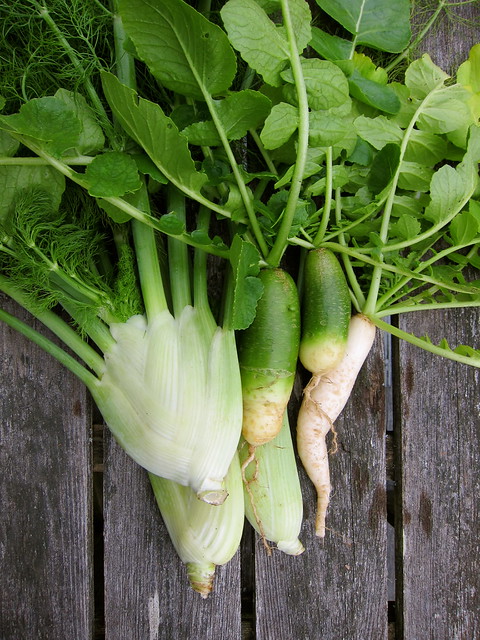
The carrots were thinned, and the rest left in-ground in the same bed as the leeks. We also pulled a couple of the larger daikon to see how they were faring.

IMG_1845
IMG_1846

This is the first time we’re growing daikon; their leaves have a most orderly growth pattern. We left the majority of them in-ground under a light row cover, but it remains to be seen how much frost they can tolerate.

IMG_1695

We grew several varieties of Tokyo turnips, but were stymied by an infestation of aphids. The roots ended up completely pockmarked below the soil level.

IMG_1706

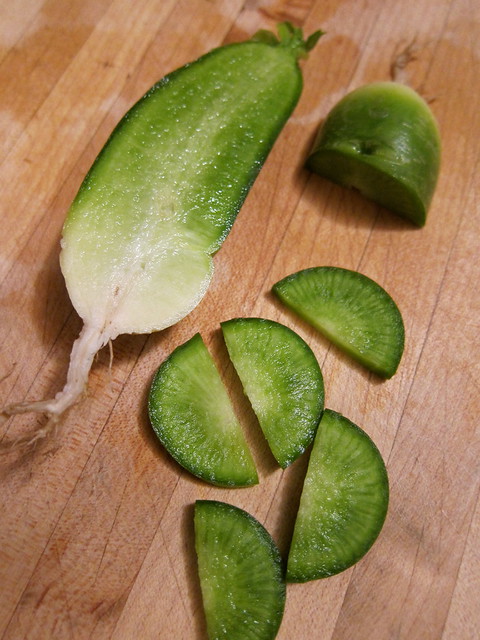
The fennel continued to produce tenaciously off of the roots left behind from previous harvests, and gave us one last final picking before clearing the bed. Along with the daikon, we also grew Green Meat radishes for the first time.

IMG_1720

Like Watermelon radishes, these Green Meat ones are suitable for winter storage. We enjoy them sliced thinly in salads and sandwiches, and are meant to be great for pickling and delicious roasted.

IMG_1876

Many thanks to Maury for keeping our garden growing while we were away!

Posted in garden | Tagged , , , , , , , , , | 19 Comments

Emergency Preparedness: Going off-grid

IMG_1795

“Be prepared.” — Girl Scout motto

We don’t have the luxury of being unprepared. We live far enough from town utility lines that when we lose electricity — whether from a disaster or extreme weather event — we also lose water as well as heat. Our oven, well-water pump, and oil burner all depend on it. Without electricity, life becomes much like camping in a big wood and sheetrock tent.

We hope that future renovations to our house will enable us to become more self-sufficient. Until then, we keep supplied with a number of things that help us adapt to most emergency situations. In addition to extreme weather, the risks particular to where we live include a nearby nuclear power plant and large bodies of water capable of flooding. The possibility of evacuation is a real one, and has become an integral part of our emergency planning.

IMG_1759

Light
First and foremost in any emergency is to stay safe. It can be perilous to move around in the dark, and we keep a store of candles, headlamps, flashlights and lanterns in a readily accessible place. Weather alerts allows us time to recharge everything, otherwise, we usually check on a yearly basis. While we’re at it, we also recharge the emergency radio. Look for features such as a solar charger and/or hand crank, and a weather band; a television band also allows you to receive news channels. A standard land-line phone gives us another link to the outside world.

IMG_1791

Water
We’re surrounded by water, little of it potable. The real irony though is that while we generally abstain from bottled water, we still need some around for emergencies and store a combination of store-bought and self-filled containers. The recommendation is 2 gallons of water per person per day, and we try to maintain keeping 5 days worth. Before any impending storm, the tubs are also filled to provide water for the toilets. We’ve a sun-heated camp shower bag, however, other than visiting friends with power, we’re still figuring out the shower issue. We’ve found that we can go about 48 hours but, by the third day, we start really really wanting one.

IMG_1764

Heat
While cozy, our fireplace proved incredibly ineffectual in keeping the house warm during a winter emergency. We installed a wood stove a few years ago, and were pleased to find that the top of it can also be used for cooking. A recently acquired portable butane burner keeps us adequately caffeinated to deal with everything, and our solar oven and outdoor grill also serve as back-ups.

IMG_1794
Sustenance
The pantry is well-stocked year round, and can be relied on to feed us no matter the emergency. Where we’ve really had to give it some thought is in the case of an evacuation. We have a friend a few towns over who, when a bordering river threatened to flood her street, was given 15 minutes to gather up her family and leave. Since then, it’s been on our minds what we would want or need if we were ever in her situation.

We keep a couple of bins ready to grab without much thought. They include rudimentary camping supplies such as a portable camp stove, sterno, lighters/waterproof matches, multi-tool knife, water purifying tablets, rope and an emergency blanket. Foodstuffs are highly personal: crackers, canned rice and beans (can be eaten cold or heated, straight out of the can), instant oatmeal, protein bars, and instant coffee. We’re constantly refining what to include but highly recommend some kind of chocolate. Fleeing is not the time to be abstemious.

IMG_1807

Extra necessities
Along with our provision bins, we keep a first aid kit, a notebook containing important contact/account information, an envelope of cash (note: ATMs don’t work without electricity), and what we refer to as the “zombie bucket.” We confess it’s in reaction to the mayhem that followed Hurricane Katrina, and contains such items as sponges, safety glasses, duct tape, spray paint, trash bags, bleach, as well as the bucket itself. Because you never know what you’ll encounter.

IMG_1802

Niceties
Pay attention to weather alerts. They give you time to do the things that make it more comfortable while waiting for the power to come back on:

– Tidy up the house — whatever state it’s in will only get worse as the days pass by. Make friends with a non-electric carpet sweeper.

– Run the dishwasher — better to start out with an empty one than end up with one full of moldering things.

– Make sure washed clothes are dry — ditto above.

– Fill your car’s gas tank — ensures you have enough to get elsewhere, should the need arise. If it’s winter, park your car in the garage with the front facing out; it’ll help keep your car from getting stuck in the snow or ice if you’re forced to leave.

– While you’re filling your gas tank, get some extra for the generator — we intensely dislike the sound the generator makes, however, we dislike losing all of the food in our freezer and fridge even more.

– With the flashlights, lanterns, and emergency radio, charge up whatever electronic device you deem necessary — on the other hand, the electronic break might be a welcome one.

– Make sure to allow time to take a shower and wash your hair. It may be awhile before you’ll get another chance, and having clean hair is always an instant attitude enhancer.

– Along with a good pair of rain boots, pants, and jacket, keep your sense of humor, gallows or otherwise. At a certain point, it’ll all be out of your control.

This is not a drill
What we learned from Hurricane Sandy — we need to put up a sticker alerting emergency personnel that we have pets; we need an anemometer to measure wind speed; we have a dismaying lack of chocolate in the house.

Resources
Plan, Prepare & Mitigate, Federal Emergency Management Agency
Plan & Prepare, American Red Cross
Safety & Preparedness – Emergency Response, UMaine Cooperative Extension

Posted in cooking, interlude | 7 Comments

11.1.12 Weathering the storm

IMG_1751

It wasn’t a matter of if, more a matter of when we would lose power. With Hurricane Sandy approaching landfall, the lights began to flicker. By mid-afternoon Monday, we were completely cut off.

IMG_1753

We lose power frequently enough that we keep the house well-stocked for going off-grid. With the wind and rain battering outside, we stoked the woodstove, lit the candles, and settled in to wait it out.

IMG_1746

We were on alert for the storm’s surge and watched the tides for possible flooding. Otherwise, our concern was with those directly in the storm’s path. Here, we’re listening intently to the radio for any further news.

IMG_1741.2

In the end, we were without power for only 36 hours. The storm left a few trees  uprooted, and the garden strewn with leaf debris and fallen limbs. In the scheme of things, minor inconveniences. Heartfelt thanks to all of you who left your kind thoughts. Our own go to those who suffered the brunt of Sandy’s destruction.

Posted in garden, interlude | 7 Comments