4.1.13 Garden Beginnings, Part 2

2008 garden

Part 2: About our first vegetable garden in 2008, with which we discover what two raised beds can produce…

Late August: We’d read about Roger Doiron of Kitchen Gardeners International and how he kept track of his first garden’s production to see how much he was saving on his family’s weekly grocery bill. We’re keeping weekly tallies of each week’s harvest, and comparing them with MOFGA’s Organic Price Reports. Lesson 10: Numbers don’t take into account the utter satisfaction we’re gaining from growing our own food.

2008 Garden

 Peas were started too late, and succumbed to heat; powdery white mildew put an end to the cucumbers; and, though there’s plenty of Delicata squash set, the vine dies back before the squash are ready. Looking back, it was most likely due to squash vine borer. Despite those setbacks, the tomatoes and summer squash, which are crowded together in half a bed, continue to produce prodigiously. Lesson 11: You win some, you lose some.

2008 Garden

We assiduously kept up succession plantings of salad greens. Much to our surprise, we had salad greens when they’d all but disappeared from the farmers’ market. Lesson 12: Each garden is a microclimate, and ours allows us to grow tender greens through the heat of summer.

2008 Garden

Late summer is beginning to take its toll on the garden, which has become impossibly overgrown and unwieldy. Maybe we shouldn’t have planted so many things, and so closely. Lesson 13: There’s inevitably a point in the season when the garden gets neglected, whether due to apathy, heat or mosquitoes.

2008 Garden

September: We’re passed the garden doldrums — days are shortening, the temperatures and bugs more manageable. One by one, plants are petering out, and we begin to plan for next year. Lesson 14: Gardening is an optimistic endeavor.

2008 Garden

2008 Harvest Totals
Cherry tomatoes – red and sungold: 22¼ lbs
Salad greens: 10¼ lbs
Peas: 1½ lbs.
Green beans – Maxibelle and Masai: 8¼ lbs
Boothby: 12 cucumbers
Costada: 16 zucchini
Zephyr: 100 summer squash
Delicata: 2 winter squash

2008 Garden

Red potatoes: 3¾ lbs
Blue potatoes: 9 lbs
Purple potatoes: 12 lbs

2008 Garden

November: The last planting of the year — garlic. We fear we may be too late in getting them in the ground, and learn from others that it’s fine as long as the soil is workable. Lesson 15: It’s not necessary to remove all of the paper coverings when planting garlic.

2008 Garden

Based on our initial foray, we add four new beds to the original two, no small feat in New England’s rocky soil. Above: A wheelbarrow full of rocks next to a pile of larger ones, all unearthed while digging out the beds. Lesson 16: Rocks are indeed New England’s largest crop.
2008 garden

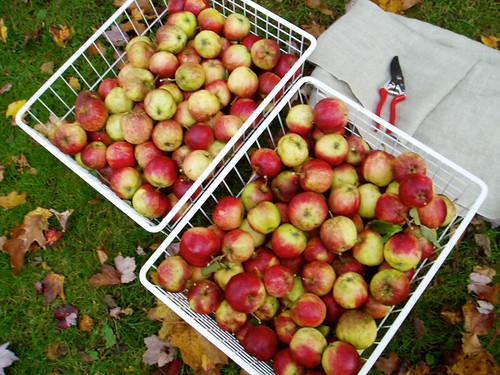
Last harvest of the season: Apples from the old tree on our property. We’d mistakenly took it for an ornamental crabapple until a neighbor came over and set us straight. We took a sample to Great Maine Apple Day, where local pomologist John Bunker identified it as a Priscilla. Lesson 17: Sometimes food is already growing in the garden, it’s knowing where to look.

Posted in garden | 8 Comments

A Moveable Feast

Five-Grain Bread

It’s been a whirlwind couple of months, stuffing my brain full of things I’ve learned from workshops I’ve either attended or given. Above, a decorated five-grain loaf from a week-long class on bread baking with Jeffrey Hamelman. Looking forward to sharing more during this season of renewal…

Posted in cooking, field trip, interlude | Tagged | 6 Comments

Local Food: Bangers and Mash

Local Food: Bangers and Mash

A busy week + a visit to Seacoast Eat Local’s Winter Farmers’ Market = Bangers and Mash for a quick supper, the kind that doesn’t require a recipe. We somehow missed Saint Patrick’s Day, and made up for it with Irish bangers from Popper’s Artisanal Meats, slow cooked in an open skillet until burnished on both sides. They’re served up with sweet winter spinach from Meadow’s Mirth, simply sautéed in a slick of oil seasoned with a clove of garlic. Chunks of celeriac and potatoes from our garden were steamed, then mashed along with a glug of milk for a silkiness; using leftovers shortened preparation time, and were heated up in another skillet until crusty. A dollop of grainy mustard from an earlier canning class, and a tall glass of pumpkin chai porter from Throwback Brewery’s “Unafraid of the Dark” series completes the scene.

Written for Seacoast Eat Local.

Posted in cooking, local food | Tagged , , , , | 12 Comments

Baking Interlude: Silver Moon Bakery

For a time, I had the early shift while cooking on the Upper West Side in New York. I wasn’t a morning person then, but still took pleasure in the daily walk to work. The sidewalks were quiet, though you could sense a kind of hum as the city was getting started for the day. I’d get to the restaurant, unlock the rusty rolling gates, and pick up our delivery of crusty baguettes left in the doorway. They would be snugly bundled, wrapped in crisp brown paper, with their pointed ends poking out. Still wonderfully fragrant from the bakery they came from, I would think to myself, someone somewhere made these.

“Working with bread dough is like playing music… I could not go a day without bread.” — Judith Norell, Silver Moon Bakery

Silver Moon Bakery: Rolling Out The Best Baguettes in New York City from SkeeterNYC on Vimeo.

Posted in cooking, interlude | Tagged | 6 Comments

3.13.13 Tulip Magnolia + 5 links

3.13.13 Tulip magnolias

• Anticipating Spring with Fig & Quince’s Sabzeh
• Finding Found, via The Improvised Life
• Waiting for Michael Pollan’s new book, while reading Taste, Memory
• Heading off to learn to bake like this
• And, looking forward to Winter Greens Field Day

Posted in interlude | Tagged , | 6 Comments

3.11.13 Garden Beginnings, Part 1

2008 Garden

It didn’t seem insane at the time. The way we figured it, you have to start someplace. It was 2008, and, with inspiration from Skippy’s Vegetable Garden, we set up two raised beds and began a vegetable garden of our own. 

2008 Garden

Mid-June (above): Mesclun salad mix in the foreground, cherry tomatoes in the middle, squash to the rear, and companion marigolds and nasturtiums tucked in between. Lesson 1: We can still patronize local farmers by buying seedlings at the farmers market, where we also find plenty of advice. 

2008 Garden

Early July: The garden is filling in. To the rear, the second bed contains peas, green beans, and cucumbers in one half, and potatoes in the other half. We have enough salad greens to give some away. Lesson 2: One of the rewards of gardening is being able to share the harvest with others. Just make sure the slugs are picked out of the lettuce beforehand.

2008 Garden

These tiny Zephyrs spied amidst gigantic leaves remind us of a baby’s first sonogram. We had a total of 4 squash plants — a yellow Zephyr summer squash, a Costada Romanesco zucchini, and two Delicata winter squashes. We wanted to cook with the blossoms and discovered, lo and behold, there are male and female ones. Lesson 3: Plants live to reproduce.

2008 Garden

Boothby cucumbers to the rear, shelling peas in the middle, and a very crowded row of green beans in front. Our intention was to thin once the seedlings came in. Lesson 4: It’s hard to bring yourself to selectively kill off things you’ve nurtured, especially from seed.

2008 Garden 2008 garden

Mid-July (above left): Peas and cucumbers climbing up their trellising. Early on, the pea pods are flat, and, thinking they’re deformed, we culled them. We later discover that the peas do eventually fill out. Above right: Boothby cucumbers in the early stages. They’re spiny, and we wonder again if that’s normal. Lesson 5: There’s a whole lot more to know about vegetable gardening then just putting things in the ground.

2008 Garden 2008 Garden

Above left: The potato plot with straw mulch. The sprouting we noticed isn’t from the potatoes pushing through, but from the straw itself. Lesson 6: There’s a difference between straw, salt hay and weed-free hay; choose with care. Above right: The squash plants are beginning to assert themselves. We try to direct their vines around and between the beds, but they’re the bullies of the garden and go wherever they want. Lesson 7: Everything they say about squash is true.

2008 Garden

Early August: Two rows of green beans thrive in their tiny allotment of space between the potatoes and peas. In the background, tomatoes and squash fight it out. We’ve abandoned using straw mulch on the potatoes, and added a removable rail to allow room for hilling them up. There’s plenty of growth above ground, while what’s below remains a mystery. Lesson 8: There can be such a thing as too much soil fertility; and Lesson 9: Growing root vegetables requires a certain leap of faith.

To be continued in Part 2…

Posted in garden | Tagged , , , , , , , | 10 Comments

Local Food: Shrimp and Cabbage Fritters + Winter Salad

Eat Local

I was going to call this post, “Not just potatoes.” This is for one of my cooking students who asked what could there possibly be to eat during winter that’s local. When I described what farmers were bringing to our Winter Farmers’ Market, I don’t think she believed me. Though, sometimes even I can’t believe it. Here’s how easy it’s become to eat locally all year long.

Winter Salad: Lettuce – Riverside Farm; watermelon radish – Garen’s Greens; carrots – Meadow’s Mirth; red onion – Wake Robin Farm.

Miso Vinaigrette: 1½ tablespoons cider vinegar – Sewall Organic Orchard; 3 tablespoons canola oil – Coppal House Farm; 1 tablespoon white miso – South River Miso, 1 teaspoon honey – Victory Bees.

Eat Local

Okonomiyaki (Shrimp and Cabbage Fritters): Eggs – Mona Farm; whole wheat pastry flour – Brookford Farm; Savoy cabbage – Stout Oak Farm; red onions (in place of scallions) – Wake Robin Farm; Northern shrimp – FV Rimrack; canola oil – Coppal House Farm; salt – Maine Sea Salt.

The recipe for Okonomiyaki, a kind of Japanese fritter, is from the Cabbage board on our Pinterest site. Don’t know what to do with some of the things you find at the farmers’ market? Check it out — we’re constantly adding new recipes, listed by ingredient.

Eat Local:

Kate at Stout Oak Farm was the first to try these little savory pancakes out. She made them vegetarian by leaving out the shrimp, and declared them delicious. We made them with the shrimp, and hardily agree with her.

Originally posted on Seacoast Eat Local.

Posted in local food | Tagged , , , , , , | 2 Comments