


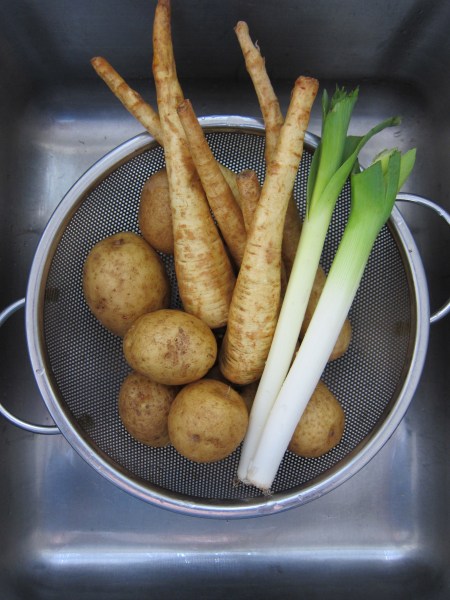
Described as having “hints of mace, cinnamon, celery seed, and clove,” the flavor that most came to mind when I first tasted parsnips was coconut. I was in my 20’s, living in New York, and visiting friends in the country for Thanksgiving. The morning after, my friend sauteed some kale, and then some parsnips to have along with our turkey sandwiches. The two were new to me and though I liked both, what I really wanted more of were the parsnips.
There’s an old New England superstition that believes “Parsnips are poison unless they are first frozen,” which may have something to do with the confusion between poison hemlock and wild parsnip. Nevertheless, parsnips left to sweeten overwinter in the ground are considered a treat here. We buy the spring-dug parsnips when we happen across them at the farmers’ market, but that’s still a ways off and I made do with some that had been stored — they don’t have the same complexity of flavor, but remind me that spring is near.

Farmhouse chowder, unlike the more well-known New England one, omit the seafood and are all about making do with what’s on hand. This one relies on the quality of its few ingredients, letting the earthy sweet, almost floral flavor of the parsnips shine through. I used leeks instead of onions, and prefer using cream rather than milk in order to keep the chowder from curdling when, inevitably, I let it overboil. Like most dishes of this nature, the flavor improves if it’s let to sit overnight.
Spring-Dug Parsnip Chowder
3 ounces salt pork (or bacon), rind removed and cut into 1/3-inch dice
2 tablespoons butter
1 large onion (10 ounces) cut into 3/4-inch dice
1 pound parsnips, peeled and sliced into rounds
1 pound potatoes, peeled and cut into 3/4-inch dice
3 cups chicken stock
1 1/2 cups heavy cream
Sea salt and freshly ground black pepper
Chives, chopped (or parsley, celery leaves)
– Render the diced salt pork in a heavy pot over low heat until it releases a few tablespoons of fat. Increase the heat, add the butter and onion, and saute until the onion is tender but not browned. Add the parsnips, potatoes, and stock, and bring to a boil. Cook vigorously for about 10 minutes, or until the vegetables are barely tender. Reduce the heat to low.
– Remove 2 cups of the chowder from the pot and puree in a food mill or processor, then return it to the chowder. Stir in the cream, and let the chowder simmer slowly for another 5 minutes; the broth should look silky-smooth. Remove from heat, and season with salt and pepper.
– If not serving within the hour, let cool then refrigerate; cover after it has chilled completely. Otherwise, let it set at room temperature for up to an hour, allowing the flavors to meld. When ready to serve, reheat the chowder over low heat; don’t let it boil. Garnish with minced chives, parsley or celery leaves.
Recipe adapted from “50 Chowders” by Jasper White.
Local ingredients: Parsnips and butter from Brookford Farm; cream from Harris Farm; Keuka Gold potatoes from Riverside Farm; bacon from New Roots Farm; leeks and chives from the garden; homemade chicken stock.

A blue afternoon, with the snow beginning to fall.
I’m not very good at things that require sustained attention, and maintaining a sourdough culture is one of them. I’ve tried ones from Carl, Breadtopia, and Paula, and even making my own. They would languish in the back of the fridge, and I couldn’t get the hang of baking with them. I can, however, be persistent. Inspired by Wild Yeast and my attempt at sourdough bagels, I was willing to give sourdough cultures another go.
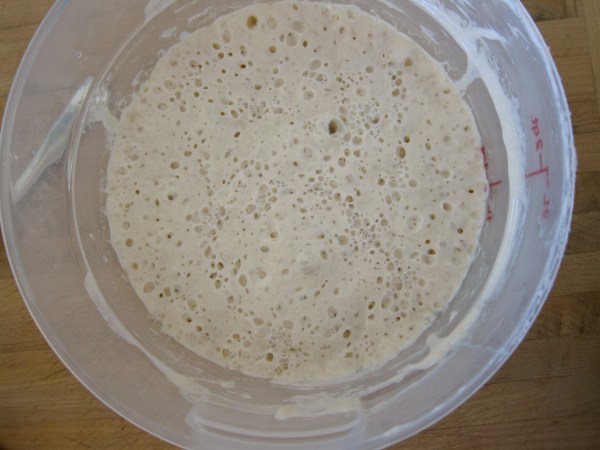
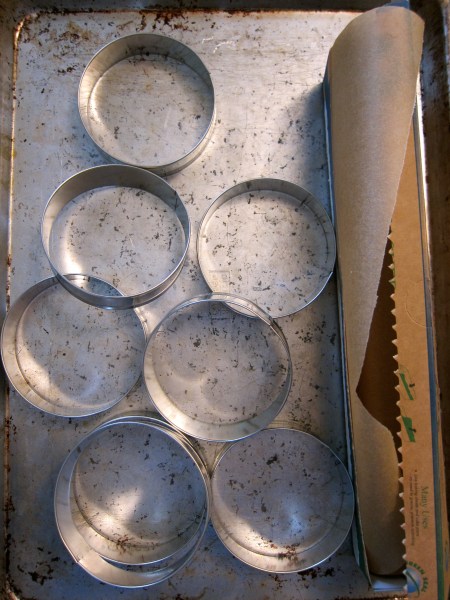
I had sourdough English muffins in mind, and ordered a fresh culture along with some muffin rings. The culture didn’t have very far to travel by mail, and took to being fed with impressive vigor.
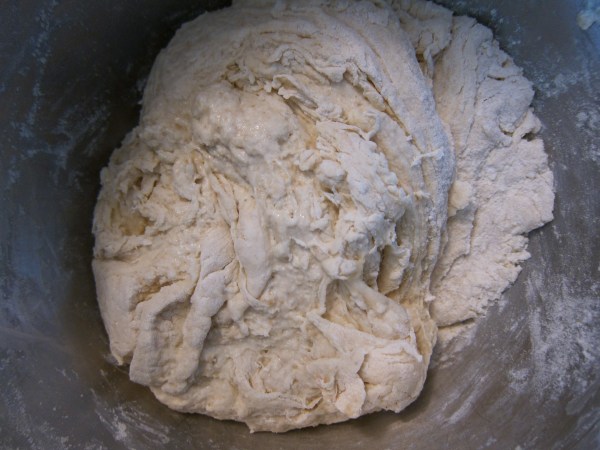
You know when the recipe says, “Resist the urge to add more flour,” that sticky dough is ahead. Did I already mention that I’m not very good at following directions? I couldn’t resist, but promise to add less flour next time.

I also can’t leave well enough alone. Rather than cooking these muffins on a griddle, I wanted to try baking them, which meant cobbling together two different recipes — the dough from Wild Yeast, and baking instructions from King Arthur. It wasn’t optimal, but curiosity got the best of me. It was convenient to bake all of them in one go, but produce a closer crumb than when cooked on a griddle. There was room for improvement on my part, however, the results were certainly nicer than store bought.

Note: Many thanks to YeastSpotting for including my sourdough bagels in their weekly showcase!

Participating in the Daphne’s weekly gathering of gardeners reminds me to take a break from the busyness of ordinary life. The start of spring is three weeks off, still there are signs of new and renewed growth. A quick walk around the garden found these shoots of cutting celery pushing their way through last season’s debris.
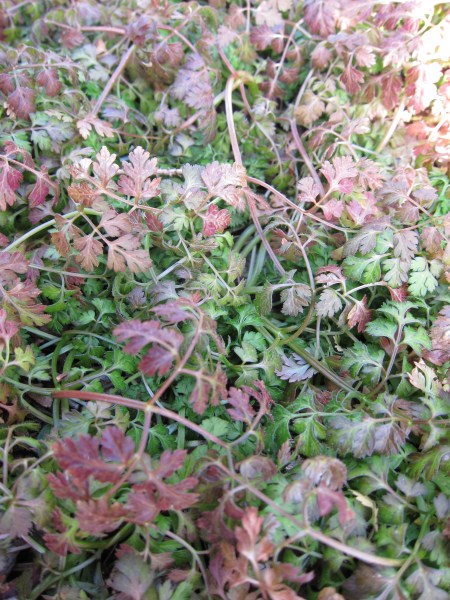
I’ll most likely regret having let the chervil go to seed, but this tenderest of herbs has also proved to be the most resilient this winter.
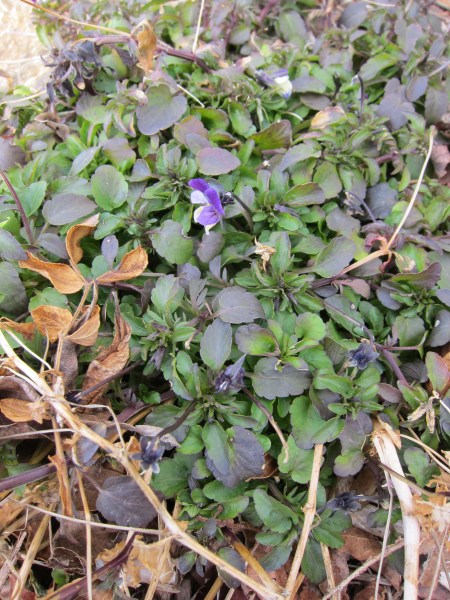
I almost didn’t catch these, so unexpected were they. Fooled by this winter’s warmer temperatures, the violets are up and flowering, despite this morning’s light frost. The prediction for snow this week has us waiting expectedly.

We take our beans seriously here in New England. Rumour has it that the reason there are so many different varieties is because every town had its own bean. I’ve yet to try them all but am working on it, abetted by the growing number of local farmers who are resurrecting the many heirloom varieties.
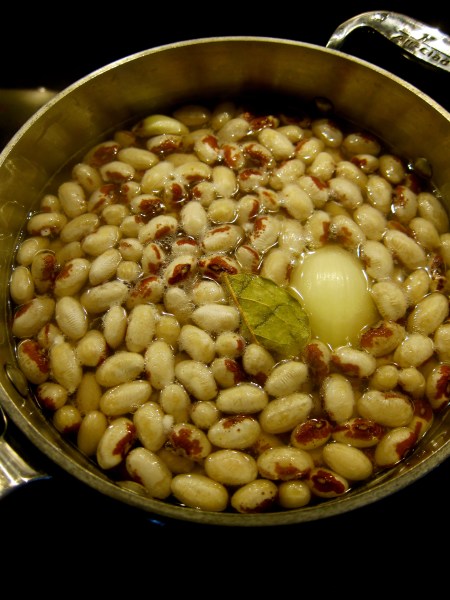
My early experience of baked beans was limited to the canned variety, a far cry from the real thing. The possibilities within this humble dish became apparent when I had the chance to taste bean-hole beans. This traditional way of preparing beans is an annual affair at the Common Ground Country Fair, where large pots of them are buried in a fire pit, then left to bake long and slow. The resulting beans were velvety in texture, imbued with a smoky, complex sweetness.

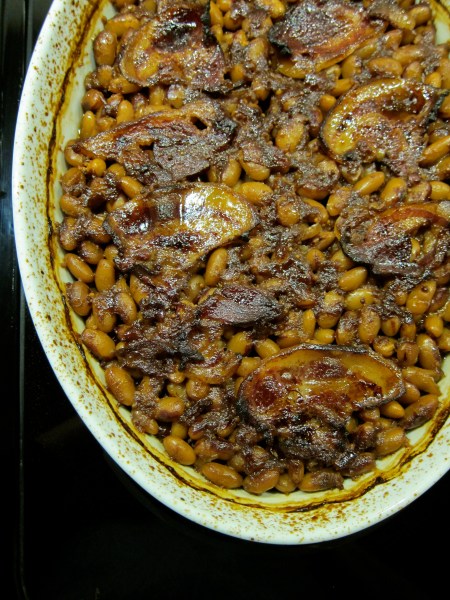
Recently, I’ve been relying on this southern take on baked beans by Andrea Reusing. The recipe call for precooked beans, something we usually have on hand and making this an easy dish to assemble. Here, I used an heirloom variety of dried bean called bumblebee, in reference to it’s large size. I also used jowl bacon instead of strips, but either is fine; the bacon itself is an integral part of the dish but omit it if you prefer to keep it meatless. As for the rest of the ingredients, I substituted more local ones — boiled cider for the sorghum, grainy mustard for dry, and maple syrup instead of dark brown sugar — all of which made for a dish still inextricable from place.
Baked Beans with Smoked Bacon
1/4 cup tomato paste
1/4 cup boiled cider (or molasses)
3 tablespoons grainy mustard
2 tablespoons cider vinegar
1 tablespoon maple syrup
Sea salt
1 cup dark beer
2 quarts cooked beans, drained, cooking liquid reserved
6 slices smoked bacon
– Heat oven to 400°F. In a medium bowl, combine the tomato paste, cider syrup, mustard, vinegar, maple syrup, and 1 teaspoon salt. Slowly stir in the beer. Add the beans plus enough of their reserved cooking liquid to create a slightly soupy consistency. Combine, and adjust to taste. Reserve the remaining bean cooking liquid.
– Transfer the mixture to a shallow baking dish and top with bacon. Bake for 30 to 40 minutes (or longer if desired), until the bacon is browned and the top begins to become crusty around the edges. Check while cooking, and add more liquid or water if necessary so that the beans don’t dry out; they should remain a bit saucy.
Recipe adapted from “Cooking in the Moment” by Andrea Reusing.
Local ingredients: Bumblebee dried beans from Baer’s Best; jowl bacon from New Roots Farm; Coal Porter dark beer from Atlantic Brewing Co.; maple syrup from Sugarmomma’s Maple Farm; cider vinegar from Sewall Organic Orchard; maple mustard from White Gate Farm; salt from Maine Sea Salt; homemade tomato paste and boiled cider.

Many traditional New England recipes call for molasses, an ingredient that’s rooted in trade with the West Indies during Colonial times. It has a deep, dark, almost minerally flavor, and is what gives such dishes as baked beans, gingerbread and indian pudding their particular taste. In searching for a more locally-produced substitute, I discovered an almost forgotten one, boiled cider. We have local honey and maple syrup, sometimes even birch syrup, but only boiled cider comes close to matching the caramel-like sweetness of molasses. When I found that it’s also known in some parts as apple molasses, I felt I was on the right track.
With further thought, I realized that boiled cider is simply another way of preserving apples for scarcer times ahead. Recipes abound for boiled cider pie (with or without additional apples), boiled cider applesauce, and “jelly” water — a beverage made of a spoonful of boiled cider or its jelly stirred into a glass of water, and drunk as a substitute for apple cider. I was already convinced by Michael Pollan in The Botany of Desire of the versatile utility of apples, and boiled cider adds to its reputation as the king of fruit.

I’ve become reliant on the rich, tangy flavor boiled cider contributes to dishes, however, the farm I’ve gotten it from has changed hands, and it isn’t known if the new owners will continue its production. With my last bottle of boiled cider reaching its end, I set about making some of my own. It’s nothing more than what the name implies — apple cider boiled down until it’s become concentrated to a syrupy consistency. Proportions range, some say 5 to 1, while others suggest 7 to 1. In any case, making boiled cider promised to be an easier endeavor than making maple syrup, with its jaw-dropping yield of 40 to 1.

I started with four gallons of fresh, organic apple cider, poured it into a non-reactive pot, and set it on the stove. Once it commenced boiling, I skimmed off the froth collecting on top and, as recommended, continued boiling it down as quickly as possible. As I waited, I went about with other chores, while at the same time kept alert for any changes in sound or smell that would warn of over-boiling. It took several hours for the level to drop sufficiently, and then the cider reaches a point where it quickly turns into syrup. Apples contain naturally high levels of pectin and sugar, and I let this first batch go too far, inadvertently becoming cider jelly (bottom of photo). This happy accident yielded four pints to add to our pantry.

 Diary of a Tomato