
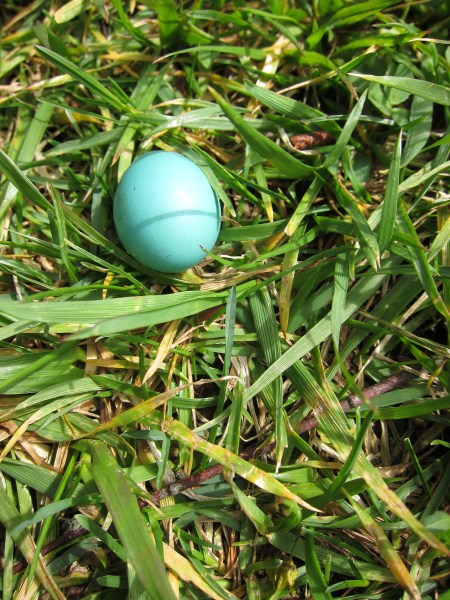
I found this fallen robin’s egg on the way to checking the garden today. Judging by the scratch marks dug into its shell, it was most likely knocked out of its nest by some marauder.
I found this fallen robin’s egg on the way to checking the garden today. Judging by the scratch marks dug into its shell, it was most likely knocked out of its nest by some marauder.

The Seacoast is home to an active permaculture community, which hosted a presentation on “Edible Forest Gardening: Perennial Food Production” with Jonathan Bates of Food Forest Farm last year. Much of the plant material Bates spoke about is available through his website. By chance, we remembered to place on early enough order this season, which just arrived. Descriptions are from Food Forest Farm:
Sea Kale, Crambo maritima (above): Mostly clumping, suckers if roots are broken by digging. Beautiful honey-scented flowers, fantastic edible broccolis. Ours are more than 10 years old. Shoots also edible in spring, and some tasty leaves can be harvested in fall without weakening plant. All parts edible.

Sweet Cicely, Myrrhis odorata (above): Self-sowing herb for sun to part shade. All parts strongly sweet anise flavored, we love the green seeds which taste like black jelly beans. Flowers attract beneficial insects.

Skirret, Sium sisarum (above): Clumping perennial, self-sows. Forms clusters of edible roots that taste like parsnips, very nice. Flowers attract beneficial insects.

“Profusion” Sorrel (above): Rumex acetosa. Clumping leaf crop, wonderful sour flavor. “Profusion” is a variety that never flowers, so it makes tender greens all season long. Ours comes up under the snow!
Welsh Onion: Allium fistulosum. This perennial scallion forms clumps, which can be thinned for harvest once or twice a year. Very good flavor and lovely flowers.
Turkish Rocket: Bunias orientalis. Robust, clumping plant. Beautiful yellow flowers, young broccolis are much like broccoli raab – nutty and mustardy.
Hazelbert (improved): Corylus sp. Large multistemmed shrub, edible nuts. High in oil and protein, may someday replace soybeans. Order two for pollination.
Resources:
• Food Forest Farm, Holyoke, MA
• Perennial Vegetables by Eric Toensmeier
• Creating a Forest Garden by Martin Crawford
• “Perennial Vegetables: Growing More Food with Less Work,” Mother Earth News
• “Ye Olde Kitchen Garden,” New York Times

We’ve been nibbling on the few shoots of asparagus that have made their way up, our self-restraint finally rewarded with enough to make a meal of.

Brothy rice with peas, called risi i bisi, is a classic Venetian dish. Though historically prepared only on the feast days decreed by the Doge, Venice’s ruler, this dish, timed to the arrival of springtime peas, is a celebration in itself. Alas, for those of us in more northern climes, peas only go in as soon as the ground can be worked, usually mid to late April, their pods just a promise until June or July. In the meantime, we patiently make do with our store of freezer peas, and await their true season as the vines climb their way upwards over the next couple of months.
Risotto with Peas and Spring Onion Oil
4 to 5 cups stock
2 to 3 tablespoons extra virgin olive oil
1 to 2 tablespoons butter
1 small onion, finely chopped
1 cup vialone nano or other arborio-type rice
1 cup dry white white
2 cups blanched peas
Sea salt and freshly grated black pepper
Spring onion oil
Asparagus, roasted and chopped, for garnish
Grated parmesan cheese
– Bring the stock to a simmer, cover and keep warm. In a wide, shallow pan, melt a large pat or two of butter in a generous glug of olive oil. Add the onion, and saute until tender. Stir in the rice, coating with oil, and continue to saute until the grains begin to look transparent. Add the white wine, bring to a simmer, stirring until the liquid is almost all absorbed. Continue by adding the stock a cupful at a time, allowing it to become absorbed between additions, until the rice is almost tender but still firm to the bite.
– Stir in the peas, and season to taste. Finish with a swirl of spring onion oil and topped with roasted asparagus. Serve with grated parmesan on the side.
Local ingredients: Butter from Brookford Farm; onion from Pickpocket Farm; peas from Meadow’s Mirth; asparagus from the garden.

A thoughtful friend recently sent me the link to Wendell Berry’s 2012 Jefferson Lecture, “It All Turns On Affection“:
For humans to have a responsible relationship to the world, they must imagine their places in it. To have a place, to live and belong in a place, to live from a place without destroying it, we must imagine it. By imagination we see it illuminated by its own unique character and by our love for it. By imagination we recognize with sympathy the fellow members, human and nonhuman, with whom we share our place. By that local experience we see the need to grant a sort of preemptive sympathy to all the fellow members, the neighbors, with whom we share the world. As imagination enables sympathy, sympathy enables affection. And it is in affection that we find the possibility of a neighborly, kind, and conserving economy.
As a companion piece, Mark Bittman’s account of his visit, “Wendell Berry, American Hero,” offers a personal view of “the soul of the real food movement.”
Photograph from walking the Johnson Farm, called Rustlewood, the last dairy farm in Kittery, ME. Together with the Kittery Land Trust, they are working to preserve this 300 acre parcel as agricultural land.

A quick stroll around the garden yields a harvest of garden alliums (left to right): Egyptian or walking onions, chives, and garlic chives. As the first things up and in abundance, I make frequent batches of green onion oil, a splash of which brightens our meals with its fresh, oniony bite.

Chop up the green onions coarsely and put them in a blender with 1/2 to 1 cup oil. A neutral tasting oil is best, here I used a milder olive oil.

Blend until just short of emulsified, still liquid and pourable. Too many onions will give a pesto-like consistency, which can be thinned with the addition of more oil.

To strain out the fibrous bits, pour into a fine meshed sieve and let drain. The less it’s blended, the more limpid the oil.

The green onion oil can be used most anywhere you would a finishing oil — soups, pastas and risottos —and is especially good over eggs. Store it in a covered jar refrigerated, it will keep about a week; let it come to room temperature before using. For a more indulgent version, mix it in with some rich, local pastured butter now in season — just the thing to adorn a simple plate of fresh asparagus.

 Diary of a Tomato