8.22.12 Garlic mites

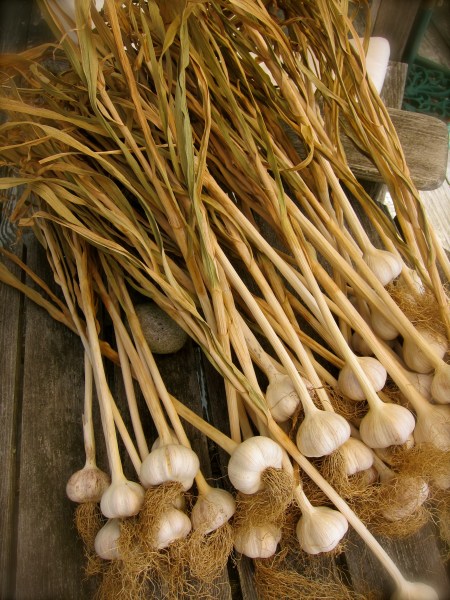
After several weeks, the remainder of the garlic harvest was ready to be trimmed for storage. On closer inspection, we were disappointed to find some damage from garlic mites, also known as dry bulb mites, on individual cloves. This is a common problem, one we’d hoped was solved through the selection of clean, undamaged cloves last season, each painstakingly peeled before planting.

To be certain that mites were the issue and not something more devastating, we contacted Eric Sideman, who, as Organic Crop Specialist at MOFGA, provides their periodic Pest Report. After sending a couple  of photographs of our garlic, Eric’s first take was that it could the beginning of penicillium. However, additional photos seemed to allay his concerns: “Bad mites would have taken many of the roots, but that does not seem the case. I bet you are ok.”

Garlic mites can also infect others in the allium family, including onions and leeks. The Oregon State University Extension Service recommends the following preventative measures to keep in mind:

• Avoid successive onion and garlic crops.
• Flood irrigation or heavy winter rain will reduce mite populations.
• Hot water treatment of bulbs prior to planting can reduce mite populations, but effective temperatures also reduce germination. Effective times and temperatures were 130°F fir 10–20 minutes, or 140°F for 10–15 minutes.
• Good control was reported with soaking affected cloves for 24 hours in 2% soap (not detergent) and 2% mineral oil.
• Light or moderate infestations are controlled with the normal drying process prior to storage.

The problem of garlic mites may have been there all along, something we just may have never noticed before. Once we spotted it, we wondered if it was something minor or more serious. We won’t really know the extent of the damage to our bulbs until the fall planting. In the meantime, we hope that the care we took in drying them will have resolved this year’s infestation.

Resources:
– Eriophyid mites on stored garlic, Oregon State University Extension Service
– Onion and Garlic Bulb Mites, UC-IPM Online, UC Davis
– Bulb Mite Found in Garlic FieldsWeekly Crop Update, University of Delaware Cooperative Extension
Another Garlic Pest – Bulb mites (Rhizoglyphus spp), MOFGA’s Pest Alert, October 23, 2012

Posted in garden | 8 Comments

8.20.12 Summer in a jar

These jars are like a timeline of summer’s harvests. Ever since reading about Daphne’s refrigerator pickles, our refrigerator has been slowly filling up with them, added to as the season progresses. Left to right: baby carrots, Cincinnati Market radishes, and Masai filet beans mixed with Dragon Langerie, all in a rice vinegar brine.

Above: A partial jar of baby beets, and a mix of summer squashes and carrots.

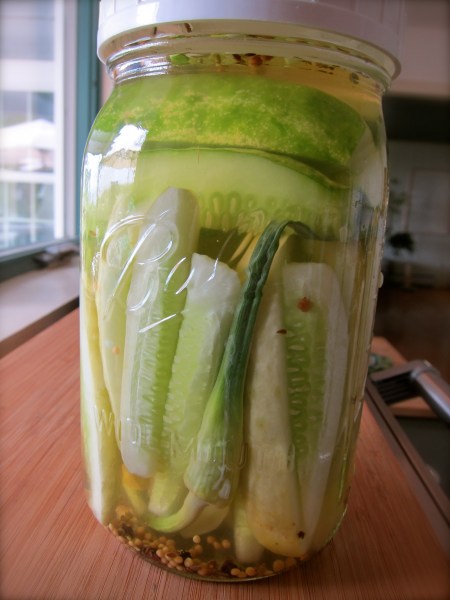
Our favorite slicing cucumber is Boothby’s Blonde, an heirloom from Maine. We usually plant more than we need to ensure there’s enough for the tomato and cucumber sandwiches we gorge on all season long.

When canned, the Boothby’s tend to go soft, more so than conventional pickling cucumbers. Using them as refrigerator pickles seems to suit them perfectly — they retain their crisp texture, and taste of lemons in a beguiling way. I added pickling spices and a garlic scape to the jar above, with some standard green cucumbers filling in the top.

These jars were an experiment in making a quick tatsoi kimchi using two different recipes. Both were more like a salad, and made me miss the flavor and texture of a true kimchi.

A mid-summer harvest of tatsoi and fun jen went into making our first batch of kimchi. Above: Before and after six house of brining.

Once everything was mixed with the rest of the ingredients, the kimchi was packed into quart-sized jars. Glass jar lids from Weck conveniently fit inside a Ball wide-mouth quart jar; they’re placed on top in order to keep the vegetables submerged during fermentation.

I used Alex Lewin‘s recipe from Real Food Fermentation —  his book is super user-friendly, with many photographs of the process. He urges the reader to taste at certain points of the process, helpful advice for ending up with something you’re sure to like. For those unfamiliar with kimchi, Lewin also includes a list of serving ideas.

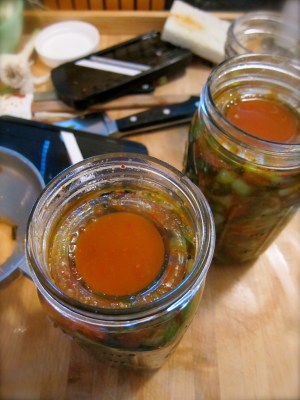
This version of cucumber kimchi is from David Chang’s cookbook, Momofuku. Meant as a fresh pickle, this particular combination of salty, sweet flavors reminded me of summers spent visiting my grandparents in Hawaii.

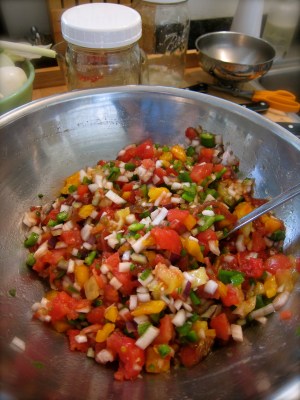
I make several jars of lacto-fermented salsa every year based on Sally Fallon’s Nourishing Traditions. This year’s batch is from a colorful mix of heirloom tomatoes fresh from the farmers’ market.

Each quart jar gets a dose  of whey obtained from draining yogurt, and salt. I employ a whey starter to create a favorable environment for the right microbes, and get the fermentation process off to a good start.

This method preserves the taste and texture of fresh tomatoes, and the resulting jars will more than make up for the space they take up come mid-winter.

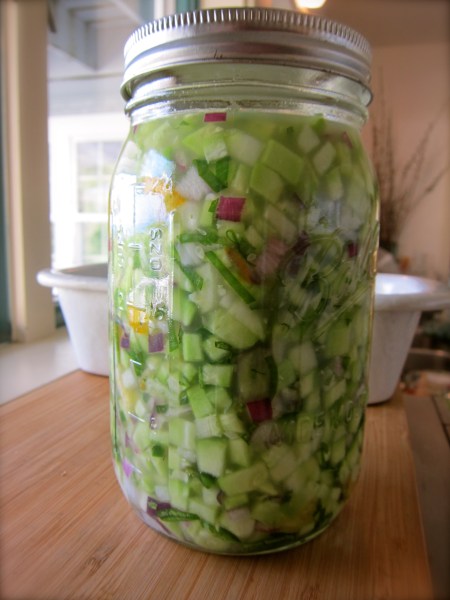
An excess of pickling cucumbers was an opportunity to experiment with a salsa based on them. With red onion and yellow tomato tossed in the mix, the color has since mellowed from its initial brightness. A taste-off is soon to come, and patience while everything cures, hopefully, rewarded.

A big welcome to those of you visiting from Bonbon Break, thanks for dropping by! Make sure to also visit Daphne’s Dandelions, where she hosts Harvest Monday, a weekly gathering of gardeners to show off what’s being harvested, and how it’s being used or saved. Harvests may ebb and flow with the change in seasons, however, there’s camaraderie in knowing others around the world are growing food in whatever space they have available, whether it’s on a balcony or windowsill, in a container or raised bed, or an entire lawn converted over to cultivation.

And a special hello to those of you coming over from Breaking New Ground, thanks for swinging by!

Posted in cooking, garden, preserving | Tagged , , , , , , , , , | 24 Comments

Mastering Food Preservation: Freezing & Canning Low-Acid Vegetables

As a general rule, it’s the acidity of an ingredient that determines the method of canning that should be used. Low acid foods (ph greater than 4.6), such as vegetables and meat, require processing in a pressure canner in order to be preserved safely at home. Unless you have unlimited freezer space, learning to use a pressure canner expands the options for the winter pantry.

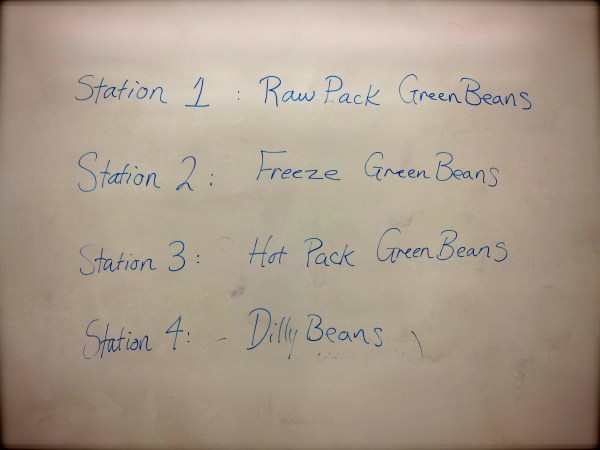
With 18 pounds of green beans from Fairwinds Farm in Bowdoinham, ME, on hand, the fourth class in the Master Food Preserver Program focused on several different ways of preserving this low acid vegetable — through freezing, pressure canning (raw and hot pack), and pickling.

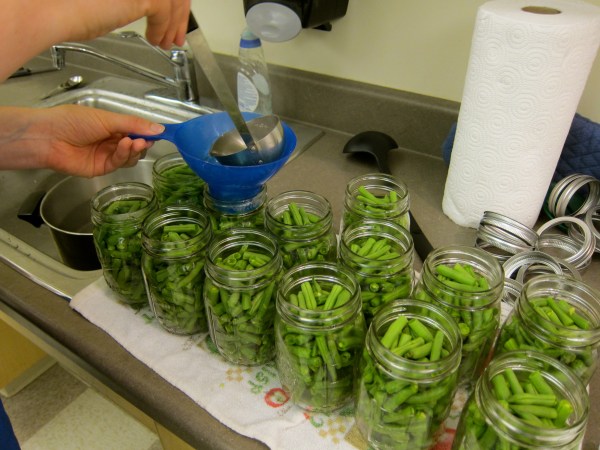
The raw pack process, also known as cold pack is just what it sounds like — packing the jars with uncooked beans  — and goes quickly. Simply wash the beans, trim and cut, and pack the jars tightly until you run out of beans or jars, whichever comes first.

A quarter teaspoon of canning salt was added to each pint-sized jar for flavor, with boiling water following, and leaving a 1 inch headspace. Once the jars were covered, they were placed in the pressure canner. Above, you can see the pressure canner being loaded with a second tier, another canning rack placed in between to keep the two levels separate. These raw-packed green beans were then processed at 10 pounds of pressure for 20 minutes.

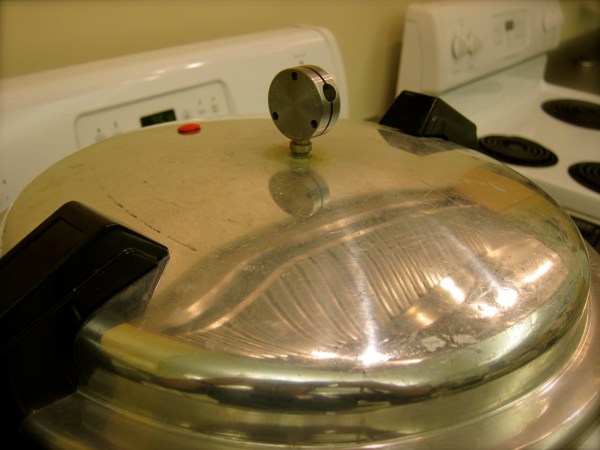
Our teacher, Kathy Savoie, brought in two different types of weighted-gauge pressure canners for us to use. The one above is from Presto and is designed to rock gently, while the one below is from Mirro and “jiggles” several times a minute once they’re up to pressure. It can be mystifying what these terms mean and, as both these canners came up to pressure, we appreciated the opportunity to experience firsthand what “rocking gently” and “jiggling” sounds like.

Another way to regulate the pressure in a canner is through a dial gauge. I use what’s called a dual-gauge canner, which has both a dial and weighted gauges, and allows the user to track pressure visually as well as by sound.

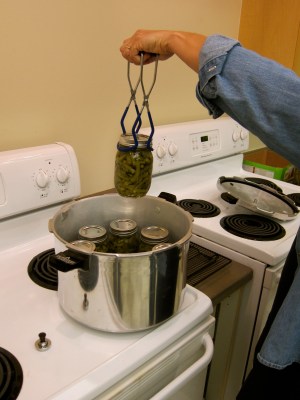
These are the hot-packed green beans being carefully removed from the canner and set aside to cool. Notice how Kathy is lifting the jar straight up from the pot before setting it down; the liquid in the jars was still boiling inside, and tilting the jars may interfere with the vacuum seal as it forms.

Rather than packing the jars raw, these hot-packed beans were covered with boiling water and left to boil for 5 minutes before transferring to jars. The extra step preshrinks the beans, allowing more to fit in the jar; it also helps to prevent floating once the jars of beans are processed. Hot-packing as a technique also improves shelf life, further preserving color and flavor, especially with foods that are processed with a boiling water canner.

After processing, these jars were left to cool undisturbed for at least 12 to 24 hours. The two jars of raw-packed beans on the left seem indistinguishable from the hot-packed one to the right. Once the rings were removed, the hot-packed jars were noticeably more full than the raw-packed ones; the raw-packed beans had shrunk more during processing.

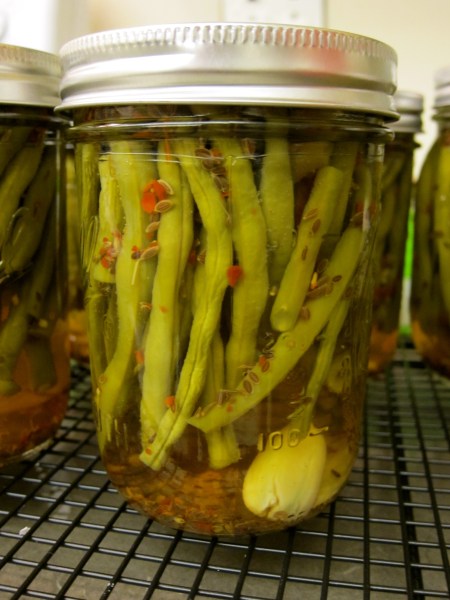
Also known as the “olive of Maine,” dilly beans are another way of preserving green beans, especially if you don’t have access to a pressure canner. The inclusion of vinegar brings up the amount of acidity, allowing these spicy pickles to be processed safely with a boiling water canner.

There seem to be two distinct camps when it comes to preserving green beans — some prefer them canned, while others prefer them frozen. In a side by side comparison, there didn’t seem much difference between the raw-packed (left) and hot-packed (middle) beans, while the frozen ones had retained both more color, flavor and texture. The closest in texture to fresh were the dilly beans, which were raw-packed and processed for only 5 minutes, compared to 20 minutes for the pressure-canned ones.

Resources:
– Preserving Food: Freezing Vegetables
Preserving Food: Canning Vegetables
– USDA Canning Guide: Selecting, Preparing and Canning Vegetables

This is one in a series of posts following the Master Food Preserver Program offered by the University of Maine Cooperative Extension.

Posted in cooking, preserving | Tagged , , , , , | 12 Comments

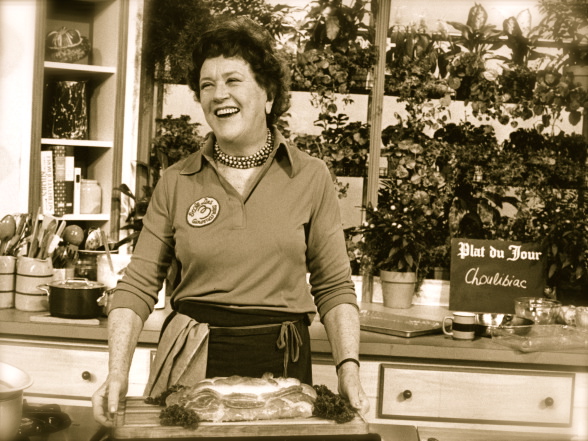
Bon appetit, Julia!

“A fine loaf of plain French bread, the long crackly kind a Frenchman tucks under his arm as he hurries home to the family lunch, has a very special quality. Its inside is patterned with holes almost like Swiss cheese, and when you tear off a piece it wants to come sideways; it has body, chewability, and tastes and smells of the grain. Plain French bread contains only flour, water, salt, and yeast, because that is the law in France. The method, however, is up to each individual baker.” 

— Julia Child, “Mastering the Art of French Cooking, Volume Two”

So begins Julia Child’s 20-page recipe for Pain Français, or Plain French Bread. This recipe is legendary among bakers, both amateur and professional alike, and provided a starting point for the American artisan bread movement. In celebration of what would have been Julia’s 100th birthday, Wild Yeast and the Bread Baking Babes take on this iconic recipe. As Julia wrote herself, it was “one of the most difficult, elaborate, frustrating and satisfying challenges I have ever undertaken.”

The recipe for Pain Français can be found here, though without the accompanying drawings, and Julia’s 3-page explication of flour, ovens, sour dough, and equipment. For that, you’ll have to return to the original source. She further instructs, “We therefore suggest that you do not attempt your first bread-making spree in a hot kitchen… pick a dry day and a dry room, then, for your first venture. In other words, make everything as easy as possible for yourself.” As for me, I’m looking forward to when the days become dry and the kitchen cools enough to spend time in her company and try it out myself.

Happy birthday, Julia, and thank-you for sharing your life so generously with us.

Posted in interlude | Tagged | 4 Comments

8.13.12 Trimming garlic

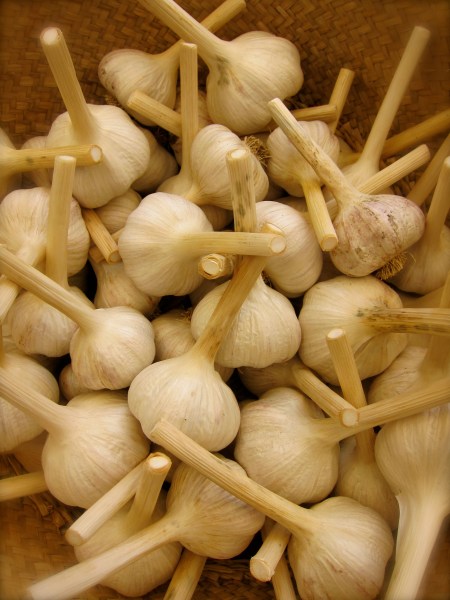
Of the three varieties of garlic we harvested, the Phillips was the first to dry and be ready for trimming. We broke a bulb apart to check for any signs of disease, and found clean, unblemished cloves within.

Once the stems, roots and leaves were trimmed off, the bulbs were ready to be placed in storage.

The core of the stem is completely white, a sign of dryness. The Music and German Extra-Hardy, two larger varieties, still show green in their cores, and need more time drying before they’re ready to be stored.

Posted in garden | Tagged | 29 Comments

Roasted Eggplant Salad with Almonds & Mint

“…here in California using Asian ingredients is part of what we do, part of a chef’s vocabulary. It’s not fusion, it’s Californian.”
— Chef Jason Fox, Commonwealth, San Francisco

Sometimes food is as much about a cook’s own history as it is about place. When I first read the ingredient list for Roasted Eggplant Salad, I couldn’t reconcile combining smoked paprika, cumin and soy sauce. Not that they’re incompatible, it just wasn’t in my taste vocabulary. Then I ran across Fox’s quote, and the flavors seemed less a cultural mash-up. I haven’t lived in California for a long while, but having grown up there, Fox had me reconsidering how these seemingly disparate flavors can be incorporated together.

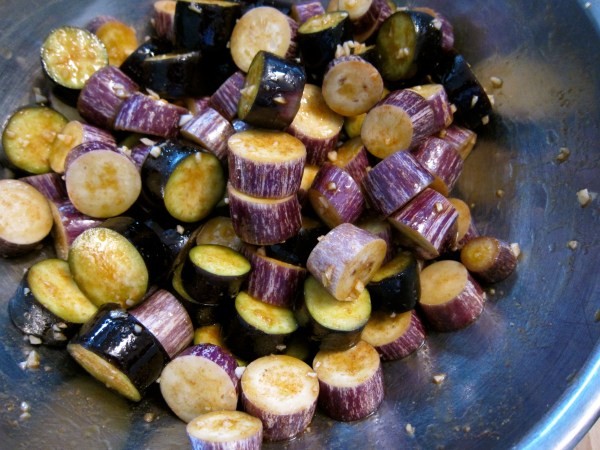
We’d harvested some Fairy Tale and Orient Express eggplant earlier and, though I was worried that they might not be able to stand up to this preparation, the small size of them made for easy cutting. No matter the type of eggplant being used, do keep the skin on. It adds texture, as well as flashes of glossy aubergine to the final dish.

There’s something elegant about a recipe that’s written such that everything gets prepared along the way. Salt the eggplant pieces, set them aside, then, while the eggplant sits, prepare the garlic and marinade. Make sure to chop the garlic as instructed, not too finely; the larger-sized chunks allows the garlic to caramelize, becoming sweet rather than burnt. Toss the eggplant with the marinade, pan it, and slide everything into the oven; while the eggplant roasts, chop the herbs, and whisk together the lemon and soy.

Once it’s done, let the eggplant cool in the pan slightly before dressing. Now’s a good time to make a green salad and cut some bread, maybe set the table, uncork a bottle of wine. Garnish it with or without the cheese. Consider trying it without cheese, consider becoming vague-an. Taste and make a mental note to double the recipe the next time around, because tonight there won’t be leftovers.

This version differs only slightly from the original. I used mint instead of parsley; cilantro or a combination of herbs would also be nice. Once the weather cools down, goat cheese or feta adds some heft. As for the smoked paprika and soy sauce, they ground the dish, and it’s this umami element that reminds me of dashi, which also has a smoky quality. As it turns out, it’s not so much a cultural leap after all.

Roasted Eggplant Salad with Almonds & Mint

2 pounds eggplant (about 2 large)
Sea salt
1/3 cup olive oil
2 tablespoons cider vinegar
1 tablespoon honey
1/2 to 1 teaspoon smoked paprika
1/2 to 1 teaspoon cumin
4 large garlic cloves, roughly chopped
2 tablespoons lemon juice (about 1 lemon)
1 tablespoon soy sauce
1 cup mint, roughly chopped
1/4 cup sliced or slivered almonds, lightly toasted
1/4 cup finely chopped green onions

– Heat the oven to 400°F. Cut the unpeeled eggplant into 1-inch pieces. Place eggplant in a colander, sprinkle lightly with salt and set aside while making the marinade.

– For marinade, whisk together the olive oil, cider vinegar, honey, smoked paprika, cumin, and garlic. Pat the eggplant dry, and toss with the marinade. Spread the eggplant on a large baking sheet, lined with parchment paper, and slide onto a rack positioned in the center of the oven. Roast at 400°F for 40 minutes, or until very tender and slightly browned. Stir every 15 minutes, and check after 30 minutes to make sure it isn’t burning. Remove from the oven and cool slightly.

– Whisk together the lemon juice and soy sauce. Return the eggplant to the bowl and toss with the lemon juice mixture. Stir in the mint, toasted almonds, and half of the scallions. Transfer salad to a serving bowl and sprinkle the reserved scallions on top. Serve warm or at room temperature. Supposedly serves 4.

Recipe adapted from thekitchn.com.

Local ingredients: Cider vinegar from Sewall Organic Orchard; honey from Victory Bees; eggplant, garlic, mint and green onions from the garden.

Posted in cooking | Tagged , , | 14 Comments

Mastering Food Preservation: On BPA in Canning Lids

With growing concern over the presence of BPA in canned goods, the safety of canning lids used for home processing is also being questioned. From Alan Majka of the UMaine Cooperative Extension:

I’ve received quite a few questions from consumers who are fearful of BPA leaching from canning lids into food so I was surprised when a caller this morning was concerned that Golden Harvest lids she recently purchased did not have a white coating like the Ball and Kerr lids she purchased previously. She was concerned that acidic foods may corrode the lid.

I did a web search and called Jarden Home Products to learn the following:

  • Jarden makes all Ball, Kerr and Golden Harvest lids at the same plant in Muncie, Indiana. In fact, someone purporting to be a production line supervisor posted that the lids are even made on the same line.
  • The only difference between the lids with white and clear coatings is the color added to the white linings.
  • All Jarden lids have the following layers applied to the metal lid:
  1. modified epoxy (contains small amount of BPA)
  2. tin plated steel
  3. modified vinyl
  4. another layer of modified epoxy
  5. red plastisol
  • Due to consumer demand, Jarden is working on a BPA alternative, but it must undergo testing prior to approval.
  • Canned food stored in upright jars is usually not in contact with the food for prolonged periods of time.
  • A consumer would need to consume tens of thousands of jars of home canned food to exceed the government’s safety guidelines for BPA.
  • The current reusable BPA alternative made by Tat[t]ler may have other unsafe compounds like formaldehyde and are not approved by the USDA.
  • Other brands of two-piece lids are made in China.

Additional comments from Kelly Cullen, PhD in Agricultural Economics, UNH:

There is a small amount of BPA in canning lids (and most steel canned food — yikes!). Luckily, with home canning, we leave “head room”, so the food doesn’t actually come into contact with the BPA. The risk is minimal. Consumers are demanding BPA-free lids, which should hopefully come on the market in the next year or two. In the meantime, rest assured that the BPA in home canned food is less than that in most canned foods, and most microwave-in-bag foods. The quality of the produce is usually much better too!

Update 8.10.12: More on “Home Canning, BPA-Free” by Linda Ziedrich

This is part of a series of posts following the Master Food Preserver Program offered by the University of Maine Cooperative ExtensionA version of this post appears at Seacoast Eat Local.

Posted in cooking, preserving | Tagged , | 3 Comments