Pot-Roasted Chicken

Local Food: Pot-Roasted Chicken

While we eagerly await the many delightful firsts of the season — peas, asparagus, and strawberries, just to name a few — we’re making our way through our remaining stores. We excavated the last chicken from the freezer and set on pot-roasting it, a technique befitting the mantra for cooking pasture-raised and locally-sourced meat: long and slow does the job. We served up the juicy results with a side of spring-sweet spinach, simply sautéed with garlic, and baby carrots simmered with a pat of butter until thoroughly glazed — a simple yet satisfying supper, with enough leftovers for several more meals the rest of the week.

Local Food: Pot-Roasted Chicken

To pot-roast a chicken:

– Pat the chicken dry, massage some olive oil into the skin, and season with salt and pepper. Truss the legs for more even cooking, and place chicken in a Dutch oven or clay pot. Add about a ½ cup of liquid — white wine, stock or water will do — enough to coat the bottom of the pot. Cover the pot and place in a 275°F oven. Let cook for 2½ to 3 hours, depending on the size of the bird. When ready, the meat will have begun to pull away from the end of the drumsticks, and the whole leg should feel lose in the joints.

– To brown, remove the pot cover and baste the chicken with additional olive oil. Turn up the oven to 400°F and cook for another 30 minutes, or until done to your liking. Remove the chicken from the pot, and let rest 10 minutes before carving. As it’s being carved, we like to let the pieces rest in the pot juices to soak up additional moisture. Serve with more of the juices or a gravy alongside.

– For crispier skin, gently lift and separate the skin from the breast and legs, and let the chicken air dry in the fridge, loosely covered, overnight before cooking. While we were at it, we tucked in a mix of sage, rosemary and thyme under the skin for additional flavor.

Local ingredients: Chicken from New Roots Farm; spinach from Heron Pond Farm; carrots from Meadow’s Mirth; garlic and herbs from the garden.

Adapted from Nourished Kitchen.

Posted in cooking | Tagged , , | 4 Comments

4.17.13 Crocuses

4.17.13 Crocuses

After this week’s news from Boston, we seek out solace in the garden to remind ourselves there’s still good in this world.

Posted in garden | Tagged | 1 Comment

4.15.13 Spring Ramps + Overwintered Greens

4.15.13 Spring Ramps + Overwintered Greens

We are beyond excited to find our planting of ramps finally making an appearance. With very little else on the scene, they aren’t shy about calling attention to themselves. 

4.15.13 Spring Ramps + Overwintered Greens

We found two small patches, both planted last April from ramps found sold as produce. It will be several years before they’ve established enough to harvest from. As added insurance, we also scattered seeds, which can take up to two years to germinate. In the meantime, we’ll be on the lookout for more ramps to plant.

4.15.13 Spring Ramps + Overwintered Greens

Compared to last year, this has been a chilly start to spring. The overwintered greens are kept covered, and many of them are bolting. Taking stock helps us to plan out this year’s rotation schedule and next year’s season extension.

4.15.13 Spring Ramps + Overwintered Greens

We hadn’t expected this half of the bed to have lasted through winter, and need to clean it out for the new season’s planting of peas. A quick inventory of survivors:  a lone head of Pan di Zucchero (beginning to bolt); Fun Jen (above, flowering); arugula; and a few Puntarelle sprouting from roots left in-ground.

4.15.13 Spring Ramps + Overwintered Greens

In the second covered bed: overwintered Red Russian, Lacinato and Siberian kales; Fordhook chard; and flowering arugula.

4.15.13 Spring Ramps + Overwintered Greens

This is the time of year when we most appreciate the hardiness of kale, allowing us to continue eating from the garden even at this sparse point in the season.

4.15.13 Spring Ramps + Overwintered Greens

Of the three varieties of arugula that over-wintered, only one hasn’t bolted. Though it’s meant to be an Italian variety called Olive Leaf, what came up bears no resemblance. Instead, it appears to be a Selvatica and, all the same, is delicious to have.

Posted in garden | Tagged , , , , , , , , , | 13 Comments

Potato-Rosemary + Onion-Thyme Flatbreads

IMG_4579

We were reminded of how good potatoes on pizza can be during a recent dinner at Flatbread. Featuring fingerlings from Meadow’s Mirth, our pizza was one of two specials showcasing local ingredients that night. Rather than being stodgy, the potatoes lent a nutty earthiness, and provided a lovely contrast to the other toppings.

IMG_4570

This is also the time of year we take stock of what’s left in the root cellar — mostly potatoes and onions at this point. Using a recipe from Jim Lahey’s My Bread as a base, these two flatbreads elevate these root vegetables from the everyday.

IMG_4581

The recipe makes two flatbreads, each topped differently. The fingerlings were left skin-on and sliced thinly, then left to soak in salted water to soften and quicken cooking. Straight out of the oven and still crispy around the edges, it’s rather like a potato chip pizza.

IMG_4595

In addition to the herbs, we like to toss in a some grated cheese. In this instance, we used local cheddar; other good choices are fontina, Gruyere, provolone or even a smoked gouda. It’s easy to improvise with these flatbreads, however, try to keep a light hand when adding more to the toppings, or the dough will bake up soggy.

IMG_4590

While similar to Lahey’s No-Knead Bread, the dough requires only a 2-hour rise and can be made the same day it’s to be used. Once it’s doubled, the dough will seem a scant amount to cover two 13 x 18 inch sheet pans — this video guides in the stretching of the dough.

Basic Flatbread Dough

500 grams | 3¾ cups bread flour
10 grams | 2½  teaspoons instant or active dry yeast
5 grams | ¾ teaspoon sea salt
3 grams | ¾ teaspoon sugar
300 grams | 1⅓  cups room-temperature water (72°F)
Extra-virgin olive oil for baking pans

– Combine flour, yeast, salt, and sugar in a bowl. Add the water and, using a wooden spoon or your hand, mix until blended, at least 30 seconds. Cover the bowl and let sit at room temperature until the dough has more than doubled, about 2 hours.
– Generously oil two 13 x 18 inch rimmed baking sheets. Divide the dough into two equal-sized pieces, and place one in each pan. Gently stretch the dough across the surface of the pan, pressing it evenly out to the edges. The oil will help keep the dough from sticking, and will be absorbed during baking, adding flavor.
– Heat the oven to 500°F. Top dough with choice of toppings, making it sure it’s spread evenly to the outer edges; this will help protect the ends from browning too quickly. Bake for 25 to 30 minutes, until the crust is pulling away from the sides of the pan. Serve the flatbread hot or at room temperature.

Potato-Rosemary Topping

400 grams | 2 cups lukewarm water
12 grams | 2 teaspoons sea salt
500 grams | 8 to 10 fingerling potatoes
50 grams | ½ cup diced onion
115 grams | about 4 ounces grated cheese
1 gram | ¼ teaspoon freshly ground black pepper
40 grams | scant ¼ cup extra virgin olive oil
½ tablespoon fresh rosemary leaves, coarsely chopped (or 1 teaspoon dried)
40 grams | about ¼ cup extra virgin olive oil

– In a bowl, combine water and salt, stirring until salt is dissolved. Slice the potatoes thinly (1/16 inch thick), and place slices directly into salted water to prevent oxidation and from turning brown. Let soak in the brine 1½ hours (or refrigerate for up to 12 hours), until the slices are wilted.
– Drain the potatoes and pat dry. Toss the potato slices with the onion, grated cheese, pepper, rosemary, and olive oil. Makes enough topping for one 13 x 18 inch flatbread.

Onion-Thyme Topping

325 grams | 1 to 2 onions
115 grams | about 4 ounces grated cheese
40 grams | scant ¼ cup heavy cream
3 grams | ½ teaspoon sea salt
1 teaspoon fresh thyme leaves, coarsely chopped (or ½ teaspoon dried)

– Slice the onion thinly (⅛ inch thick), for about 3 cups sliced onion. In a bowl, toss the onion slices with the remaining ingredients. Makes enough topping for one 13 x 18 inch flatbread.

Adapted from “My Bread” by Jim Lahey; submitted to YeastSpotting.

Local ingredients: Potatoes from Hollister Family Farm and Meadow’s Mirth; onions from Black Kettle Farm; cheddar cheese from Brookford Farm; herbs from the garden.

Posted in cooking | Tagged , , , | 4 Comments

4.8.13 Spring Seedlings + Winter Tomatoes

IMG_4168

Spring is taking its time arriving, the early occurrence of Easter a false start to the season. There’s very little to forage from the garden, though we found a sprouting onion in storage that we’re keeping for the greens.

IMG_4598

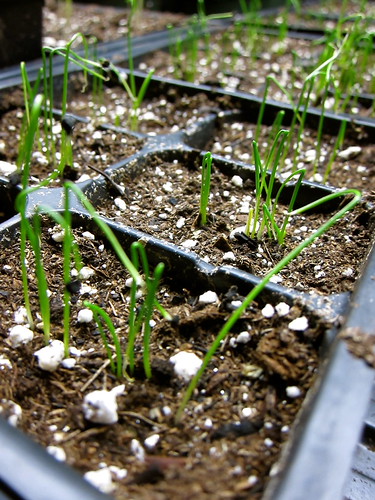
The emergence of seedlings never fails to delight us. The leeks and onions are shouldering up through the soil, proffering their tender leaves like victory flags. 

IMG_4600

We somehow ended up with three kinds of fennel this year — Finale, Perfection, and a new one, Orion. The celeriac are finally poking through, while the Shishito peppers lag. It’s our first time growing peppers, and we don’t know what to expect; we wonder if the soil’s too cold for them to germinate.

IMG_4605

Coming full circle, the Aprile tomato seedlings are coming up while we’ve still a tray of winter tomatoes, or pomodorini, left in storage. 

IMG_4609

 We’ve finished consuming the Aprile first, and are now making our way through the last of the Ponderosa pomodorini. These tomatoes were harvested in early October, and kept in a single layer on trays lined with paper.

Posted in garden, tomatoes / pomodorini | Tagged , , , , | 14 Comments

Digestive Biscuits

Digestives

Plain, simple, humble. Above any other, this recipe for digestives, a type of cookie, lets locally-grown whole wheat flour shine in all its glory. They’re from Hanne Risgaard’s Home Baked: Nordic Recipes and Techniques for Organic Bread and Pastry, with special thanks to Joe for introducing us to them — they made for a perfect ending to a convivial evening among friends.

Digestives

Digestives, also known as sweetmeal biscuits, refers to the inclusion of baking soda, which counteracts stomach acid. A plate of these served at the end of a meal satisfies as well as settles, and can be equally effective the morning after or a lovely treat with afternoon tea. We like these cut in smallish rounds, no more than 2 to 2½ inches across, just large enough to nibble on and not feel guilty when we reach for seconds or thirds.

Digestives

The sandy texture of most whole wheat flour can make it challenging to bake with. Here, the graininess is an integral part of the biscuit’s tender crunch, with the barest amount of sugar added to enhance the natural sweetness of the whole wheat.

Digestives

Amounts are given in baker’s weights and, as Risgaard instructs, there’s pleasure to be found in mixing the dough by hand. Depending on how long it’s been left in the fridge, the dough may feel crumbly to work with. Don’t fret, unlike that for pie, it’s a forgiving dough and will become more pliable as it’s worked. Avoid underbaking the digestives — you’ll know they’re done when they begin to caramelize and brown around the edges, releasing a toasty, buttery aroma.

Digestives

250 g whole-wheat flour
5 g (about 1 teaspoon) baking powder
50 g sugar
3 g (about ½ teaspoon) salt
120 g unsalted butter
1 large egg

– Heat oven to 390°F. Sift flour and baking powder into a bowl, then mix in sugar and salt. Cube the bold butter, and rub it quickly into the flour mix. Add the egg, and knead until you have a smooth dough. Wrap dough, and refrigerate 30 to 60 minutes.

– On floured work surface, roll out dough until it is about ⅛ inch thick. Cut out digestives with a cookie cutter, and place them on a parchment-lined sheet pan. Prick with a fork, then brush lightly with a little water.

– Bake in the center of the oven for 10 to 12 minutes, until they are lightly golden. Cool completely, then store in an airtight jar.

Adapted from “Home Baked: Nordic Recipes and Techniques for Organic Bread and Pastry” by Hanne Risgaard.

Local ingredients: Whole wheat bread flour from Brookford Farm; unsalted cultured butter from Casco Bay Butter; egg from Mona Farm; sea salt from Maine Sea Salt.

Note: Thanks to those who’ve mentioned McVitie’s digestives in the comments! We haven’t had them so aren’t able to compare the McVitie’s to this recipe; the recipe here is similar to the more familiar Carr’s. Two other versions — ones that might come closer to childhood memories — are Hugh Fearnley-Whittingstall’s, which includes oatmeal; and King Arthur Flour, which employs a mix of white and whole wheat flour. Both versions include milk rather than an egg; I’ve also seen vanilla extract added in other recipes online.

I also wanted to include a note about the digestive dough — it can be stiff and unyielding when taken straight out of the fridge. If so, leave it on the counter for 20 to 30 minutes to soften a bit. Just avoid letting the dough get too warm; it will start to feel greasy when worked, and the butter will leak out of the biscuits during baking.

Posted in cooking | Tagged , | 10 Comments

How to Preserve a Husband + 5 links

How to Preserve a Husband

We came across instructions for “How to Preserve a Husband” tucked in the back of a “Ball Blue Book” from 1966. For more on the topic of preserving…

~ Watch: Cassie Parker, the Canning Queen of New York — “I teach people how to put the love in their food by canning.”

~ Want: Ball’s Heritage Collection blue canning jars.

~Visit: June Taylor’s Still Room — “You preserve what’s around you. That’s why we cherish the fantastic regional foods that exist around the world…”

~ Read: Harold McGee on aging your canned goods — “Now I think of best-by dates as maybe-getting-interesting-by dates.”

~ Learn: The Master Food Preserver Program offered by the UMaine Cooperative Extension is now accepting applications for this year’s session. For those outside of Maine, request the program at your local cooperative extension.

Posted in interlude, preserving | Tagged , | 2 Comments