Summer Pea Soup, with Walnut Bread and Herbed Cream Cheese

Day of Rest

A day of rest and recuperation called for gently heated minty pea soup mixed with potato leek from The Soup Guy, seasoned with some good olive oil and saved just for this occasion; walnut bread made with Maine Grains and baked off in a wood-fired oven at the Kneading Conference; and served with an herby, soft cheese spread. When the bread ran out, we had the rest of the cheese scooped up with shards of Craquelins crackers. Because every day is a banquet, dear friends, even when the orders are to keep it light.

We adapted this recipe for homemade Boursin, using chives and their blossoms, dill and garlic scapes from the garden — thanks for the inspiration, Katrina!

Posted in cooking | Tagged , , , , , | 2 Comments

7.30.13 Garden Bouquets

7.30.13

Vegetables are trickling in, beginning with carrot thinnings…

7.30.13

…a mixed bouquet of radishes…

7.30.13

…joined by the first of the cucumbers…

7.30.13

…and summer squash, and the last of the peas.

Harvesting this week:
Salad greens, kale, chard, peas, favas, cucumbers, summer squash, radishes, and carrots.

Putting-up: Canned tomato-vegetable broth.

Posted in garden | Tagged , , , , | 11 Comments

Penne with Fava Beans, Summer Squash and Blossoms

IMG_6522

When the question of dinner came up, the garden answered loud and clear. This summery version of Vignarola makes use of everything starting to come in, and then some — the first of the fava beans, a mix of baby summer squash with their blossoms still attached, and the last of the peas. We served it all over pasta, with slivers of basil for a hint of minty anise, and a few slices of bacon adding a salty backbeat to the mix.

Penne with Fava and Summer Squash

Favas and broad beans are one and the same, with fava stemming from its latin name Vicia faba. Above: Cascine pods standing tall on the plant — some say the favas are mature when the pods begin to droop downwards.

Penne with Fava and Summer Squash Penne with Fava and Summer Squash

To peel, or not to peel? The favas were picked a little later than we would have liked, maturing enough that their leathery skins needed to be removed after blanching. I had the good fortune to meet the wonderfully knowledgable Nancy Harmon Jenkins at this year’s Kneading Conference, where she gave me her thoughts on the subject of peeling. We’ll catch them younger next time around to keep them unpeeled, or, as Nancy suggests: “If the pods are no fatter than your little finger, you might copy Lebanese cooks and handle them as one would green beans, topping and tailing, then chopping and cooking the pods along with shelled favas, garlic, olive oil and lemon.”

Penne with Fava and Summer Squash

We grew three varieties of fava beans, the same as last year and all imported by Seeds From Italy. Above, from top to bottom: Aguadulce, Cascine, and Super Aguadulce. In a departure from previous year, we find ourselves preferring the flavor of the Cascine and Aguadulce over the Super Aguadulce. To be fair, the Super Aguadulce should have been harvested at an earlier and less starchy point.

Penne with Fava and Summer Squash

In cooking seasonally, use the following recipe as more of an approximate guide than a set of restrictive instructions. The summer squash — a combination of Costada Romanesco zucchini and yellow Zephyr — are sliced into the thinnest of coins, and cooked with the bacon and garlic until they become tender and buttery. The favas add their earthy nuttiness, while the peas keep things bright; if neither are to be had, green beans would do just as well. To hold onto their delicate flavor, shreds of basil and squash blossoms are stirred in only at the very end. Finish with a drizzle of good olive oil, and serve with your choice of grated parmesan or pecorino, though we found ourselves preferring the slight sharpness of pecorino over the sweetness of parmesan in this dish.

Penne with Fava Beans, Summer Squash and Blossoms

1 pound penne, or other short pasta
⅓ cup olive oil
3 slices bacon, diced
1 to 2 cloves garlic, thinly sliced
4 to 6 small summer squash, thinly sliced, with their blossoms torn into shreds
2 cups fava beans, blanched and peeled
½ shelled peas
Shredded basil, to taste
Grated pecorino or parmesan

– Heat the olive oil in a large skillet, add the diced bacon and cook until the bacon is barely beginning to brown. Stir in the garlic, and cook briefly before adding the summer squash. Continue to cook until the summer squash are soft and tender, then add the fava beans to finish cooking them. Remove pan from heat.

– For the pasta, boil in salted water until al dente. Add the peas to the pasta water to cook briefly, then drain the pasta with the peas. Toss the pasta with the rest of the cooked vegetables. If necessary, add some reserved cooking water to loosen the sauce. Season to taste with salt and freshly ground black pepper, and stir in the shredded basil and squash blossoms. Finish with a drizzle of good olive oil, and serve with grated pecorino or parmesan cheese.

Local ingredients: Bacon from Meadow’s Mirth; fava beans, peas, summer squash and blossoms, basil, and garlic from the garden.

Posted in cooking, garden | Tagged , , , , , | 4 Comments

7.22.13 A Harvest of Garlic

7.22.13

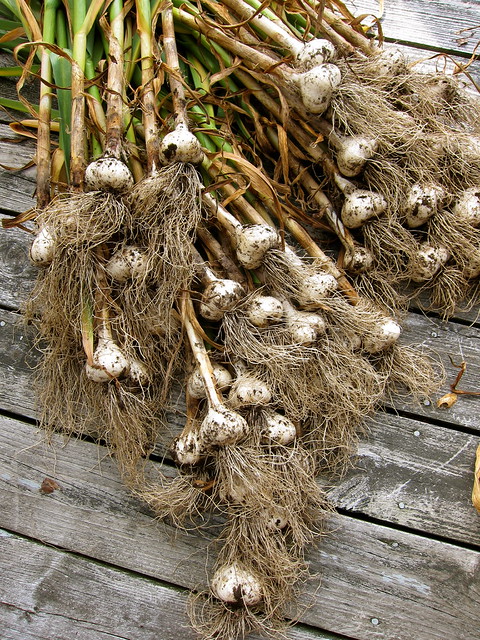
Once mid-July passes, we scan the weather reports for a run of warm, dry days to harvest garlic in. We pulled samples from each of the three varieties we planted last fall — Phillips (above), and Music and Rossa di Sulmona (below) — to check on how they’re progressing. At the same time, this gives us some juicy, fresh garlic to cook with, one of the true delights of the season.

7.22.13

Our first planting of garlic was in 2008, and originally started with seven varieties. We’ve since winnowed it down to Music and Phillips, and only recently added the Rossa di Sulmona, an impulse purchase.

7.22.13 Garlic Harvest

Along with favorable weather conditions, we look for the bottom two or three leaves to die off as a sign that the garlic is ready to harvest. Of equal importance are the remaining leaves, each representing a layer of protective papery skin surrounding the bulb. We look for five to seven left to ensure long storage.

7.22.13 Garlic Harvest

This is the second year of planting the Rossa di Sulmona (above), which is still adapting to our soil and climate. This year’s harvest is promising, with enough seed for planting come fall. It’s said that red garlic is sweeter, and this particular variety is especially prized in Italy for its mild flavor.

7.22.13 Garlic Harvest

At first glance, Music (above) is often mistaken for German Extra Hardy. The large bulbs characteristically contain only four to five cloves, making it a less economical choice for planting. However, its rich, nutty flavor — a clear favorite in a tasting against other garlics — makes it worth the space necessary for propagation.

7.22.13 Garlic Harvest

Another red-skinned variety, Phillips (above), is named for the place in Maine it originates from. It comes up later in spring than the Music, though catches up and is harvestable at the same time as the others. Once the bulbs are pulled, they’re left in the sun briefly to dry the clinging dirt.

7.22.13 Garlic Harvest

Through trial and error, we’ve learned to strip an outer layer off each bulb to rid them of any soil-borne pathogens that might affect their storage. After being cleaned, bulbs of Phillips (above) are ready for curing.

IMG_6499

The bulbs are laid out on screens in a dry, warm room, and a fan to keep the air circulating. After only a day of curing, the Phillips (above) along with the rest of  of the bulbs are already pinking back up.

7.22.13 Garlic Harvest

Coming full circle, leftover garlic (above and below) from last season’s harvest, a year later and still viable.

7.22.13 Garlic Harvest

Harvesting this week:
Garlic, favas, peas, kale, chard, radishes, and salad greens; planted onions and leeks.

Putting-up: Frozen Romano green beans.

Posted in garden | Tagged | 16 Comments

Mastering Food Preservation: More on Identifying Ball’s BPA-Free Lids

Identifying Ball's BPA-Free Lids

For those concerned about the presence of BPA in the lining of lids for home canning, we posted previously on identifying Ball’s new BPA-free lids by looking for the serial number on the boxes they come in. Since that post in May, two more tips for telling which lids are BPA-free have come up.

Identifying Ball's BPA-Free Lids

We found printed on the bottom of  a case of Heritage Collection blue pint jars, the simple claim, “BPA Free” (above). We looked at cases of Ball jars at two different stores, and found that only the blue Heritage pint ones had this phrase printed on the cardboard. This raises the question of how to tell if the lids that come with recently purchased cases of jars are BPA-free.

Identifying Ball's BPA-Free Lids

A concerned reader (thanks, Canner!) alerted us to her own experience with Ball representatives, and passed on the information that BPA-free lids have “Made in USA” printed on them (above, right). When asked about this, Jardin responded:

That is correct. The lids will have “Made in USA” printed them. Those products will also have a production date code stamped on the outside of the package. Starting this summer, you will also see the “BPA Free” message start to appear on the front face of those packages.

When buying new jars, look for the silver lids with the design pictured above or replace the lids with BPA-free ones. If purchasing replacement lids, look for the serial number printed on the end of the box (below). For our canning friends in Canada, Livin’ La Vida LOCAphile’s comparison shows that Bernardin’s BPA-free lids can be identified by a tiny maple icon in the upper left-hand corner, and that the boxes also have a serial number.

IMG_6325

Resources:
Ball & Kerr/Jarden Home Brands
Mastering Food Preservation: On BPA in Canning LidsDiary of a Tomato
• Mastering Food Preservation: Ball’s BPA-Free Canning Lids, Diary of a Tomato
Mastering Food Preservation: More on Identifying Ball’s BPA-Free Lids, Diary of a Tomato
Home Canning, BPA-Free, A Gardener’s Table
New BPA-Free Mason Jar Lids: Are They Really Safer?A Gardener’s Table
New BPA-free canning lids from Bernardin Canada, Livin’ La Vida LOCAphile

Update 8.1.13: From the Ball/Jarden website, under lid description, “Material: Tinplate Steel.”

Update 8.6.13: Update on composition of lid, from Ball/Jarden Customer Service: “In answer to your question, the lids are a tin-plated steel with a BPA-free modified vinyl, and the varnish is a modified epoxy.”

Posted in preserving | Tagged , , | 15 Comments

7.15.13 Agretti, Invaders, and Other People’s Harvests

7.15.13

This is the second time around with the radishes and agretti. The early spring plantings of both failed to thrive, and were replanted with enough success to be included in this week’s harvest.

7.15.13

To get beyond the low germination rate, we seeded the agretti thickly enough that they actually needed to be thinned out.

7.15.13

One morning, we found part of the garden fencing down and footprints scattered throughout the raised beds.

7.15.13

On closer inspection, we found that the beans, carrots and, of all things, the bitter-flavored Italian chicory lightly nibbled. We’re still not sure what came through, though were grateful the damage wasn’t any worse than it was.

7.15.13

To create some ease in the garden, we’ve cut down on what we’re growing this year, and make up for it with weekly visits to local farmers’ markets. From the Portsmouth and York Farmers’ Markets: Red onions, fennel and carrots from Black Kettle Farm; agretti and stem lettuce from Wake Robin Farm; sweet onions, green peppers, jalapeños, summer squash, and cucumbers from Meadow’s Mirth; broccoli and cauliflower from River Lily Farm; and radicchio from Connolly’s Organics.

7.15.13 7.15.13

Some of the bounty went into a summery Panzanella salad, while leafy tops and stems went into a thrifty vegetable stock.

7.15.13 7.15.13

Carrots, onions and greens were mixed with pea pods and fennel — there’s something satisfying about capturing another use for these vegetables before they head to the compost heap.

7.15.13

This week’s harvest: Peas, kale, chard, salad greens, agretti, and radishes.

Putting-up: Frozen peas, canned pea pod broth, and canned pea and fennel broth.

Posted in garden, preserving | Tagged , , , , , | 17 Comments

Macaroni Peas

Macaroni Peas
The reward for shelling ten pounds of peas for freezing is setting aside enough to make Macaroni Peas. A meetup of two English classics, mushy peas and macaroni cheese, this is the kind of seasonally vibrant dish that is completely of the moment. Tasting purely of peas, the sweetness of them in their freshest state is enriched by a creamy blend of butter and parmesan cheese.

To make this exquisitely simple dish — just five ingredients, not counting the basil — you’ll need about two pounds of peas for a pound shelled. Feel free to use good olive oil instead of butter, or garlic scapes in place of the cloves. New garlic is appearing at the markets, and would be especially lovely to use. If you can, make sure to include some freshly slivered basil, it adds just the right note of mint. To someone accustomed to the spare Italian way of dressing pasta, the sauce will seem alarmingly too much for the amount of pasta. Set aside your prejudices and think English comfort food, the sauciness is rather the point.

Macaroni Peas
1 pound shelled small peas, fresh or frozen
10 ounces pasta, in a small shape (like macaroni, fusilli, orecchiette)
3 tablespoons butter or olive oil
1 garlic clove, chopped
1 ounce (about ⅓ cup) parmesan, coarsely grated
Shredded basil (optional)

– Put on a large pot of salted water on to boil, enough to hold the pasta. Add peas and cook until just tender, a couple of minutes at most. Scoop peas out into a bowl, leaving behind the water to cook pasta in later.
– Melt the butter (or heat the olive oil) in a small pan over low heat; add the garlic and cook gently for several minutes. Remove from the heat.
– Put half the cooked peas in a blender with 6 tablespoons of their cooking water, the butter and garlic, and the grated cheese. Puree until smooth, adding more cooking water if necessary. Combine with the remaining (whole) peas and season liberally with salt and pepper.
– Add the pasta to the pot of boiling water and cook until al dente. Drain the pasta and toss with the hot pea sauce. Finish with shredded basil, adjust seasonings, and serve with more grated cheese.

Local ingredients: Peas from Riverside Farm; Rustici pasta from Valicenti Organico; organic cultured unsalted butter from Casco Bay Butter; garlic scapes and basil from the garden.

Adapted from “River Cottage Veg” by Hugh Fearnley-Whittingstall, via Food52.

Posted in cooking | Tagged , , , | 4 Comments