Cucumber Gazpacho with Shrimp, Basil and Lime

Cucumber Gazpacho

This week’s burst of August heat calls for a bowlful of cool Cucumber Gazpacho topped  with a salad garnish of Northern shrimp, basil and lime. Serving as a base, the gazpacho easily adapts to what’s freshest or on hand — everything is tossed into a blender or processor, and you can taste and adjust as you go. The garlic gives a nice warming note, though keep it in check as it can quickly overwhelm the balance of bright flavors. Otherwise, let whim be your guide. Amounts are for 4 first-course servings; we upped the amount of shrimp for a heartier dinner portion.

Cucumber Gazpacho with Shrimp, Basil and Lime

2 to 4 large cucumbers, peeled and coarsely chopped
1 yellow tomato, seeded and chopped
1/2 small red onion, chopped
1 green pepper, seeded and coarsely chopped
1 jalapeño pepper, seeded, chopped
Handful of herbs — chives, garlic chives, parsley, mint
1 small clove garlic, smashed and coarsely chopped
1/4 cup yogurt
Olive oil + dash of vinegar or citrus
Salt + pepper

Shrimp garnish:
1 pound Northern shrimp, poached
1/8 cup small red onion, thinly sliced
Shredded basil + minced chives
Olive oil + juice from 1/2 lime
Salt + pepper

– For gazpacho: Place the vegetables, herbs and yogurt in a blender or food processor, and puree until desired texture. Season with good olive oil, a dash of something acidic like vinegar or lime, and salt and pepper. Chill in the refrigerator for 1 to 4 hours before serving.
– For shrimp garnish: Toss ingredients together in a small bowl, and season to taste. If making ahead of time, hold the lime (to keep the shrimp from turning mushy) and add when ready to serve.
– To serve: Ladle gazpacho into bowls, and serve with the shrimp garnish spooned on top.

Adapted from Epicurious.

Local ingredients: Green pepper and jalapeño from Meadow’s Mirth; yellow tomato from New Roots Farm; red onion from Misty Brook Farm; Northern shrimp from F/V Rimrack; yogurt homemade from Harris Farm milk; cucumbers, herbs and garlic from the garden.

Posted in cooking, garden | Tagged , , , , | 10 Comments

8.19.13 Fennel: Bulb and Herb

8.19.13 Fennel

We’re refining our planting list, and took a closer look at which of the various fennel varieties best suit our needs. Of the three fennel we planted this year (left to right): Orion had the plumpest bulbs, Finale had the most flavor, and Perfection was quick to bolt. We’ve grown these three before and, judging by our notes, with fairly consistent results through different years. 

8.19.13 Fennel

Growing fennel can be tricky, with bolting a common problem. They require light, fertile soil, and proper spacing. As we recently learned, planted too close and they’ll bolt. Another way of preventing bolting may be to choose one of the Alpine varieties, which are sown from June to August, and grown into cold. To harvest fennel, we cut them at the base of the bulb, resulting in a second and or even third growth. Above: Baby fennel resprouting from a taproot left in the ground.

8.19.13 Fennel

Herb fennel differs from the bulb variety, and we grown it specifically for their more fully-flavored leafy fronds. As the season progresses, we also cook with the pollen, green seeds, and then dried. Bronze fennel, above, unfurling in the herb garden, and, below, their pollen-rich umbels.

8.19.13 Fennel

Harvesting this week: Fennel, filet green beans, Shishito peppers, cucumbers, summer squash, cherry tomatoes, kale, chard, and salad greens.

Posted in garden | Tagged , | 10 Comments

Okra Cornmeal Cakes

Okra Cornmeal Cakes

Okra is uncommon here in New England, and when it appears at the farmers’ market we make sure to buy a bagful. Making gumbo first comes to mind but, tucked away with other preparations to try, we had our eye on Okra Cornmeal Cakes. Thin slices of slightly grassy okra are encased in a nutty cornmeal pillow, with a just a hint of spice on the backbeat. The local flint cornmeal we used gave a distinctive popcorn-like flavor, turning this southern dish into something more regional and reminiscent of Johnnycakes.

Okra Cornmeal Cakes

We used a mix of okra — Clemson Spineless and Carmine Splendor — from Wake Robin Farm. The open-pollinated Clemson Spineless is a southern standard, while Carmine Spendor starts off deep red, turning a lighter shade as the pods grow larger. For those growing it themselves, the flowers are also edible. We don’t usually think of okra as health food, though, nutritionally speaking, they’re high in antioxidants, folates, vitamin C, and fiber, and a good source of calcium and potassium.

Okra Cornmeal Cakes

Many are turned off by the mucilaginous nature of okra, however, keeping the pods intact and using dry methods such as sautéing, grilling or frying are some of the ways to minimize this. Cooking okra with something acidic like tomatoes, or adding lemon or vinegar also helps. They become sticky when cut up, though long cooking dissolves this and may be used to thicken soups and stews. Where most okra have 5 to 8 points or seed chambers, the burgundy-colored one has only 5 — cut up, they resemble a bowlful of stars.

Okra Cornmeal Cakes

You can vary the size of the cakes, the smaller the easier to flip in a skillet of hot oil. Increasing the amount of oil gives a more fritter-like, crispy texture; less and these become softer and closer to pancakes. For variation, we imagine throwing in a handful of sweet corn into the batter or, when okra’s unavailable, substituting green peppers, or even some chopped up kale. To accompany them, we served the okra cakes hot with thick slices of juicy tomatoes, a vinegary slaw-like salad, and simply steamed filet beans on the side.

Okra Cornmeal Cakes

Okra Cornmeal Cakes

2 cups finely ground yellow cornmeal
2 teaspoons baking powder
1 teaspoon fine sea salt
1 large egg, lightly beaten
1 1/2 cups cold water, plus more if needed
8 ounces fresh okra, stems trimmed and sliced 1/4 inch thick
1 jalapeño, cored, seeded, and finely chopped
1 clove garlic, mashed into a paste
1/4 cup mild vegetable oil, for frying

– In a large bowl, whisk together the cornmeal, baking powder, and fine salt. In a second bowl or large liquid measuring cup, combine the egg and water. Add the liquid to the dry ingredients and whisk until smooth. Add the okra, jalapeño, and garlic and stir to combine. (The batter should be thick and wet, not dry. Add a little more water at a time if needed. The amount will depend on the exact grind of the cornmeal.)

– Heat some or all of the oil in a cast-iron skillet over medium heat, depending on how “fried” you like your cakes. Scoop 1/4 cup batter onto the heated surface and, if needed, flatten the griddle cake so it has an even surface. Repeat with additional batter, being careful not to crowd the skillet. Cook the griddle cakes until the bottoms are brown and bubbles form on the tops and edges, 2 to 3 minutes. Turn and cook until the other side is golden brown, an additional 2 to 3 minutes. Transfer to a paper towel–lined plate or tray. Season the cooked griddle cakes with salt and pepper. Repeat with the remaining batter. Serve immediately.

Adapted from “Basic to Brilliant, Y’All” by Virginia Willis, via Leite’s Culinaria.

Local ingredients: Okra from Wake Robin Farm; flint cornmeal from Wild Miller Gardens; jalapeño and egg from Meadow’s Mirth; garlic from the garden.

Posted in cooking | Tagged , | 4 Comments

8.12.13 Hands in the dirt, head in the sun, heart with nature

8.12.13 Hands in the dirt, head in the sun, heart with nature

“The glory of gardening: hands in the dirt, head in the sun, heart with nature. To nurture a garden is to feed not just on the body, but the soul.” — Alfred Austin

Spring planting has long given way to summer, and the garden is now in full as we finish planting for next season. Above: Masai haricot verts, or filet beans. Originally French-bred, they’re a more slender version of green beans, and are full-flavored when picked young. This particular variety is forgiving if you miss a day or two, and will keep on the plant. This is our second year of planting Masai from saved seed.

8.12.13 Hands in the dirt, head in the sun, heart with nature

Spanish Padron peppers are delicious simply blistered in a hot skillet and finished with a sprinkle of good salt. The occasional one, however, can be formidably hot, with no warning until you bite down. If you’re not up for pepper roulette, we’ve found that these Shishito peppers make a fine alternative. It’s our first try at growing peppers, and we’re pleased with the results. The Shishito is producing vigorously, enough to concern the Gardener as to what we were going to do with all of them once they were ready. We grilled up the first batch, and knew immediately there was no need for worry, that these were going to disappear from the table quickly.

8.12.13 Hands in the dirt, head in the sun, heart with nature

These beauties were a gift from John Forti, The Heirloom Gardener, who brought back seeds from last year’s Salone del Gusto. Known as “pomodorini appesi,” or hanging tomatoes, these have the “pizzo” (or point) and lobed shape more characteristic of those from around Naples, and called “pomodorini del pienolo del Vesuvio.”

8.12.13 Hands in the dirt, head in the sun, heart with nature 8.12.13 Hands in the dirt, head in the sun, heart with nature

Tromboncino squash is another Italian heirloom we’re trying out for the first time. It can be grown as both a summer and, later in the season, a winter squash, and is resistant to powdery mildew and squash vine borer, all qualities that make it attractive to grow in our climate. So far, it’s growing at a prodigious rate, living up to its other name, “zucchini rampicante.” The leaves have a beautiful webbing, as if they can barely keep up with their own growth.

IMG_6985

The greens bed is showing typical signs of August, a little overgrown and undertended. Above, clockwise from upper left: Rainbow chard, agretti, Catalogna Emerald endive, mixed salad greens, and arugula.

8.12.13 Hands in the dirt, head in the sun, heart with nature

Germinating agretti can be problematic, and we compensated by sowing more seeds than usual. Once it got established, it’s been growing steadily and proven hardy. We continue to use it raw in all manner of salads, and have plans to make agretti spaghetti as soon as there’s enough.

8.12.13 Hands in the dirt, head in the sun, heart with nature

Erba stella resembles, as one reader described it, a burst of fireworks. Known as buck’s horn in English, it’s a small plant and, like agretti, may be used raw in salads. The dried leaves may also be used to make teas.

8.12.13 Hands in the dirt, head in the sun, heart with nature 8.12.13 Hands in the dirt, head in the sun, heart with nature

Along with erba stella and agretti, we found scuplit in the Seeds from Italy catalog, where it’s described as “a bit like a combination of arugula, tarragon, chicory, and other herbs.” Scuplit is also used raw in salads, and it’s said to flavor egg dishes and risottos. As Barbara Damrosch points out, we know it as bladder campion and, though widely used in Italy, here it’s considered a weed.

8.12.13 Hands in the dirt, head in the sun, heart with nature

This is our second attempt at growing Duborskian rice, one of the very few varieties available as seed to nonindustrial growers. This dry-land type doesn’t require flooding, however, don’t be mistaken, it still needs steady watering. Only one survived of our ten seedlings, and it’s begun to take on a calligraphic form, reminiscent of Asian ink paintings.

8.12.13 Hands in the dirt, head in the sun, heart with nature

Based on last year’s success, we’re again growing potatoes in containers — it frees up precious growing space, makes it easier to harvest, and we deposit the soil afterwards. This year’s experiment is about yield, and each container contains a different number of Yukon gold seed potatoes. These won’t be ready to harvest until late September.

8.12.13 Hands in the dirt, head in the sun, heart with nature

Above: An overview of the garden — a moment in time and before the squash take over.

8.12.13 Hands in the dirt, head in the sun, heart with nature 8.12.13 Hands in the dirt, head in the sun, heart with nature

We’ve skipped summer leeks, and planted Siegfried and King Sieg (above, left) for winter use. The celeriac (right), called Brilliant, requires 100 days of patient waiting.

8.12.13 Hands in the dirt, head in the sun, heart with nature

8.12.13 Hands in the dirt, head in the sun, heart with nature 8.12.13 Hands in the dirt, head in the sun, heart with nature

This week’s harvest:
Masai filet beans, Shishito peppers, Napoli carrots, Perfection and Orion fennel, Boothby Blonde and National Pickling cucumbers, Costata Romanesco zucchini, Zephyr summer squash, Tromboncino squash, favas, Siberian, Beedy’s Camden and Red Russian kales, rainbow chard, sungold and peacevine tomatoes, and salad greens.

8.12.13 Hands in the dirt, head in the sun, heart with nature

Putting up: Garlic cured for storage.

With this year’s garlic crop, we made some changes on how we prepare them for storage. After a week of curing indoors in a warm, dry room, we clipped a portion of the tops off to expose the stalk and allow excess moisture to escape, but left the roots as is. Above: Music garlic after a week of curing.

8.12.13 Hands in the dirt, head in the sun, heart with nature IMG_7015

After a second week, we trimmed the stems further, and also the roots. At this point, the Phillips was ready for storage after a couple more days. With their heavier bulbs and stems, the Music required more time to cure. We placed the bulbs in a rack to expose all sides to air, and left them for another week of curing, for a total of three weeks.

IMG_6820

We began growing garlic in 2008, and have planted from the previous year’s harvest ever since. The Phillips garlic started out small and, through selection, has adapted and now produces good-sized bulbs. Above: Phillips garlic done curing after two weeks.

8.12.13 Hands in the dirt, head in the sun, heart to nature

Fall planting:
Lacinato kale; Fordhook chard; Miyashige daikon, Green Meat, Watermelon, Shunkyo, Japanese Long Scarlet radishes, French Breakfast, and Cherry Belle radishes; tatsoi; Hon Tsai Tai; Puntarelle Stretta, Brindisina, and Italiko Rosso chicories; Cime di Rapa Quarantina.

Posted in garden | Tagged , , , , , , , , , , , , , , , , | 16 Comments

Mastering Food Preservation: A Pickle Primer

Mastering Food Preservation: The Pickle Whisperer
“The laws of hair care are simple and finite.”
— Elle, “Legally Blonde”

We’ve all had them, bad hair days. And, for those who practice the art of canning, the same goes for less than optimum pickles. Luckily, like hair care, the laws of pickling are simple and finite — start with the freshest cucumbers you can find, follow the recipe, and process them, but not too much. Still, we frequently receive questions regarding problems with pickles, and we hope this compendium of advice will help you towards making the perfect one.

Of the three main categories of pickles — fermented, refrigerator or quick, and quick-processed — here, we concern ourselves with the processed version, where variability of texture and flavor most occur. Though the focus is mainly on cucumbers, these tips may apply to any variety of fruit and vegetables that are used for pickling.

Selection

– Pickling, as with all canning, begins and ends with good ingredients. Select firm, unblemished cucumbers; any presence of mold or rot may produce off-flavors in the finished product.

– There are three main varieties of cucumbers: slicing, pickling, and “burpless.” While all three types may be pickled or eaten fresh, cucumbers bred for pickling have a thinner skin, the black spines giving a characteristically bumpy appearance.

Weather may also have an effect — too dry and the skin can toughen and become bitter, too wet and cucumbers become waterlogged, chancing soft and flavorless results. It’s recommended to wait at least 2 to 3 days after heavy rain fall before using vegetables from your garden to make pickles.

– Use cucumbers that have been freshly picked, and keep them cold until it’s time to process them. Cucumbers are 90% water and, once picked, will lose moisture rapidly, especially if let to stand at room temperature. They may start to develop a hollow center after 24 hours, which traps air and causes them to float.

Preparation

Wash cucumbers well — mold and yeast left clinging to the skin may produce off-flavors.

– To avoid using additives, presoaking in ice cold water for 4 to 5 hours prior to pickling is recommended for crispier pickles. Alum, a firming agent, does not work in the case of quick-processed pickles.

– Squash blossoms contain an enzyme that softens pickles. This can be removed by cutting  a 1/16-inch slice off the blossom end, and is more convenient than plunking a grape leaf in the brine, especially if you’re grapevineless.

– Choose salt without anti-caking additives; these additives will cause the brine to become cloudy. In general, whole spices are preferable to powdered, which may also make the brine cloudy and sludgy.

 When a recipe calls for it, sugar helps to keep pickles plump and firm. Do not substitute artificial sweetener — through heat and/or storage, these may cause bitterness or loss of flavor.

– Choose a vinegar of at least 5% acidity; if too weak, the pickles may become soft or slippery, or even spoil. If water is included in the recipe, choose distilled or soft water; hard water may contribute to off-flavors.

– Use equipment made of nonreactive materials. Metals such as copper, brass, galvanized or iron react with acids or salts, and cause undesirable color changes in pickles.

– Freshly made, unused pickling solution may be stored in the refrigerator for later use.

Processing

– The high temperatures of a boiling water bath may rob pickles of their crispness and color. To minimize the amount of time the pickles are exposed to heat during processing, pre-warm the water in the canner to 140° for raw-packed foods, and 180° for hot-packed. Once processing time is complete, remove jars immediately from the canner.

– An alternative to processing in a boiling water bath is low-temperature pasteurization. With this method, the jars are processed for a longer period in a 180°F water bath. Care must be taken with this method to maintain the water at a steady temperature, and is not appropriate for reduced-sodium pickles.

Serving

– Pickles are edible soon after they are processed; to develop flavor, store jars for 4 to 5 weeks before using. A crispy texture is further enhanced by chilling the jar before serving.

– For best quality, use pickles within one year of canning. If processed properly, they will last far longer, however, they will deteriorate in both texture and flavor. To store, remove screw bands from sealed jars, wash food residue from jars then rinse, and keep in a cool, dry place. Avoid storing in a warm place, which may cause pickles to lose quality or even spoil within a few weeks or months, depending on the temperature.

– Always check the jar for spoilage — signs may be a bulging lid or leakage, spurting liquid, disagreeable odor, change in color or unusual softness, mushiness, or slipperiness of the product. If there is even the slightest indication of spoilage, do not taste and dispose so it cannot be eaten by humans or animals.

Resources

Let’s Preserve: Pickles, UMaine Cooperative Extension
Pickling, National Center for Home Food Preservation
Causes and Possible Solutions for Problems with Pickled FoodsNational Center for Home Food Preservation
• Crispy and Delicious Homemade Pickles, Winnebago County UW-Extension
Mastering Food Preservation: Pickles & Relish

Posted in cooking, preserving | Tagged , , , | 16 Comments

8.5.13 Mid-Summer Harvest

8.5.13 Mid-Summer Harvest

The beginning of August marks the midpoint between the summer solstice and fall equinox. Known as Lammas or Lughnasa, this is the time when harvesting begins in earnest. Above: Costata Romanesco zucchini, Zephyr summer squash, National Pickling and Boothby Blonde cucumbers, a mix of favas, and the first Shishito pepper.

8.5.13 Mid-Summer Harvest

After harvesting, the garlic was left to cure in a warm, dry room. Coastal conditions are damp and we’ve had trouble in the past getting the bulbs to dry quickly enough. This year, we cut the tops off midway through curing, leaving about 10 inches attached. This allows excess moisture to escape, especially with the thicker Music stems.

8.5.13 Mid-Summer Harvest

We check the garden most every day to keep such rampant producers as the summer squash and cucumbers on the small size and under control. Still, some get away from us. The Red Cored Chantenay carrots struggled this season, with most of them failing to germinate, and we pulled what remained to make way for fall planting.

8.5.13 Mid-Summer Harvest

While attending to garden chores, we saw that the Egyptian onion had formed bulbs the size of shallots. Though it’s taken us several years to appreciate it, this perennial allium continually proves its worth.

8.5.13 Mid-Summer Harvest

The first of the tomatoes also made their appearance this week, and now is the time to delve deeply into the summer squash dishes we’ve been waiting all year for.

8.5.13 Mid-Summer Harvest

The first flush of cucumbers produced enough to make a small batch of pickles with. We cut the blossom ends off to keep them crisp, and, while we’re at it, trimmed the stem ends to even things up.

8.5.13 Mid-Summer Harvest

Harvesting this week: Kale, chard, salad greens, favas, cucumbers, summer squash, carrots, fennel, radishes, and shishito peppers.

Putting-up: Quick Sour Pickles.

Posted in garden | Tagged , , , , , , , | 15 Comments

Beet Carpaccio with Feta and Agretti

Beet Carpaccio

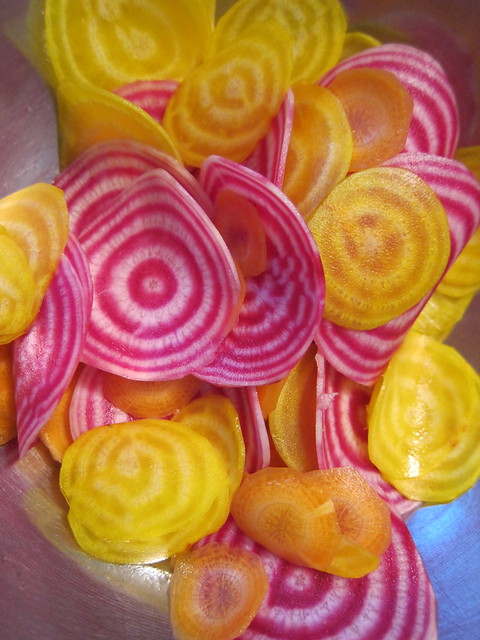
One of the benefits of eating locally is tasting things as they change flavor, texture and uses through the seasons. In the case of beets, save for a brief period in early spring, locally-grown ones are available for most of the year, and, like other storage crops, it’s easy to overlook them. Roasted and sliced wafer-thin, this beet carpaccio with its layers of salty goat feta and crunchy agretti renewed our memories of how good they can be.

Beet Carpaccio

You know the beets are fresh when they come with their full head of greens attached, like this early bunch from Greenlaw Gardens. It’s like having two vegetables for the price of one, and the greens from the Chioggia and golden varieties can be especially tender and lush. If there’s not a use for them right away, we save the greens much like their relative, chard: Water blanch for 2 minutes, cool, drain and package for freezing.

Beet Carpaccio

For the first take on this dish, we took the notion of carpaccio literally and served the beets sliced raw. As attractive as these Chioggias were, we discovered what others have been saying all along, that beets can taste like dirt. Beets seem to produce a chemical called geosmin, an evocative combination of the Greek words for “earth” and “smell” to describe the scent of soil following a rainfall. We also found eating them raw left a tannic or astringent sensation in our mouths, and wonder if some of these issues may be due to a genetic predisposition, as in the case of cilantro.

Beet Carpaccio

Raw aside, we still enjoy the almost caramel sweetness of roasted beets. Beets have a particular affinity with acid, and some good balsamic vinegar and a bit of olive oil were all that was needed to finish the plate.

Beet Carpaccio

Feta is just one of the several delicious cheeses we brought home from Flying Goat Farm at the North Berwick Farmers’ Market. Owners Devin and Cara are currently seeking to expand their cheesery and are closing in on their Kickstarter goal — if interested in helping to back their campaign, funding closes August 7, 2013.

Local ingredients: Beets from Greenlaw Gardens and New Roots Farm; feta from Flying Goat Farm; agretti from the garden.

Posted in cooking | Tagged , , | 9 Comments